18 June – 23 June 2025
Our Rwandair flight touched down to Mount Kilimanjaro airport about 90 mins late from Kigali and we were soon navigating through customs and busting to get out and see what Tanzania would offer.
We were met by Malles who would be our driver and guide for the next 5 days and found our way to the ubiquitous Land Cruiser that would take us to Arusha, Ngorongoro Crater and the Serengeti. He was a 60 something year old grandpa; truckie turned guide that didn’t look like he would take shit from anyone.
The drive from the airport to Arusha is about 1 hour – most of it through suburban sprawl. The differences to Rwanda were immediate and stark. Even Arusha (a small city of 400,000 people and a tourist gateway) felt busier, less clean and more chaotic than Rwanda. More like what we’ve experienced in Central America and the like.
We eventually arrived at our accomodation for the night – the ridiculously oppulent Gran Melia with it’s beautiful gardens, enormous swimming pool and views over Mount Meru volcano.
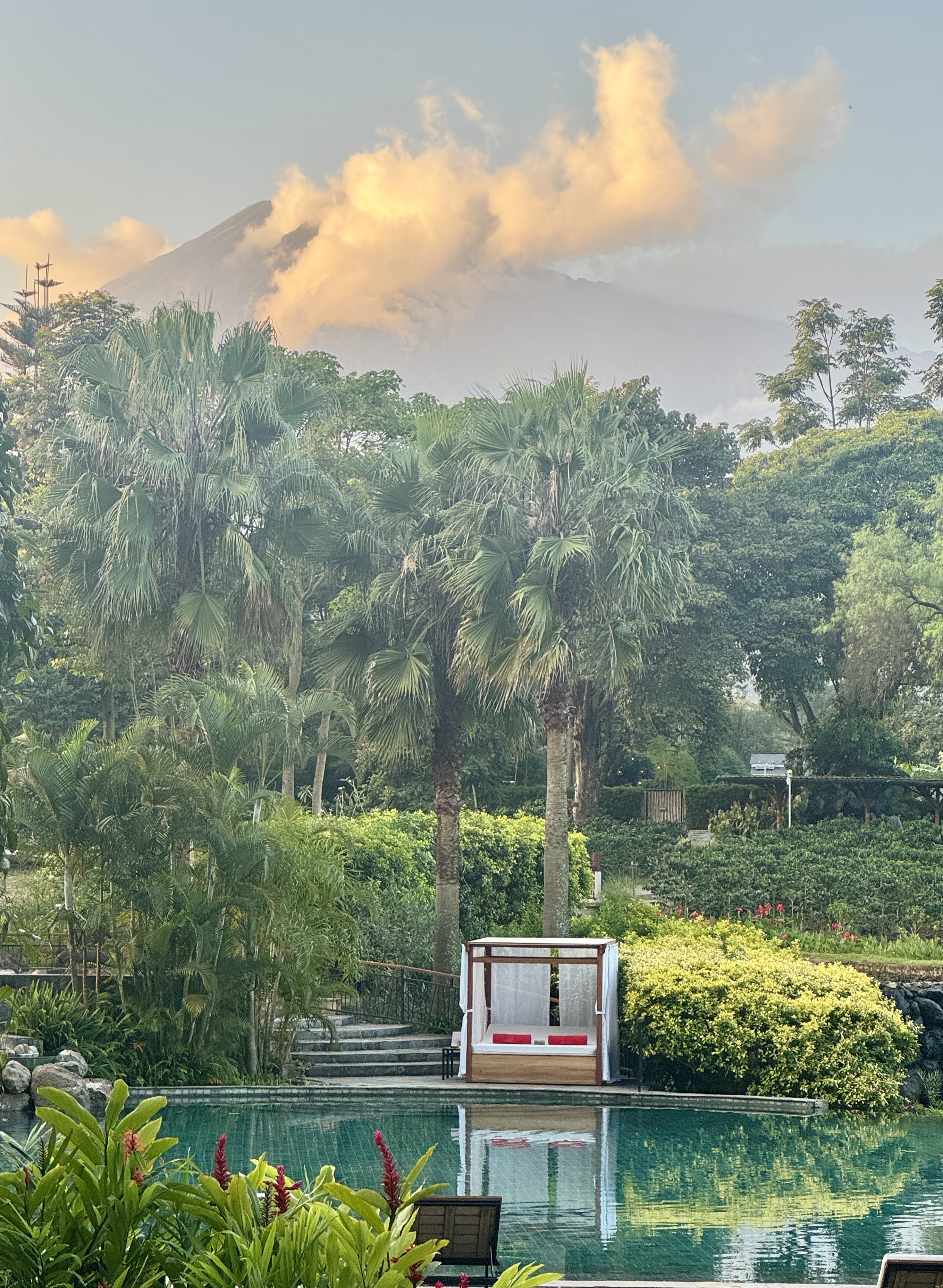
The difference between the chaotic world outside and the oasis of privileged calm inside the resort made our heads spin. This place was one of the nicest we’ve ever stayed, and so far beyond what we needed for our 12 hour stopover (and another dent in the girls’ inheritance. Sorry girls).
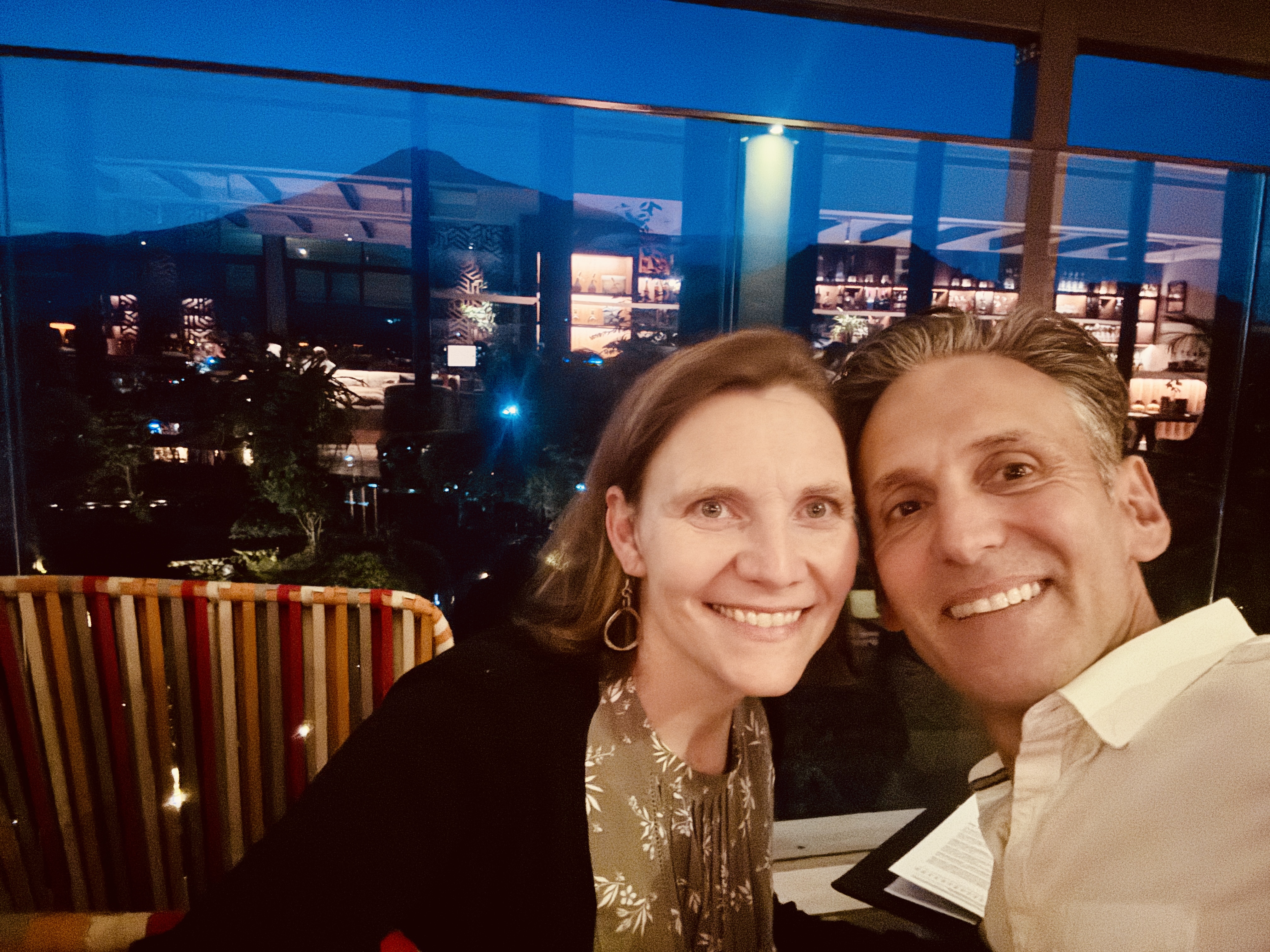
Always up for a challenge in the face of adversity, we piled in, got changed and hit the rooftop bar to grab a drink and the last of the stunning sunset. This was high end tourism like we hadn’t previously experienced. Not really our world, but visiting for the evening was not hard to take.
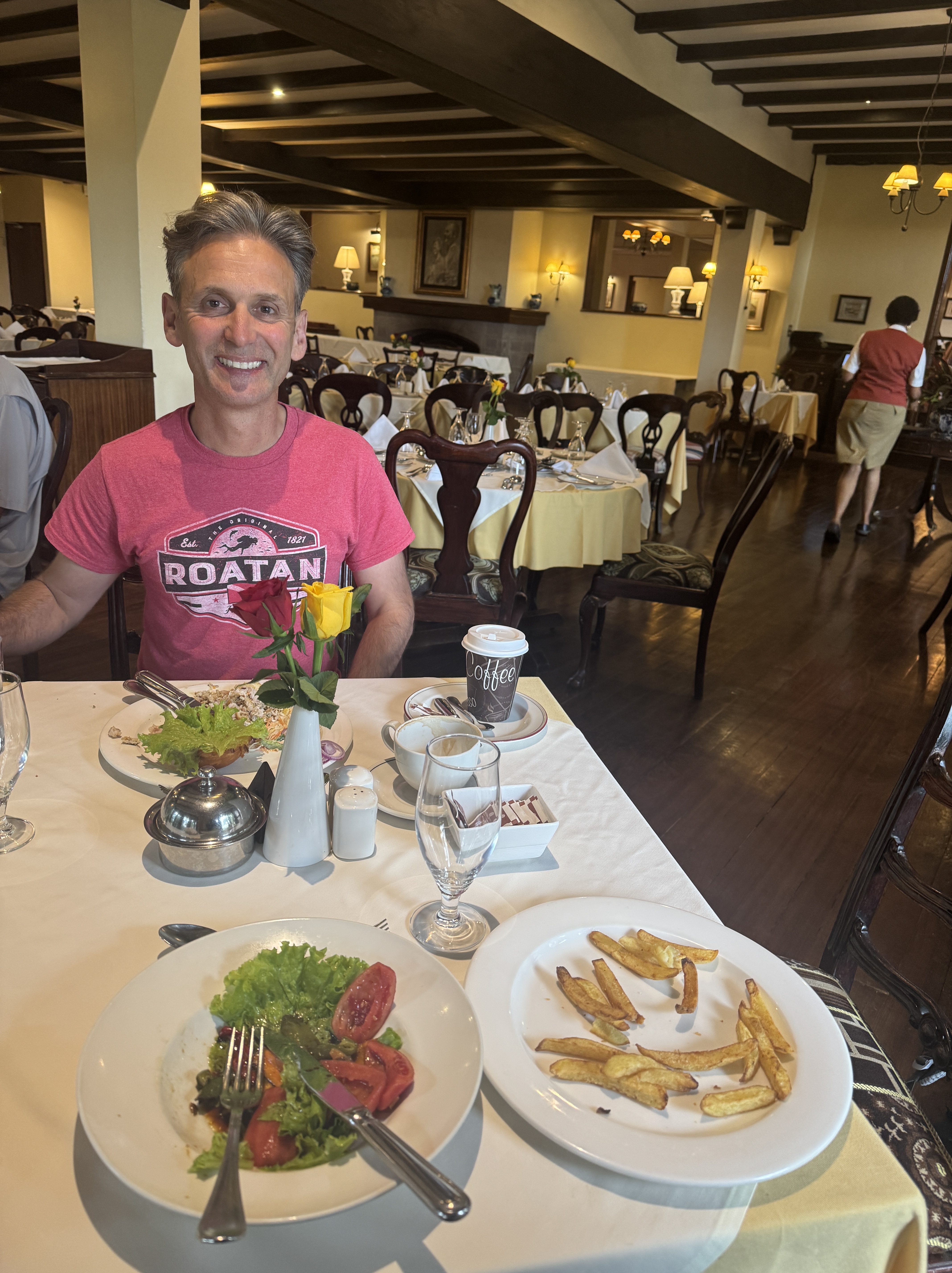
The following morning, after a suitably amazing breakfast,
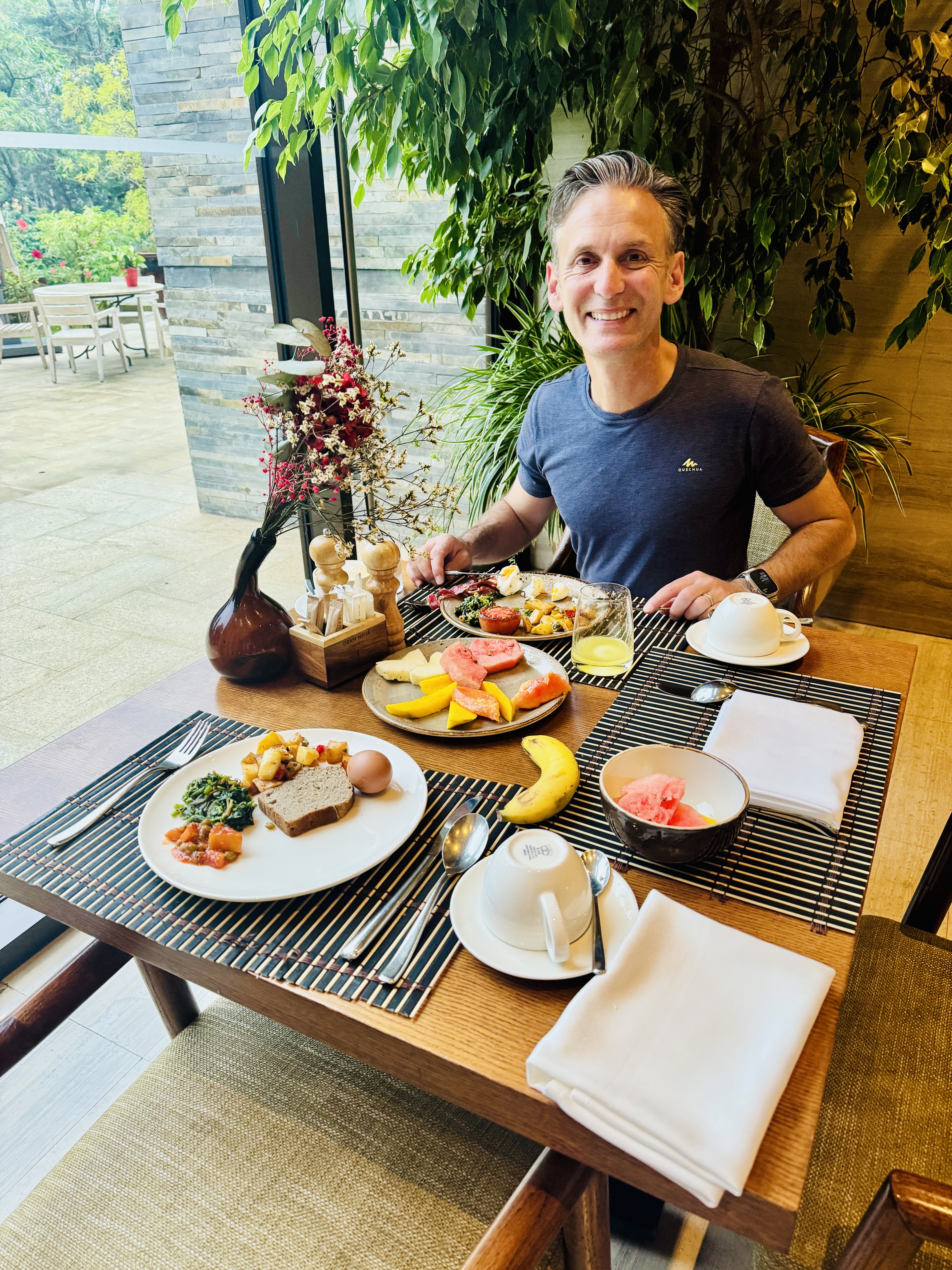
we hit the road for the 4 hour drive to the Ngorongoro Crater, which promised to be one of the *many* highlights of the trip.
The drive from Arusha to the gate of the Ngorongoro Crater National park was lovely – passing by coffee plantations, rice fields on the way to Lake Manyara and the climb up to the Rift Valley. For some reason just the knowledge that we were in the Rift Valley struck a chord of excitement – it was something that we’d heard about previously that always sounded a bit mysterious and remote – and now we were on it (in reality, it feels a bit like when you cross the Blue Mountains and get the first glimpses of the Great Western Plains in NSW).
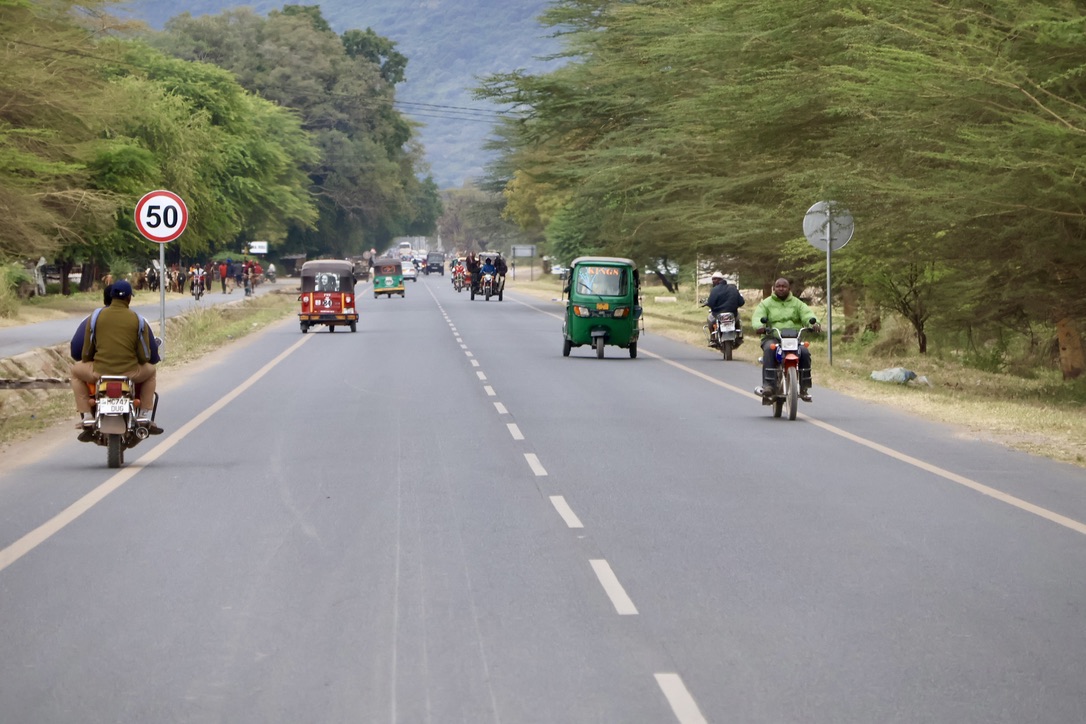
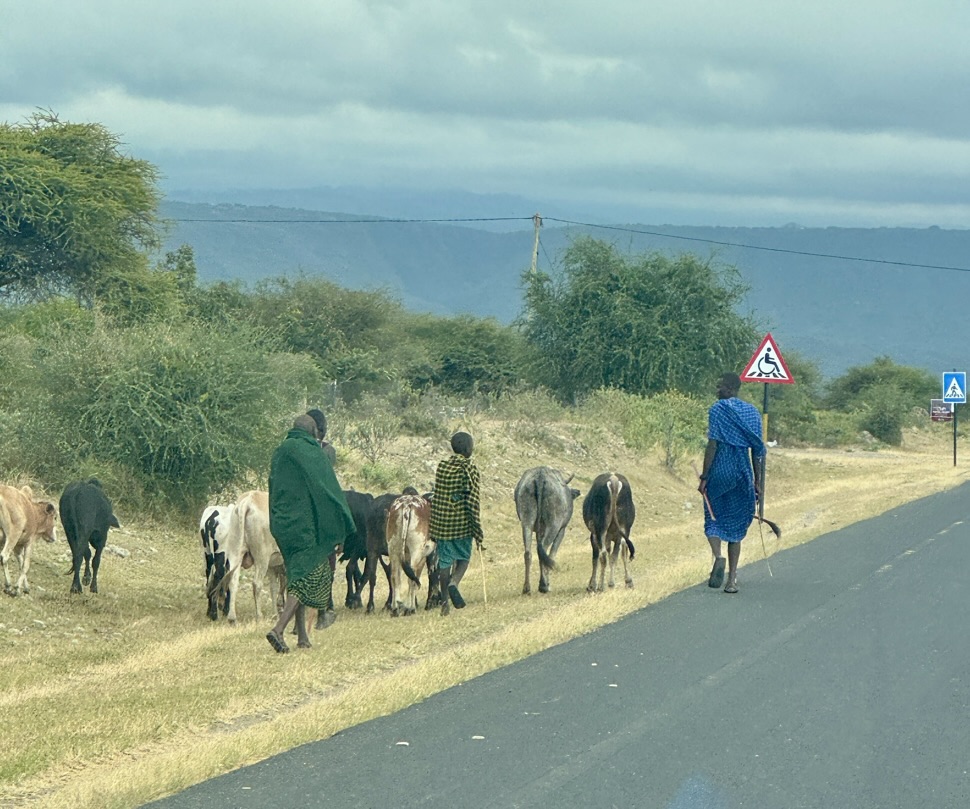
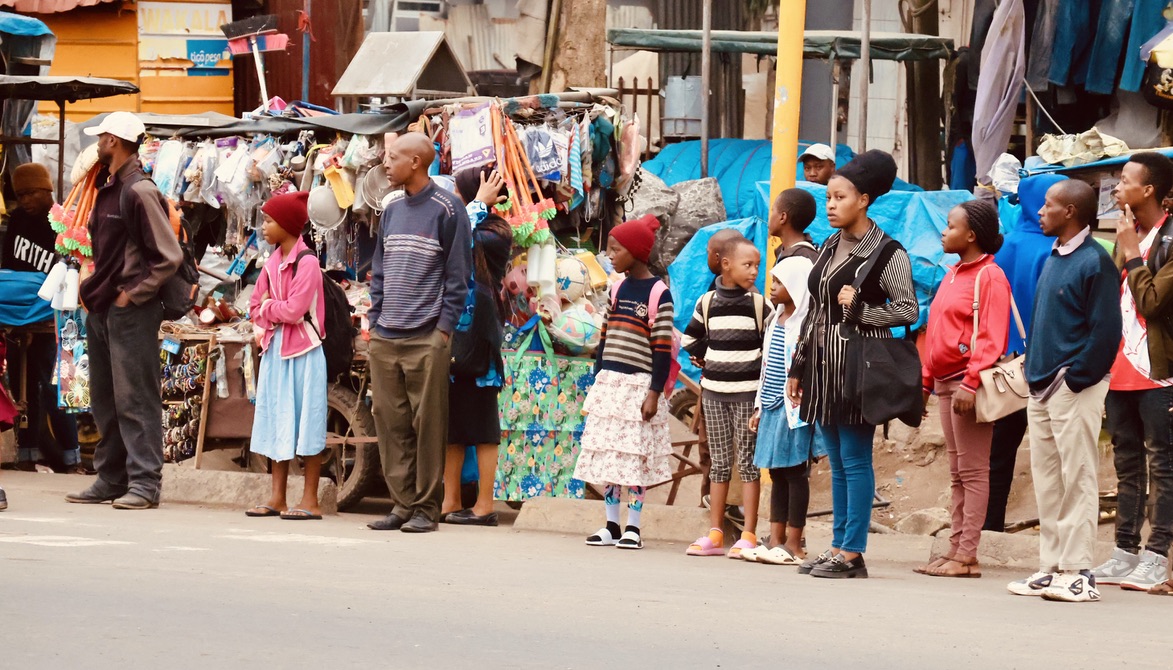
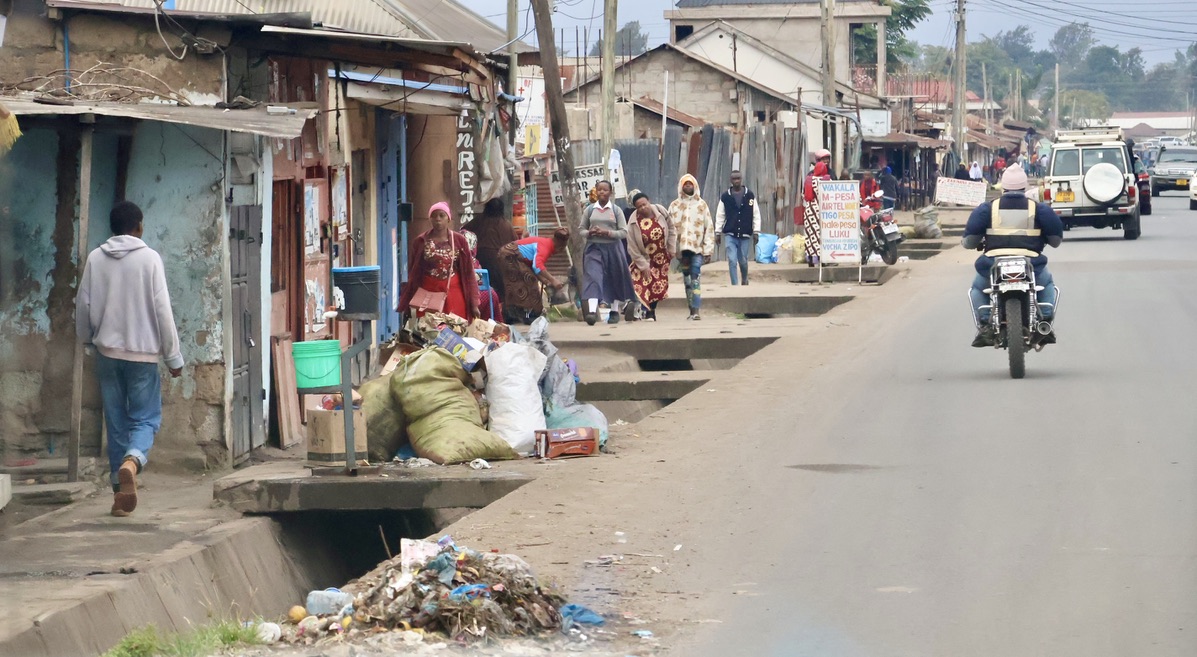
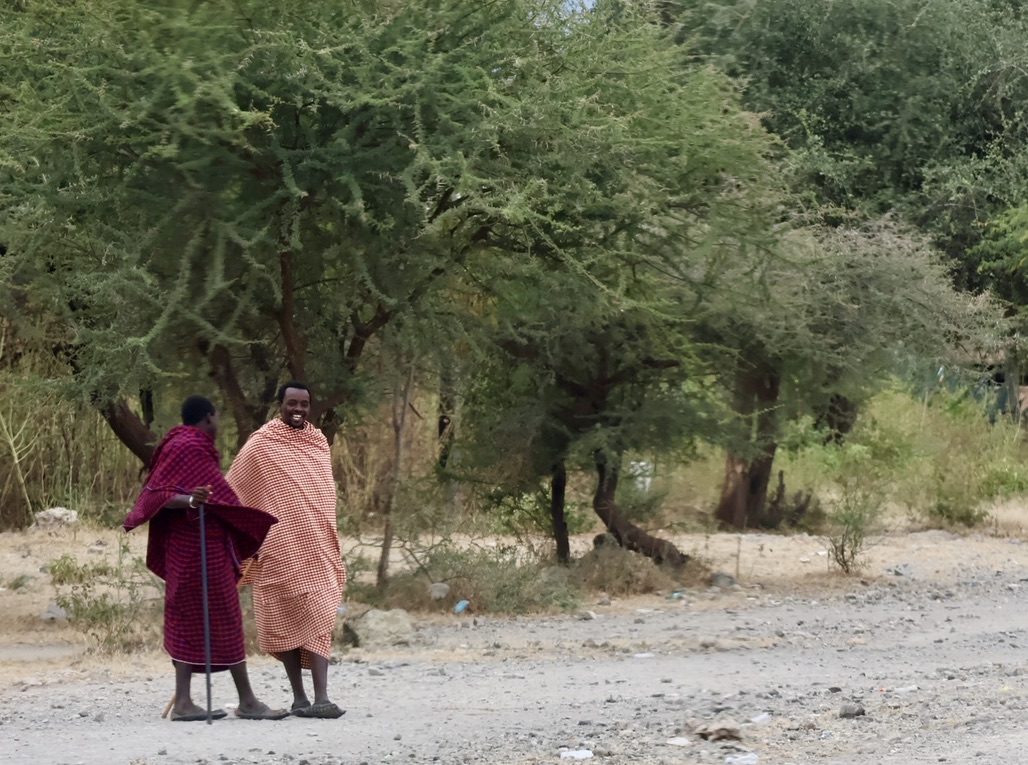
As soon as we hit the gate to the National Park the tarmac stopped and the dirt began. This was the only road that fed the crater, the Serengeti and Lake Victoria beyond. It was full of Land Cruisers shuttling tourists around game reserves, trucks servicing the various lodges and Massai villages in the area, and the very occasional Massai local’s 4WD.
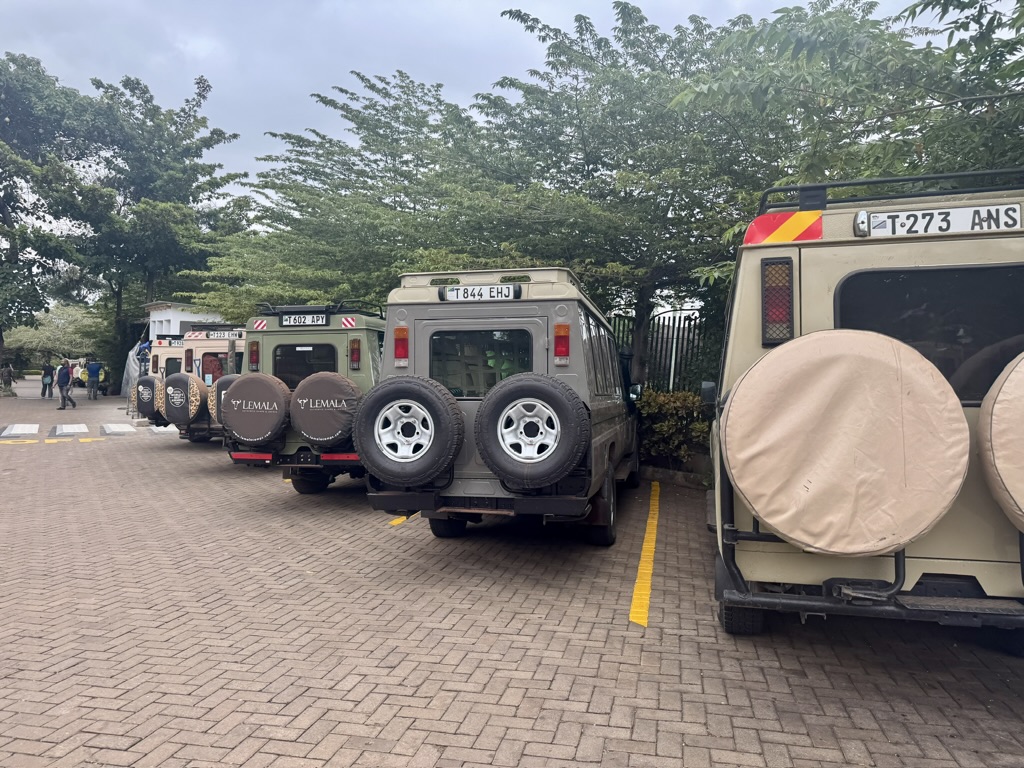
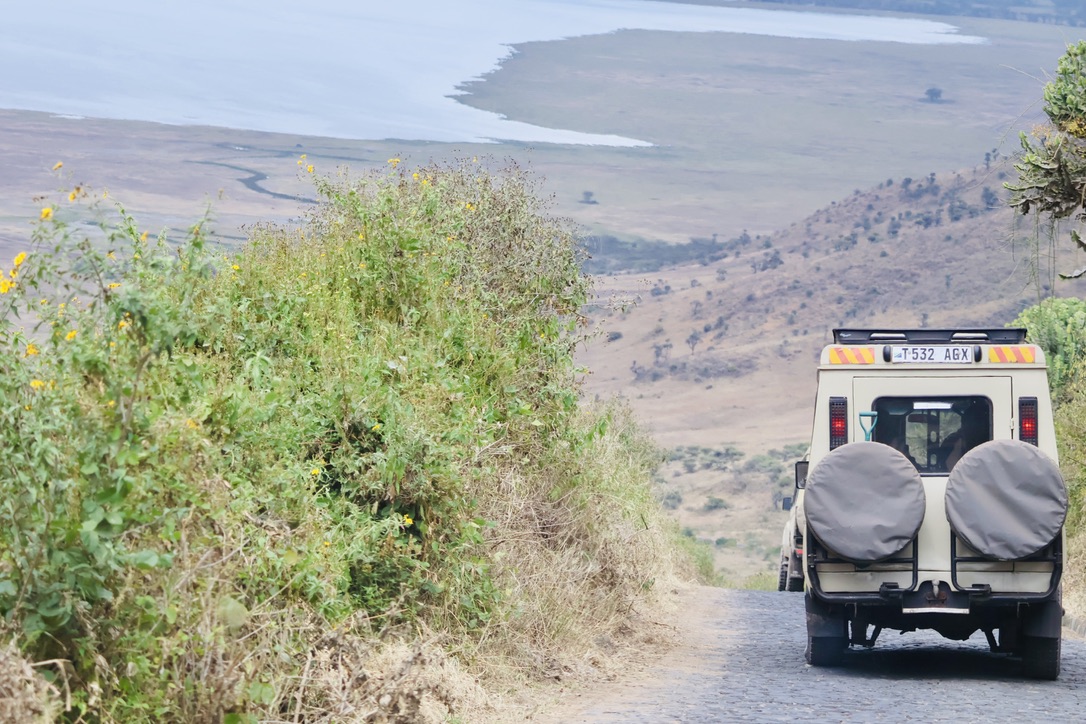
Fair to say, the scenery was amazing as we climbed steeply and then started to make our way around the crater rim, but the red clay road was narrow, bumpy and treacherous. Malles navigated it expertly, frequently commenting on the death wishes held by his fellow road users. Most of the cars managed to stay on the road, with the exception of one truck who was hoping that 3 out of 4 wheels was enough (it wasn’t – and he was left dangling on his suspension with wheel spinning in thin air).
The Ngorongoro Crater itself is a marvel. It was formed by a massive volcanic eruption some 2 million years ago. The crater rim sits between 2000-2500m elevation, the floor is around 600m. It is 19km long and 16km wide and about 300 square kilometres, a chunk of which is taken up by Lake Magadi. The geography has created a natural barrier and ecosystem inside the crater which has led to a proliferation of native animals – only reinforced by its establishment as a UNESCO World Heritage site in 1959, and the subsequent rehoming of the Massai locals to the crater rim. It is famous for the concentration of animals including elephants, lions, hippos and wildebeest. No giraffes however, as there’s not enough of the right kind of trees in there to keep them happy.
Needless to say we couldn’t wait to check it out.
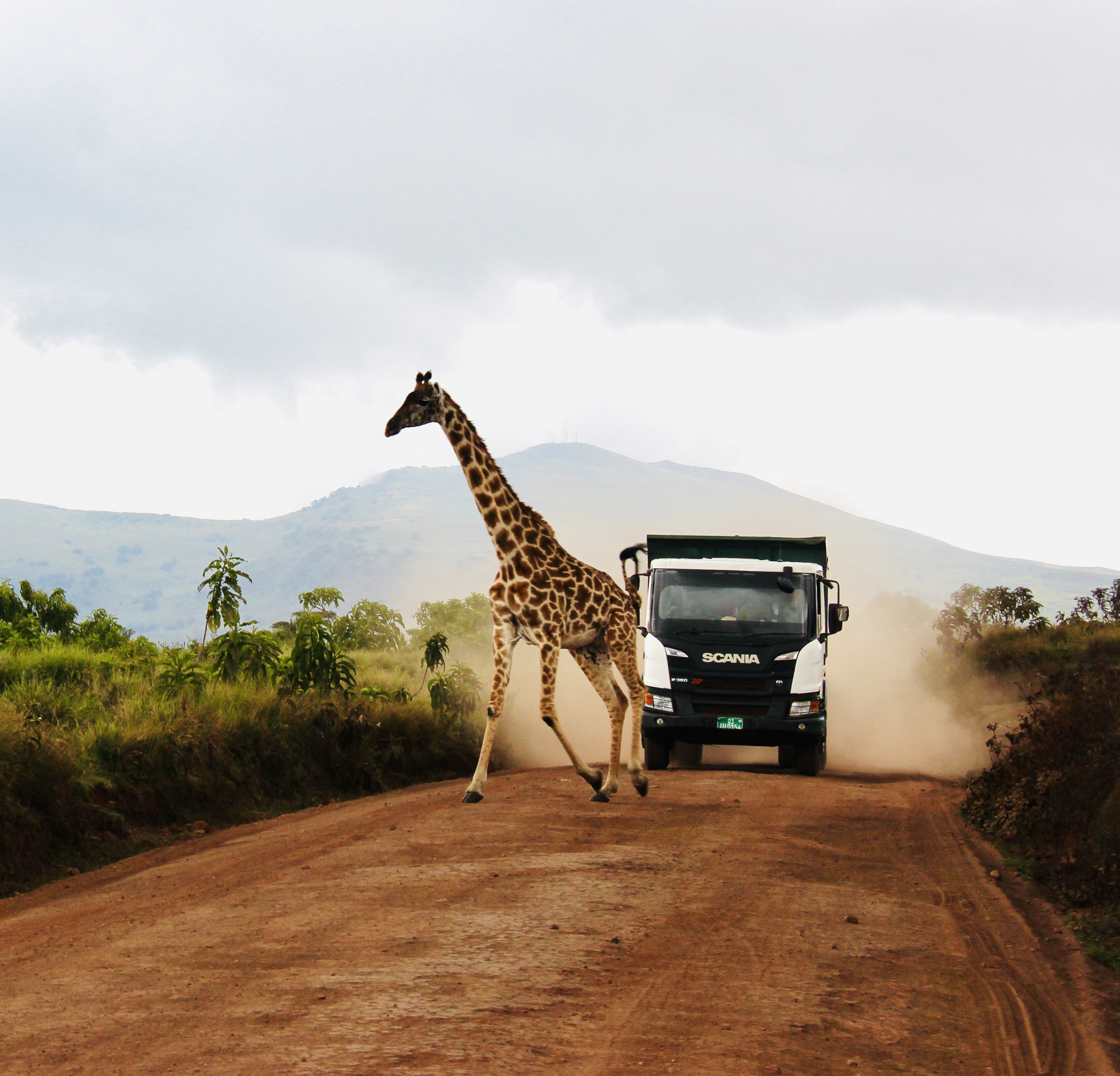
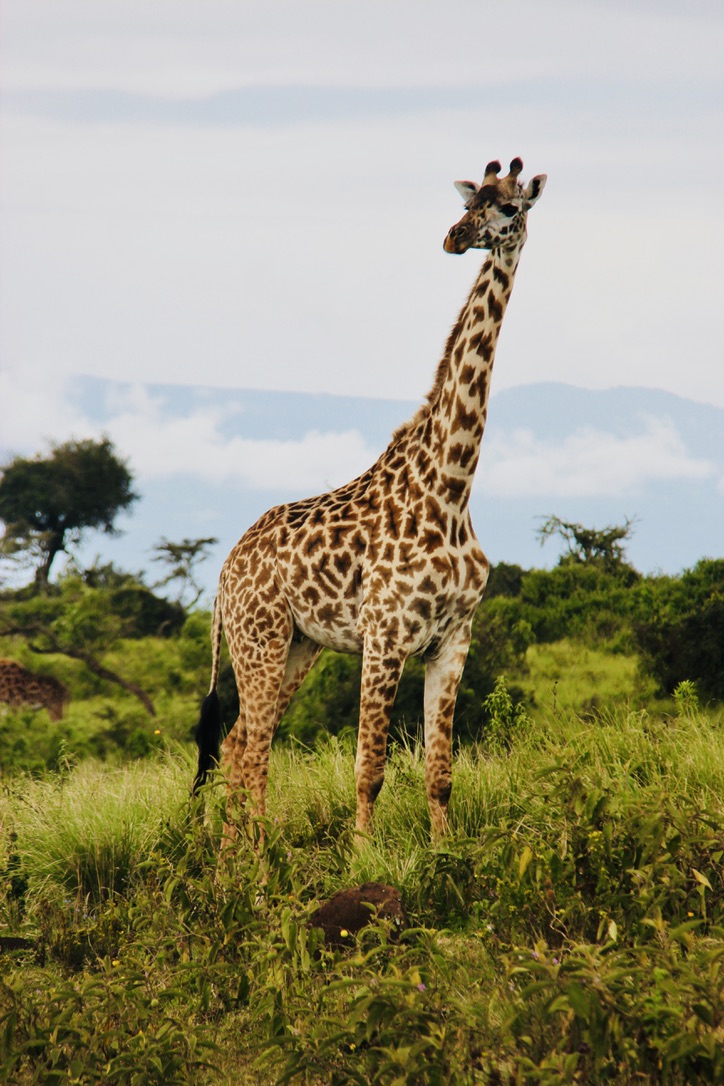
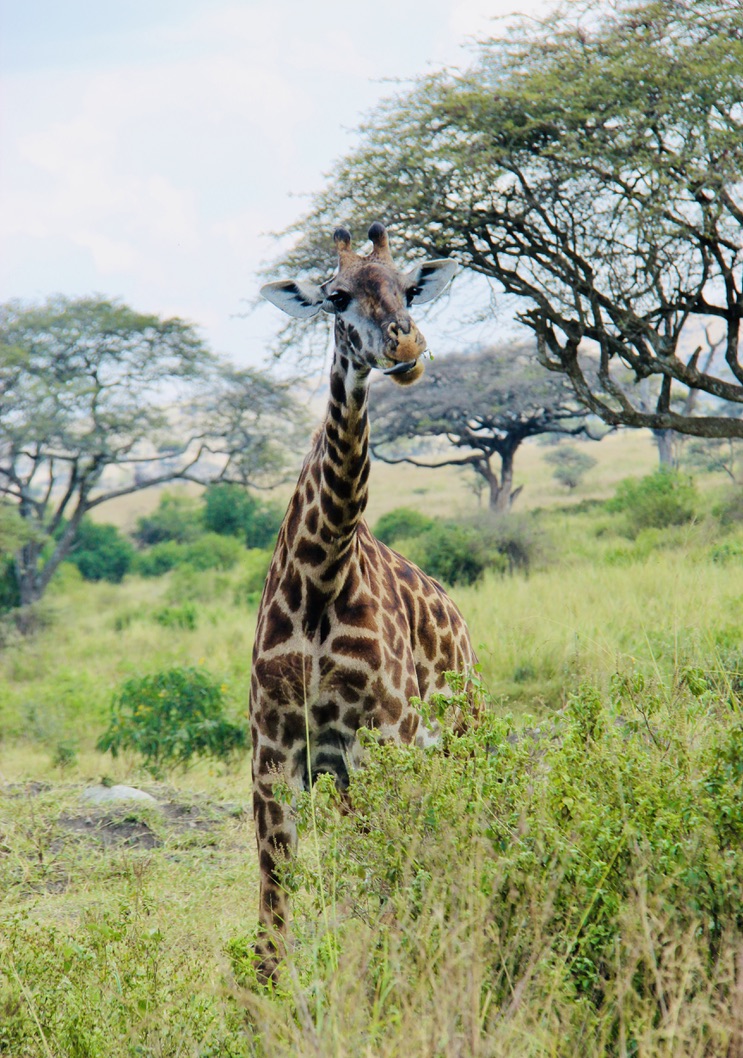
But before we could get in, we needed to bounce around half of the 62 km long track that circumnavigates the cater to get to one of the two descent points off the rim. On the way around we literally almost ran into a group of giraffes – the one animal that we knew we wouldn’t see in the crater. It was an incredible start to our sightseeing.
From there we made our way down into the crater and were immediately struck by the unique landscape. The grass and tree covered crater walls envelope you as they make there way some 1500m above the floor. The crater is mostly grassland with the odd tree dotting the horizon. Wildlife is everywhere.
We pushed up the roof of our Land Cruiser and suddenly had an unrestricted, 360 degree view of the landscape. So that’s what those things were for.
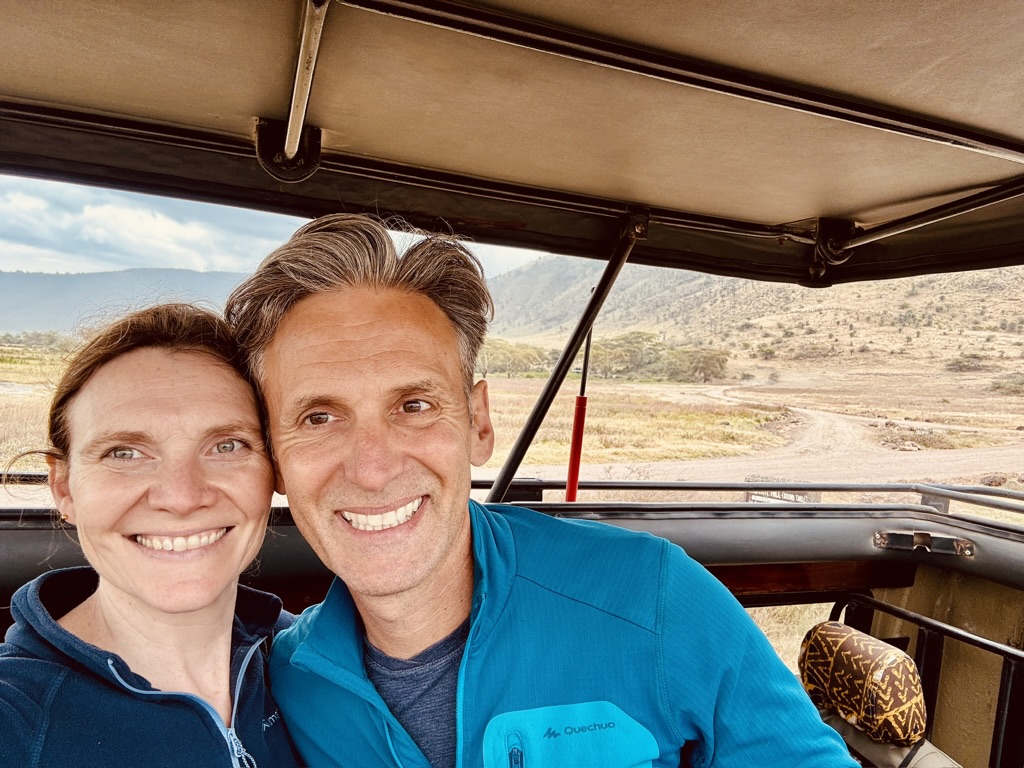
It is clearly not Malles’s first rodeo.
He dutifully stopped as we squealed at our first gazelle, taking dozens of photos of an increasingly embarrassed looking, dog sized bovine. Clearly it wasn’t used to this kind of attention.
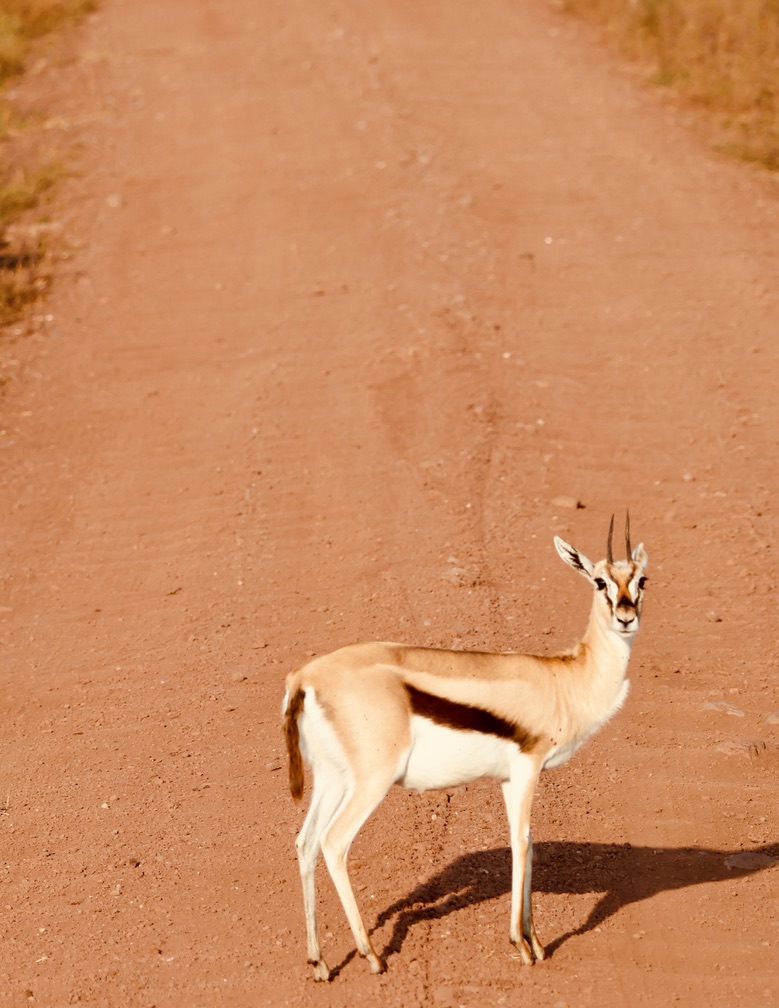
50 photos later and we realised why – gazelles of various variety literally dot the landscape.
We had the same reaction to our first zebra and wilderbeest. It turns out that neither of these guys are going endangered any time soon.
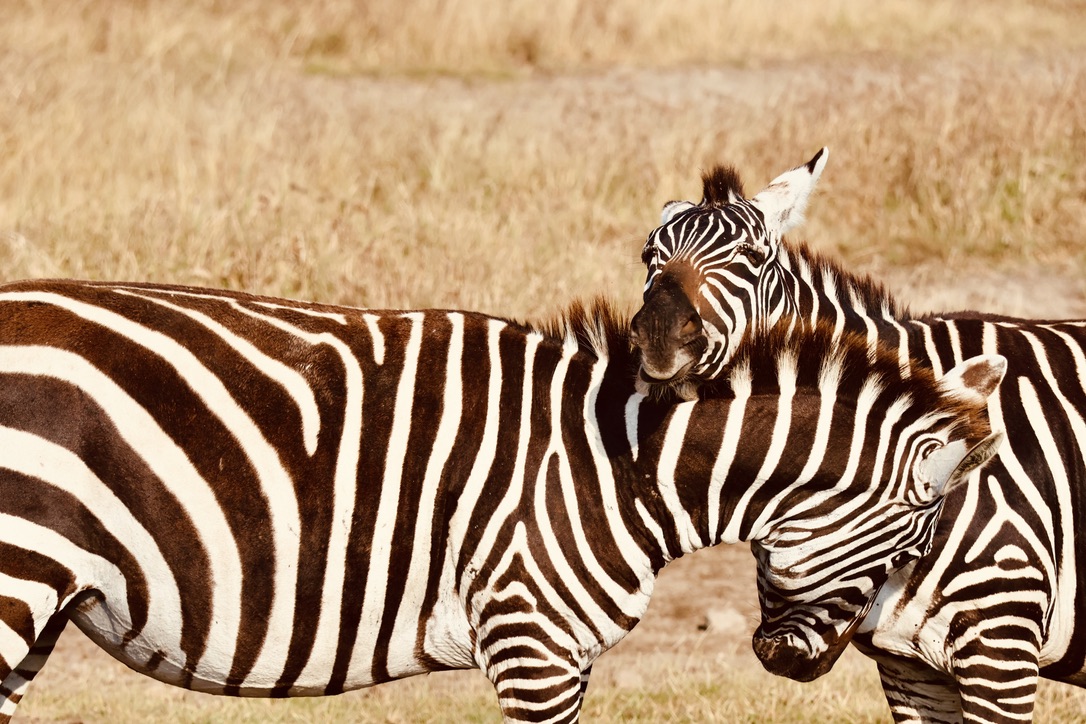
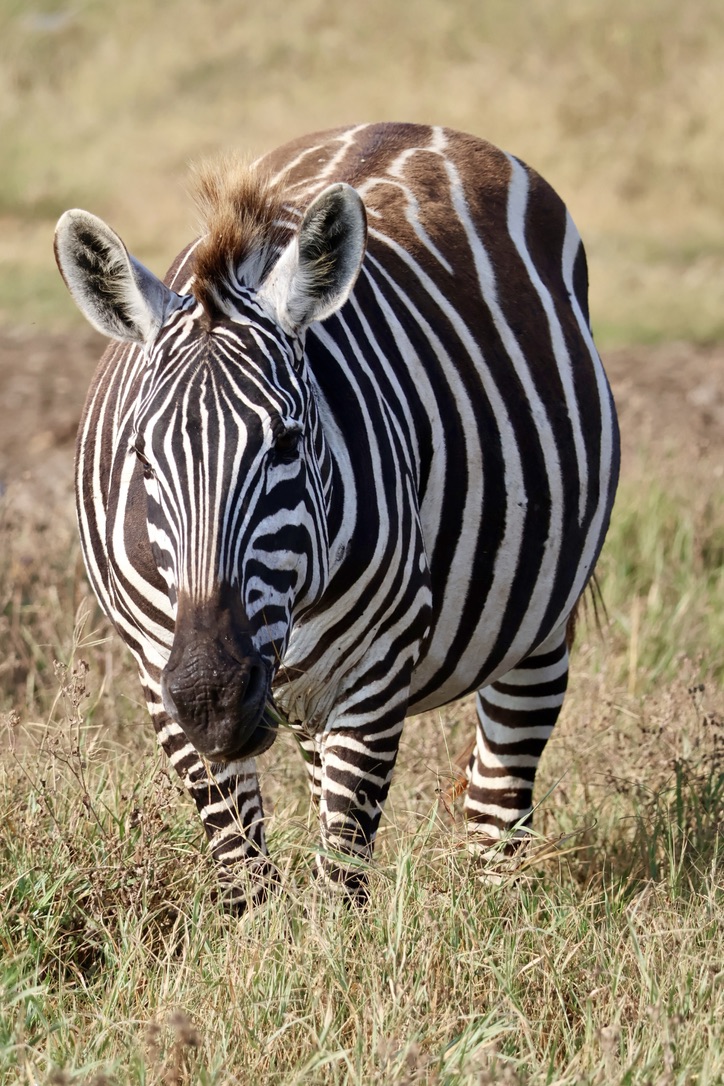
Within the first hour we had spent quality time with hyenas, warthogs, a sleepy male lion, hippos (stationary and at a distance to be fair), ostrich, pink flamingos and pelicans. We even saw an elephant (not particularly common in the crater) from a distance.
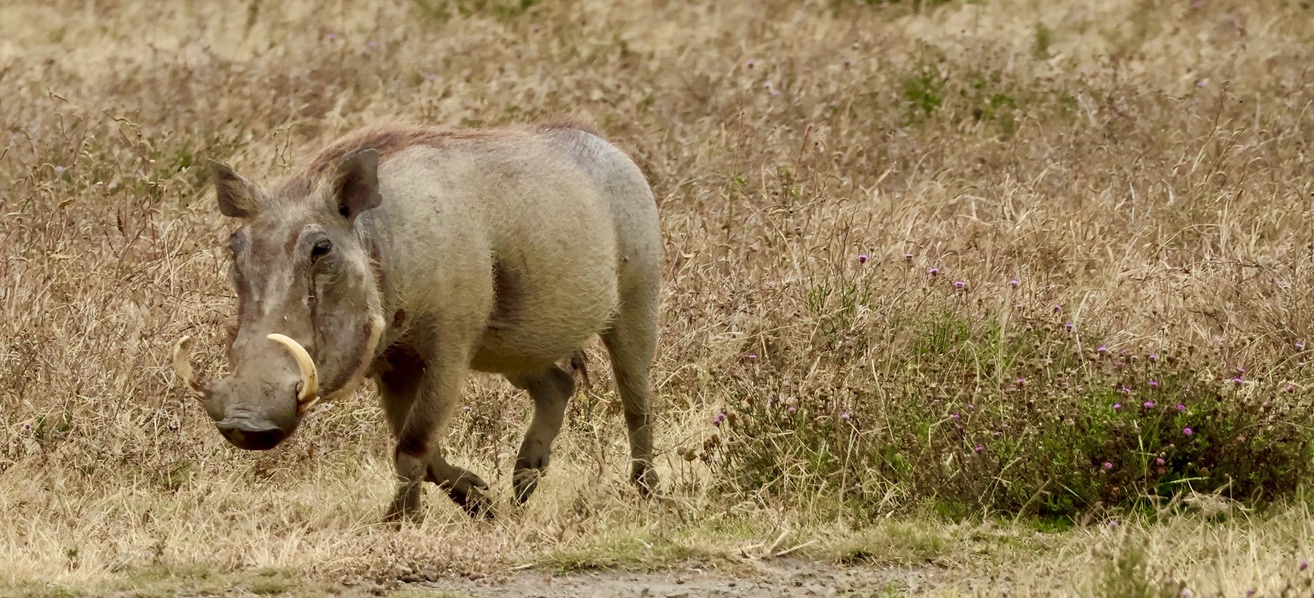
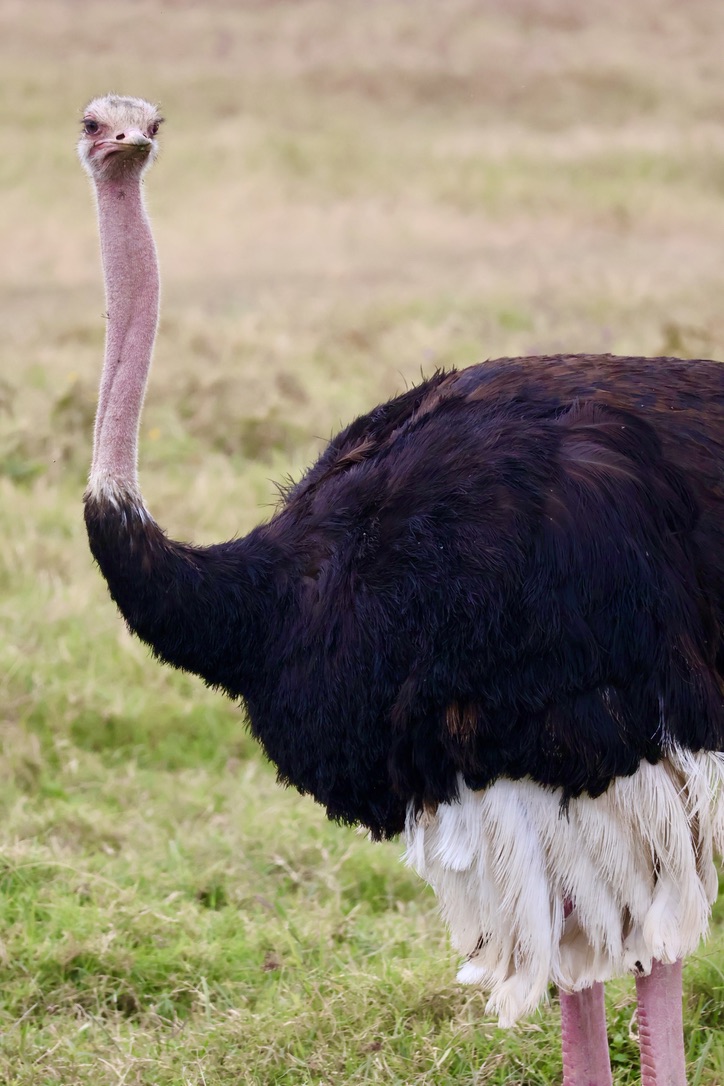
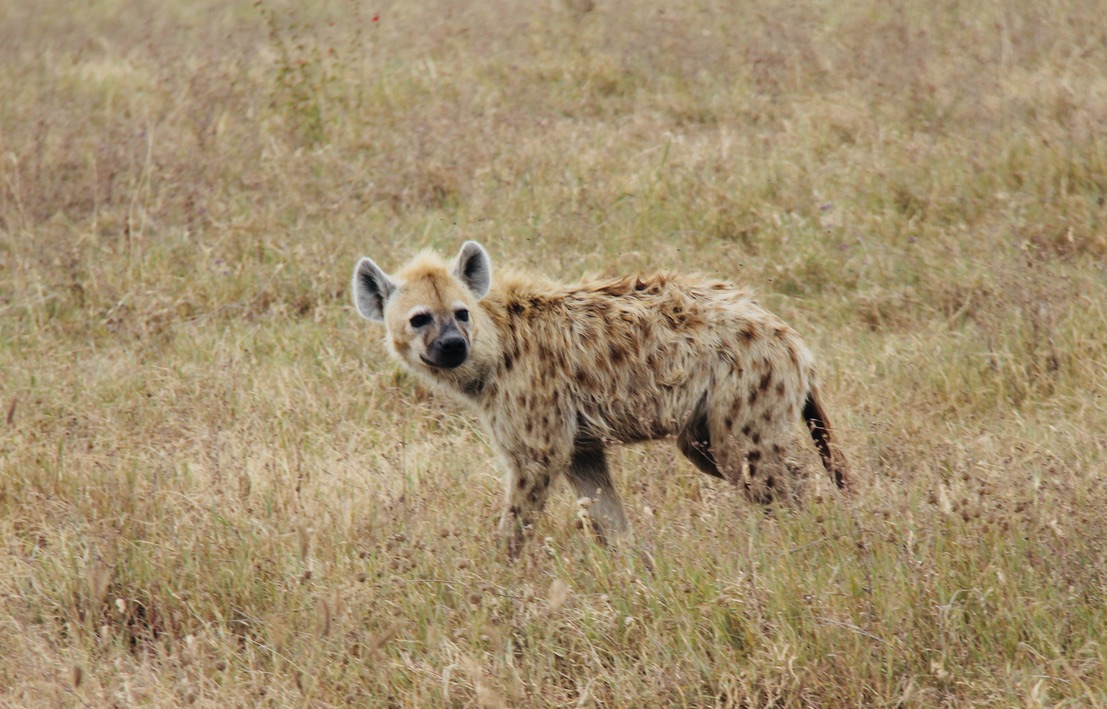
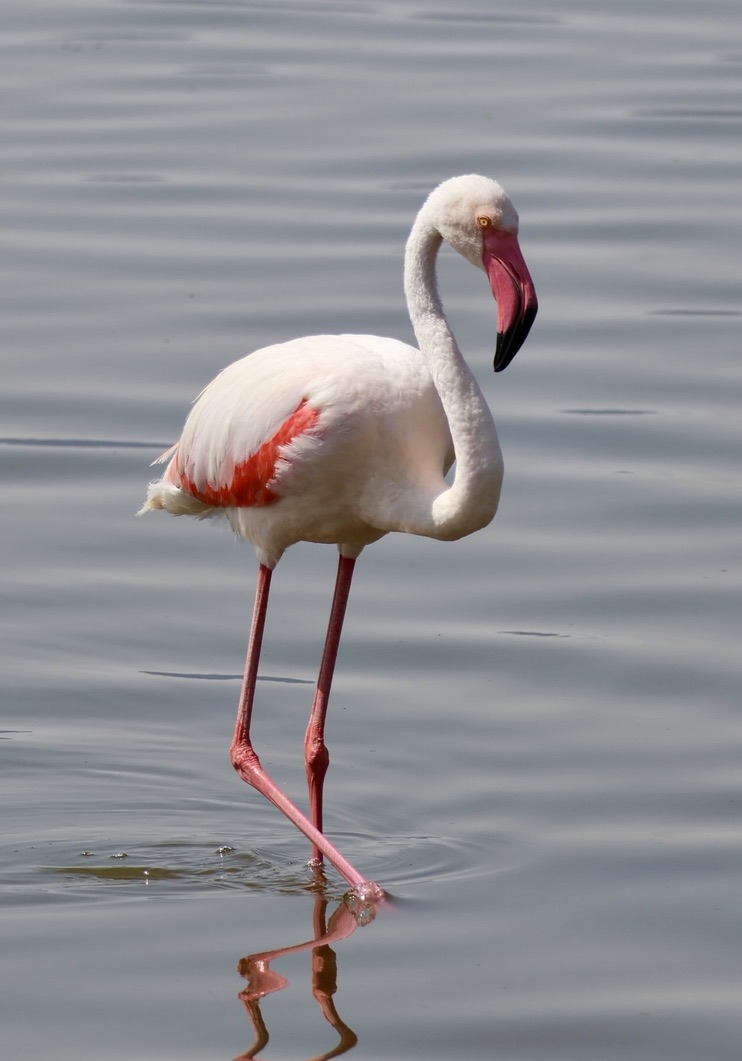
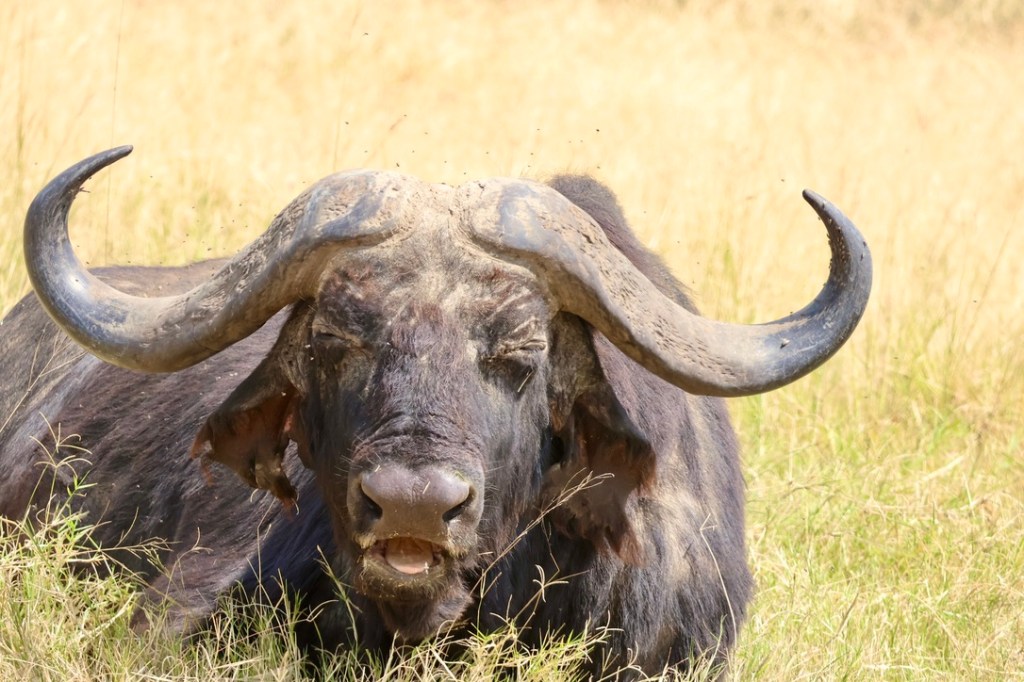
The place was literally crawling with stunning wildlife and we didn’t know where to look. Malles rarely got the chance to drive more than a couple of minutes before we were asking him to stop.
It was then time for a late lunch, so we pulled in to one of the picnic spots in the crater and pulled out our packed lunch boxes. We noticed that most others were not out of their vehicles, we asked why.
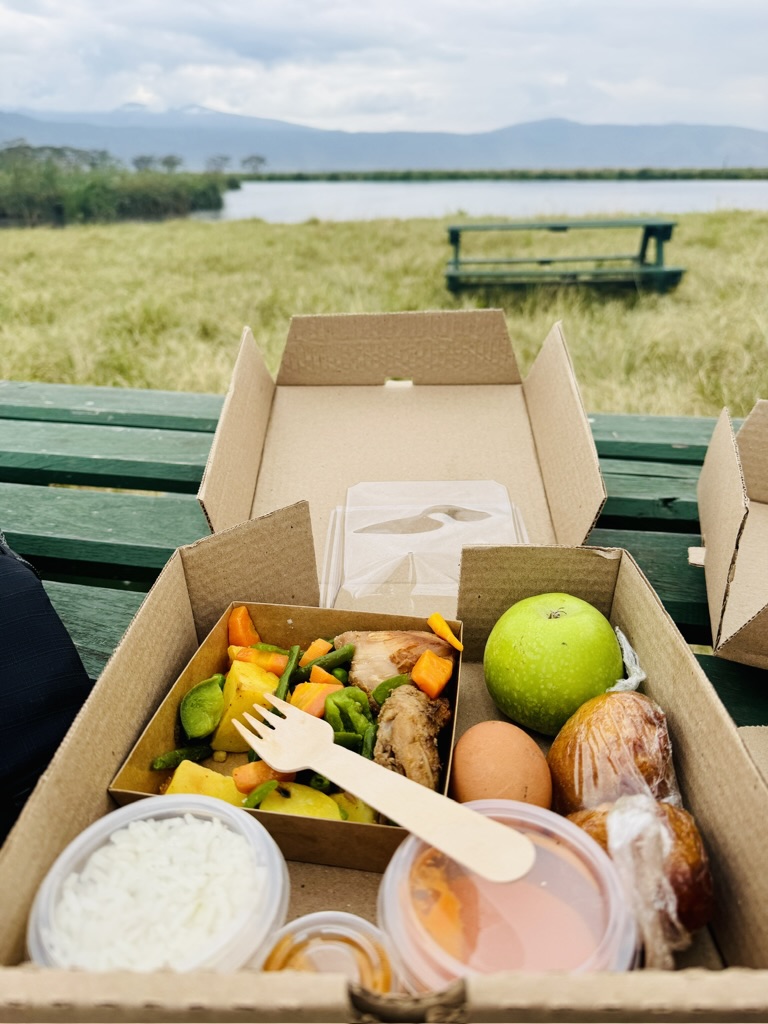
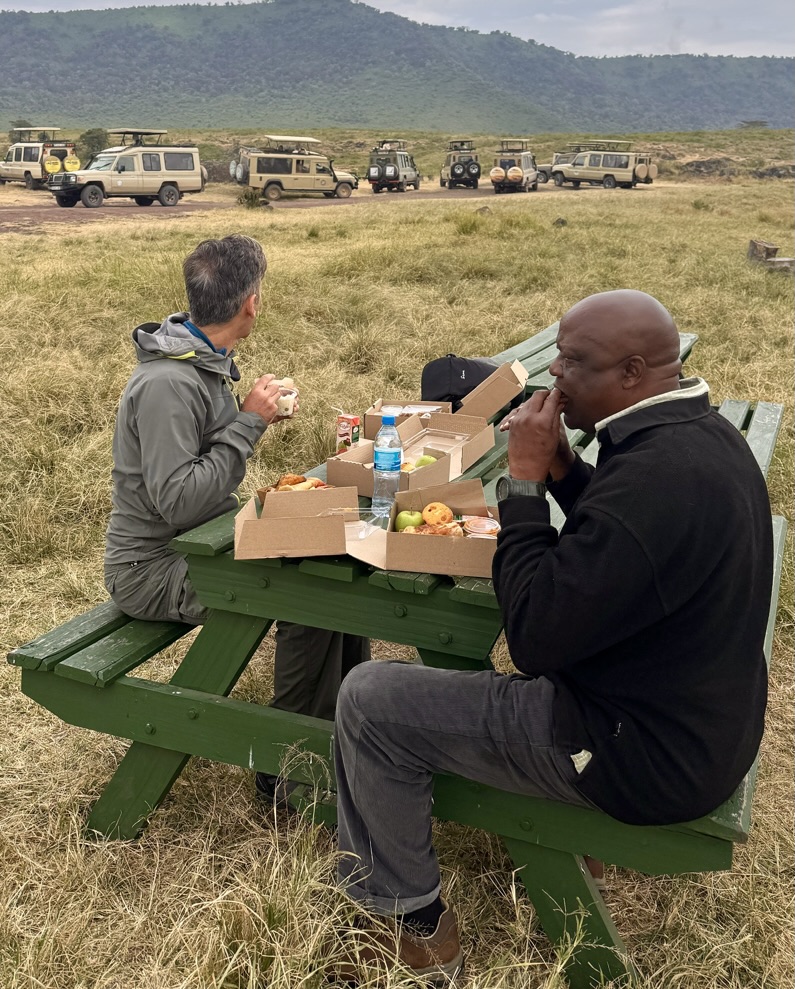
Because of the two lions sitting on a rock some 30 meters away.
Liz made the suggestion that we eat in the car. Malles agreed.
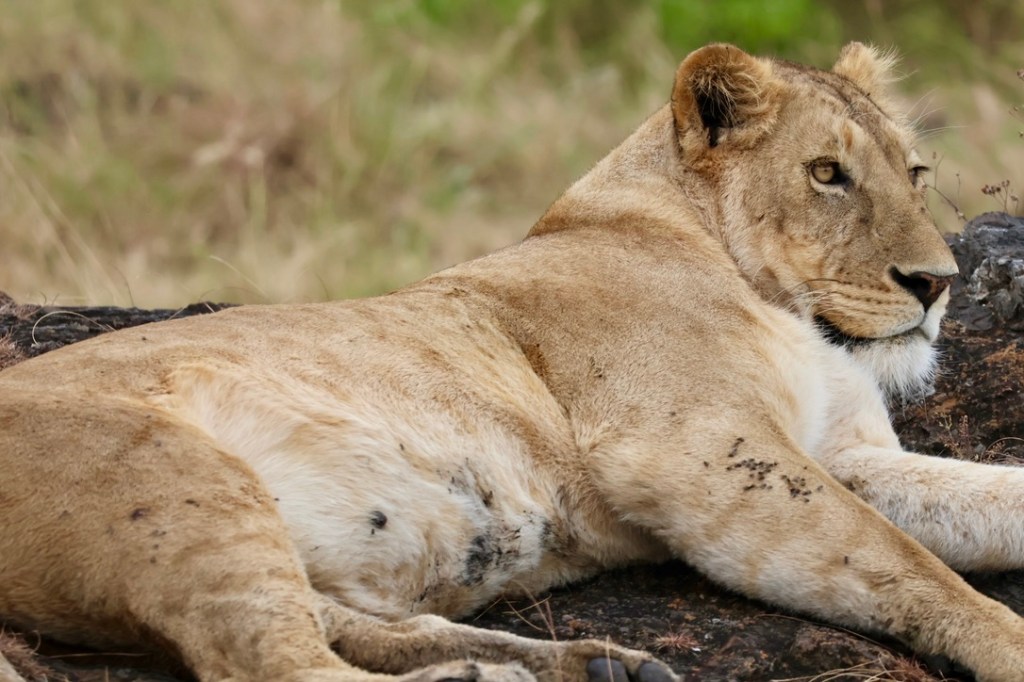
We were then treated to one of the most special parts of the trip so far, as the female lion woke up and spied a zebra in the distance. She then proceeded to study it, stalk it briefly and then decided that she wasn’t that hungry anyway and went back to her rock.
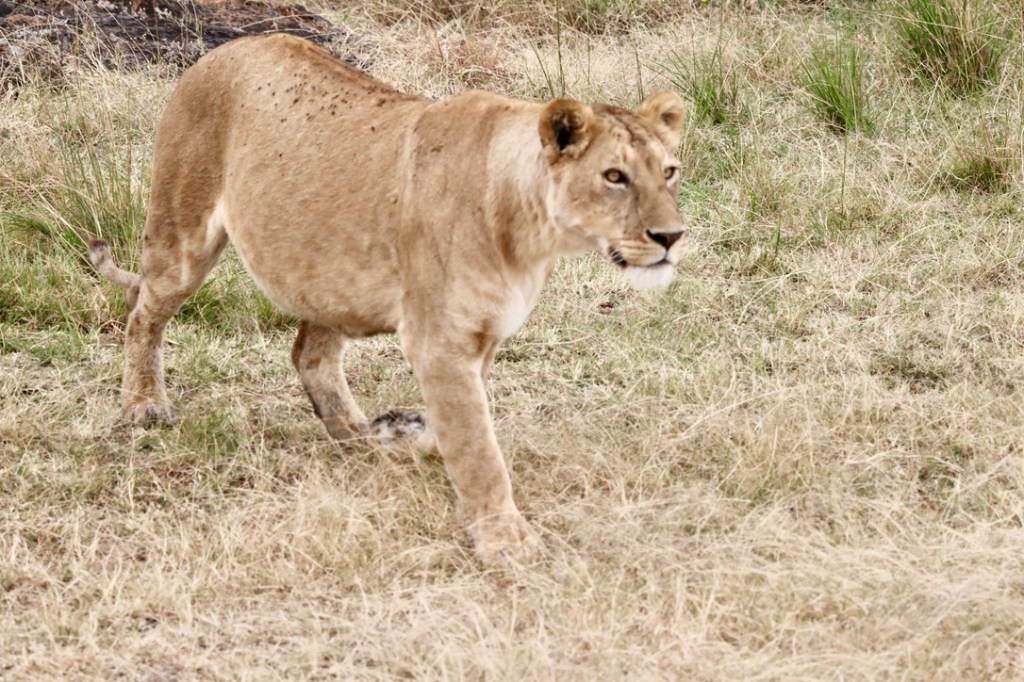
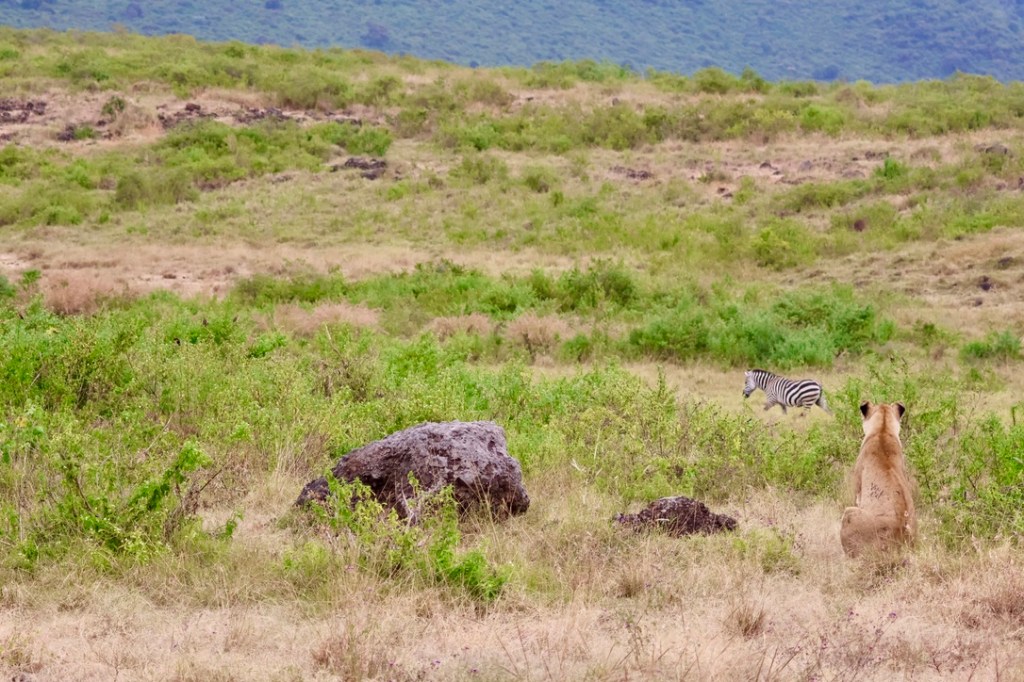
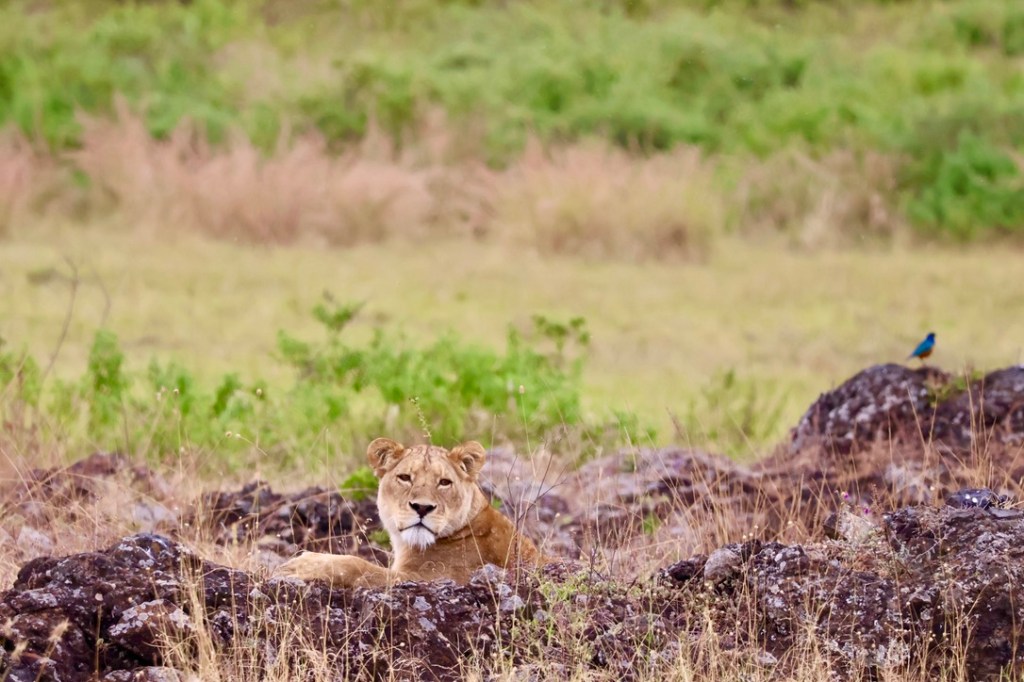
I don’t think the zebra was any the wiser. The grace and power that she demonstrated was amazing, and we were secretly quite happy that no zebra were harmed in the display.
Even Malles seemed impressed. Safari is a game, he said. Sometimes you win, sometimes you lose. Apparently today we won.
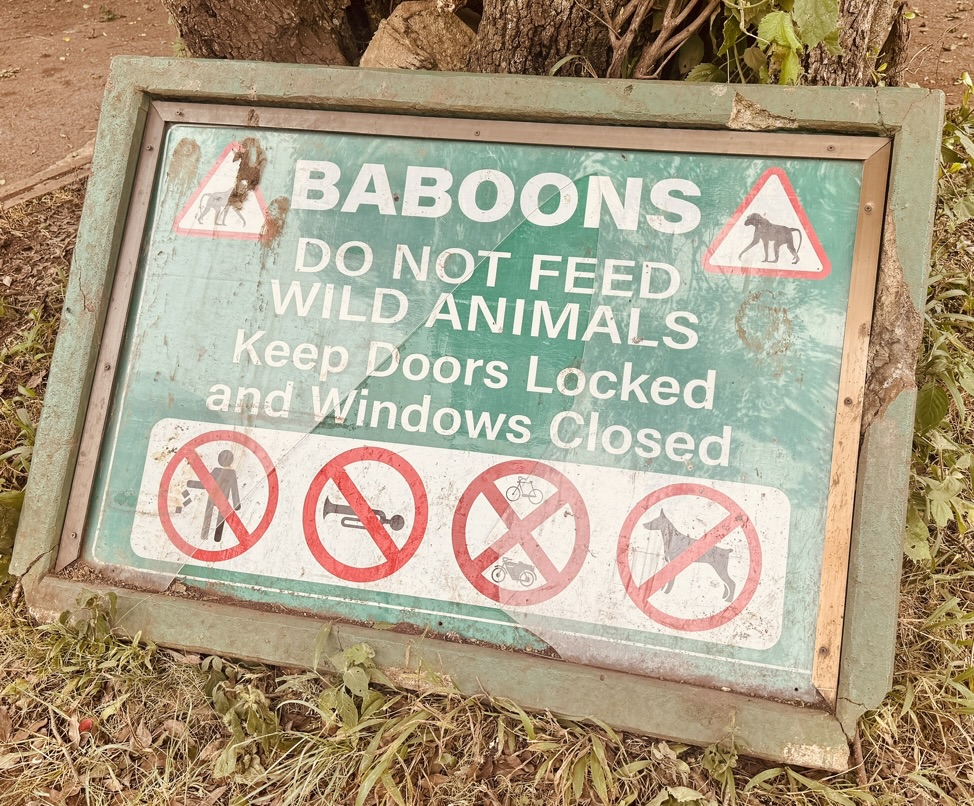
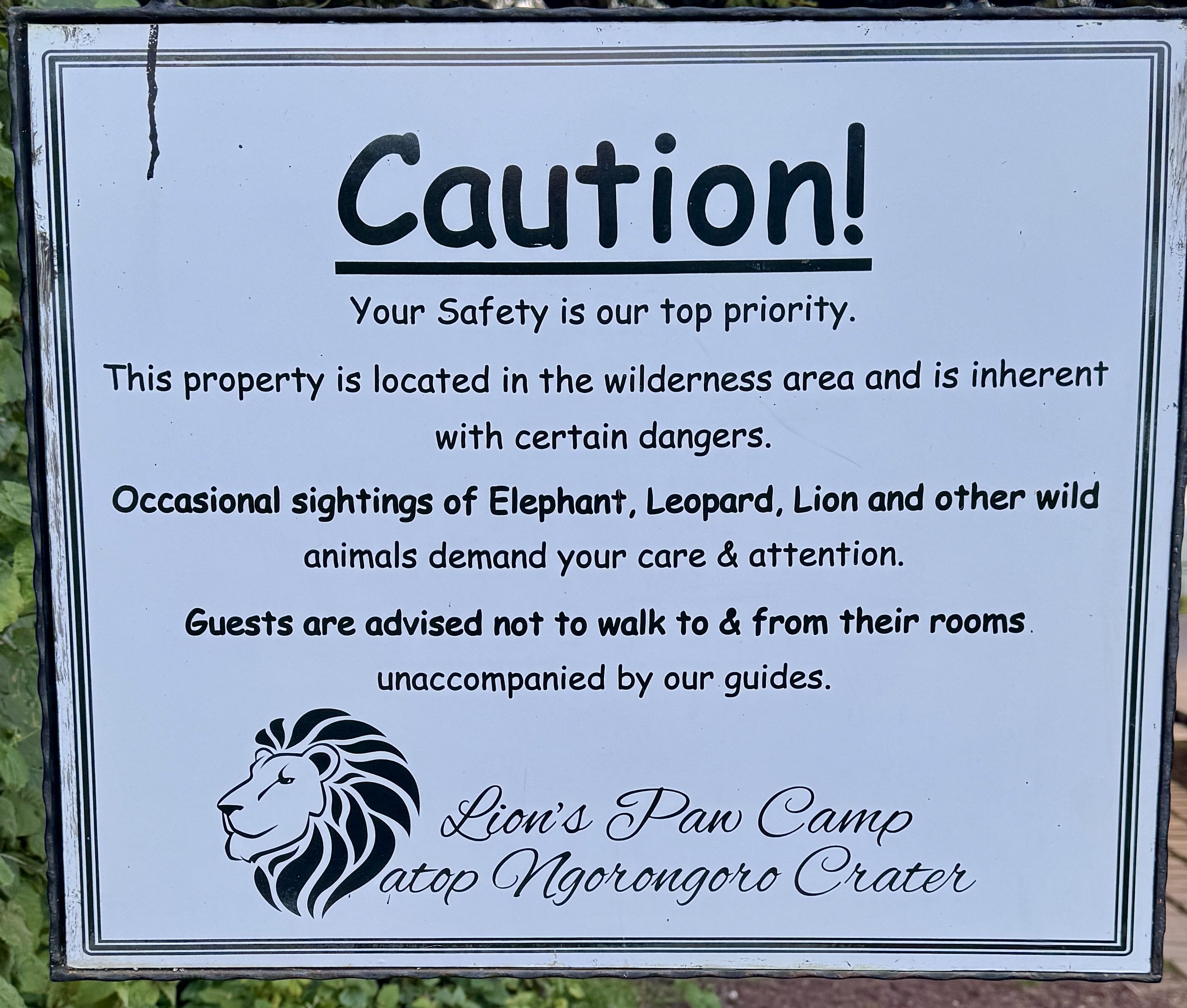
At the end of the day we made our way back up to the rim and to the lovely ‘Lions Paw’ camp, which was set in scrub land overlooking the crater. A sign welcomed us saying that lions, elephants and other animals frequented the property and guests needed to be accompanied to their huts after dark.
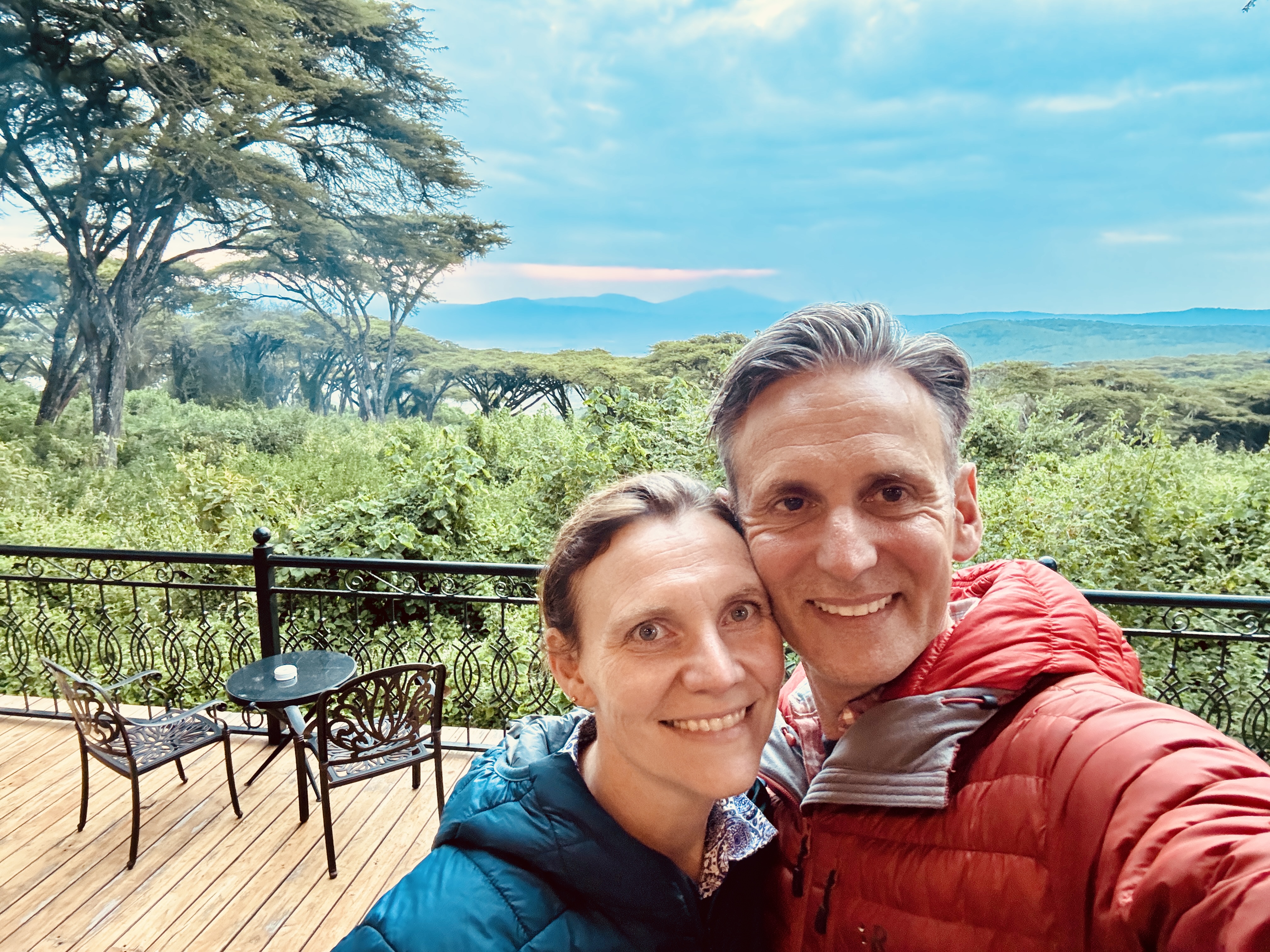
We were then introduced to our ‘personal butler’ (not quite as bad as the Rwandan women wanting to massage our post hiking feet, but still cringe worthy). Initial cringing aside, the place was stunning with incredible views over the crater, an open bar and a fire pit in the evening to hold the cold at bay (we were still high at 2300m – so not as warm as we thought it would be).
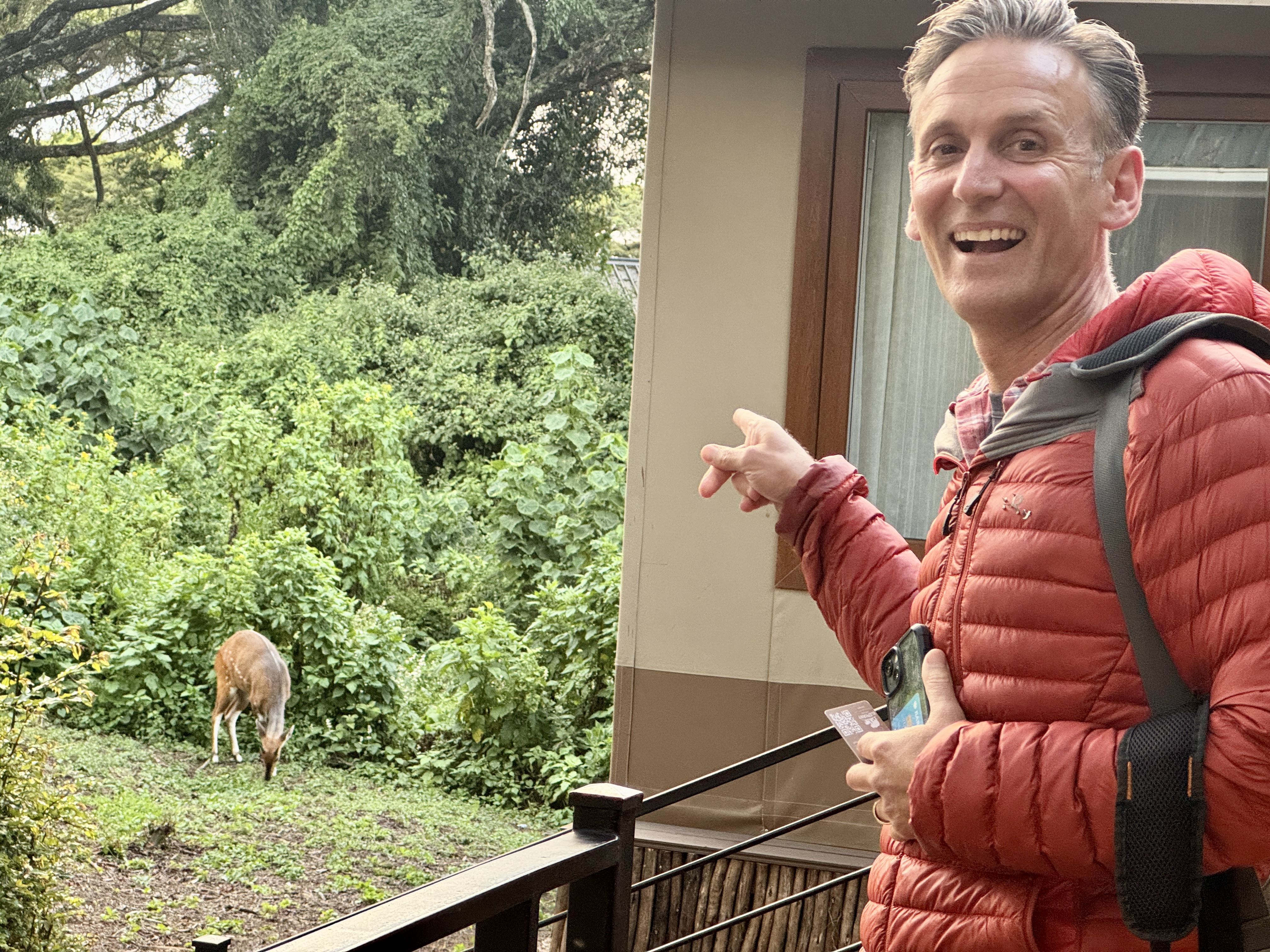
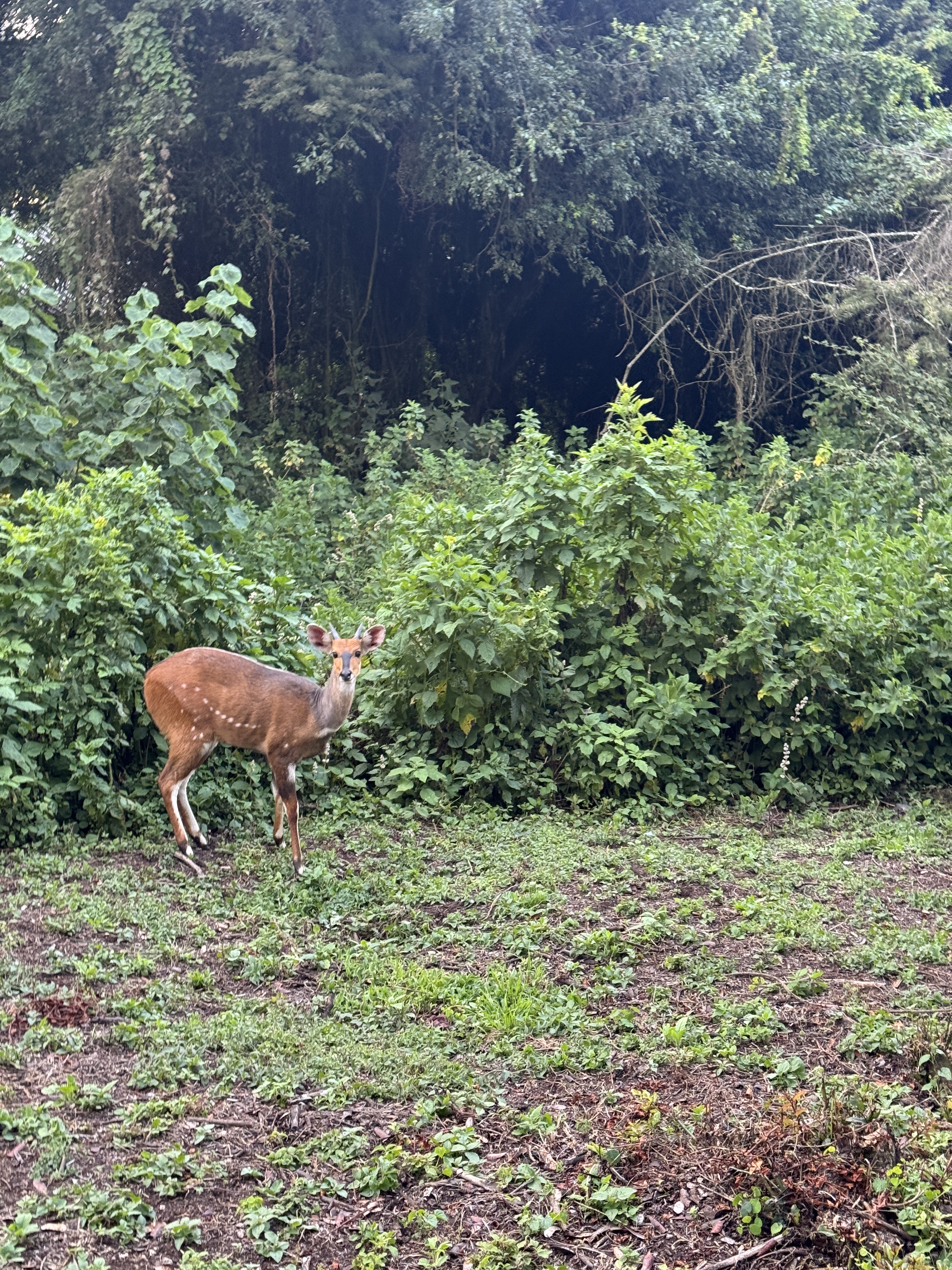
We managed to survive the night and following morning and not get eaten by any of the local residents – although we did run into a couple of bush bucks who tried (but sadly failed) to look menacing as we walked past.
There was an inevitable conversation about what would happen if a lion did in fact show up, and how would our unarmed (and probably untrained) escort make a difference? A question for another day.
The next day we bristled with excitement as we made our way down into the crater for a full day of sightseeing. Rather than list off all the animals we saw, I’ll let the photos do the talking. Special call outs however to the herd of elephants that were hiding in the trees, but decided to put on a show for us as we drove passed; and the wonderful troop of baboon who escorted us for 500m or so, playing with their babies and wrestling through the trees. Their mannerisms, expressiveness and complete nonchalance about the 2 tonne of Land Rover sharing the road with them made them an instant favourite. A special call out for the endangered rhinoceros that we caught in the distance. We appreciate him making the effort to show up for us – even from afar.
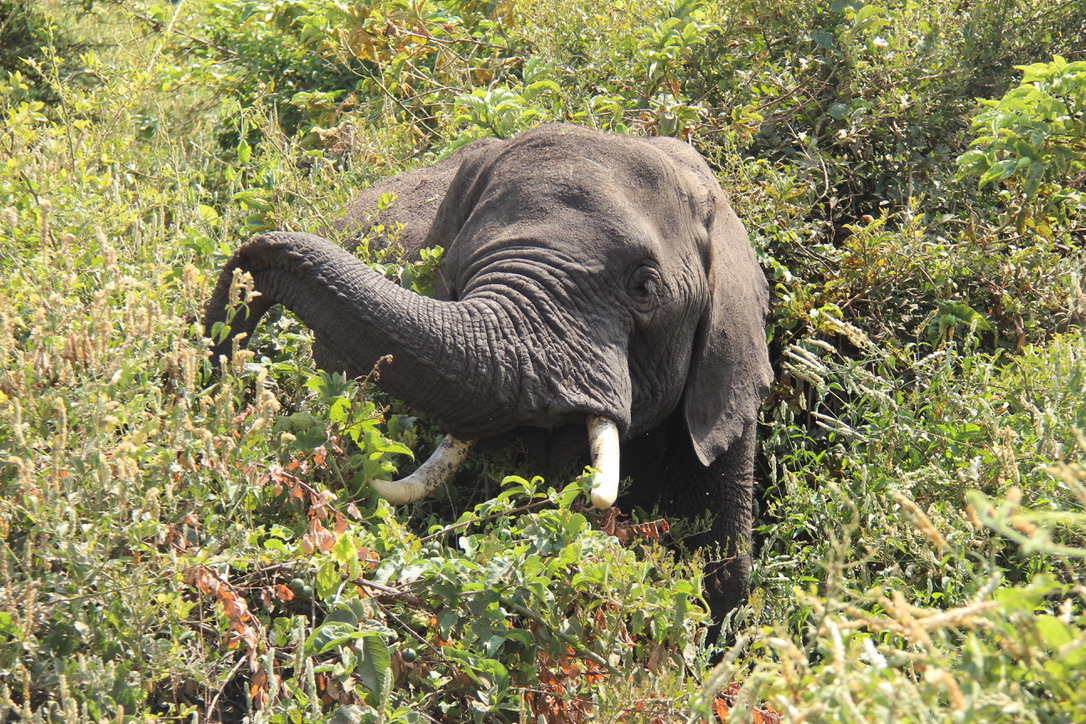

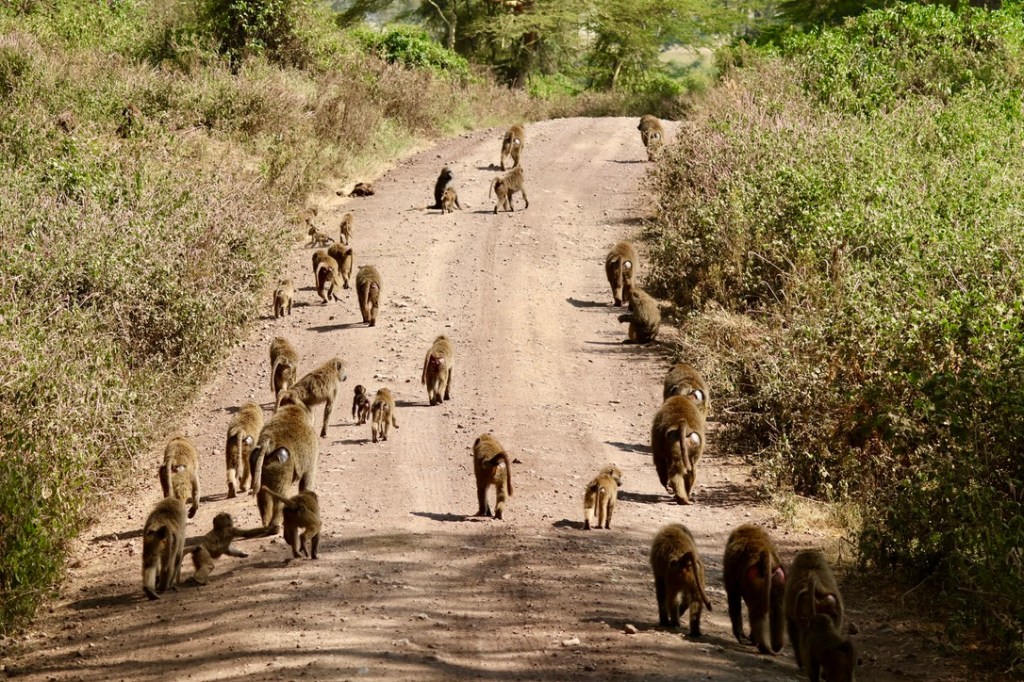
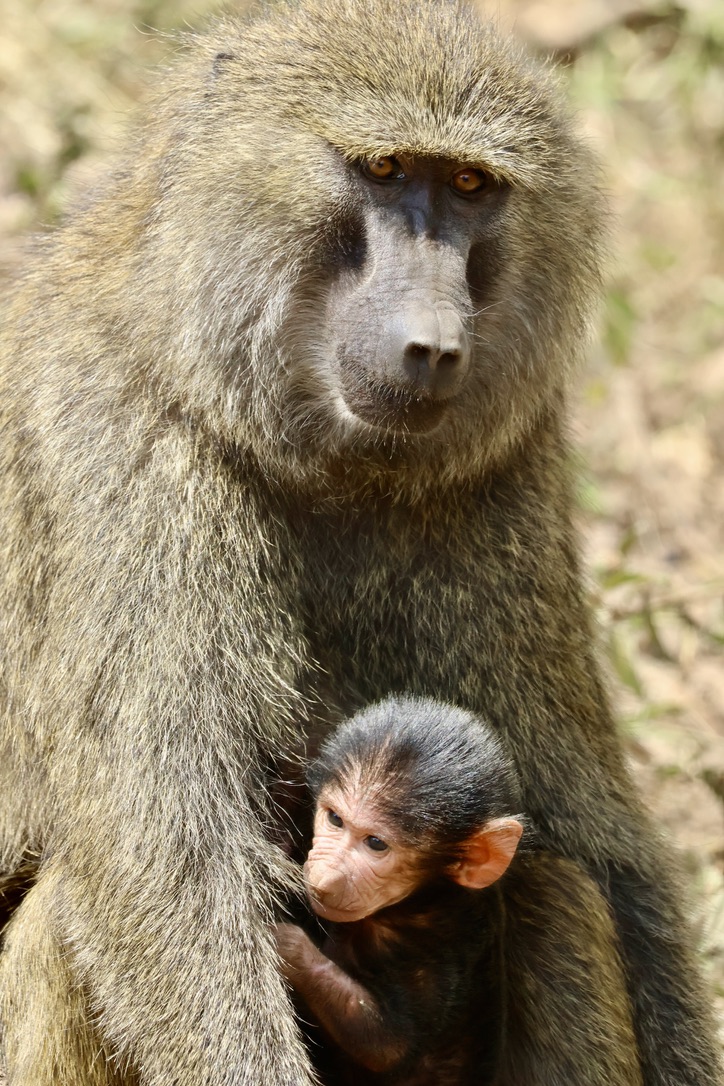
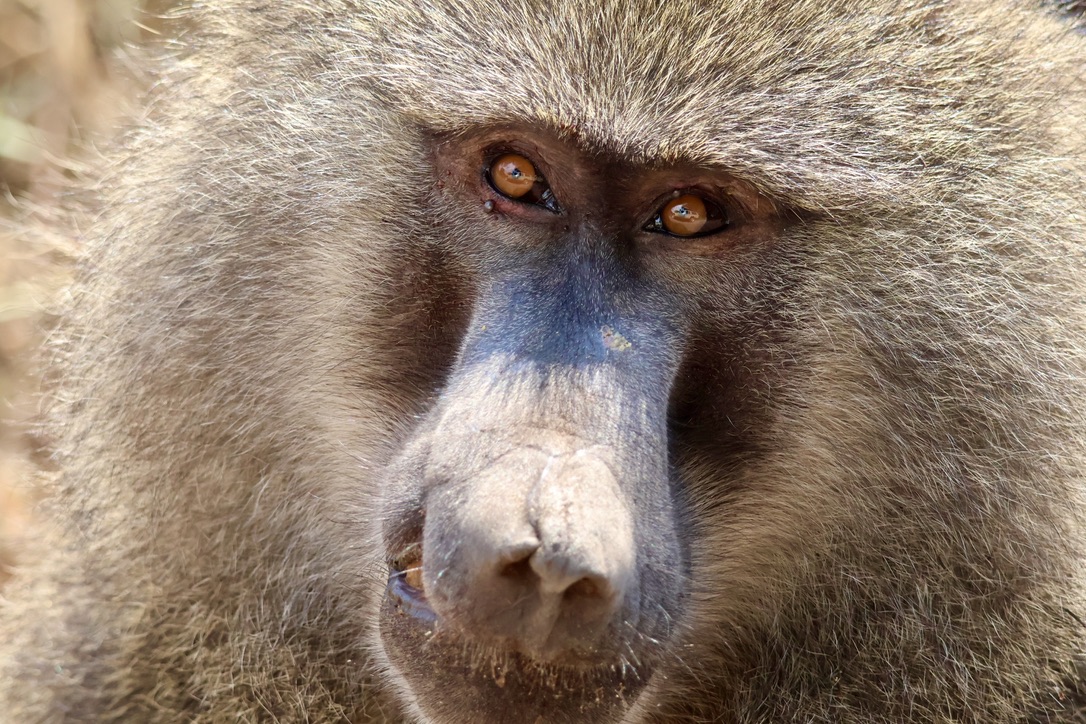
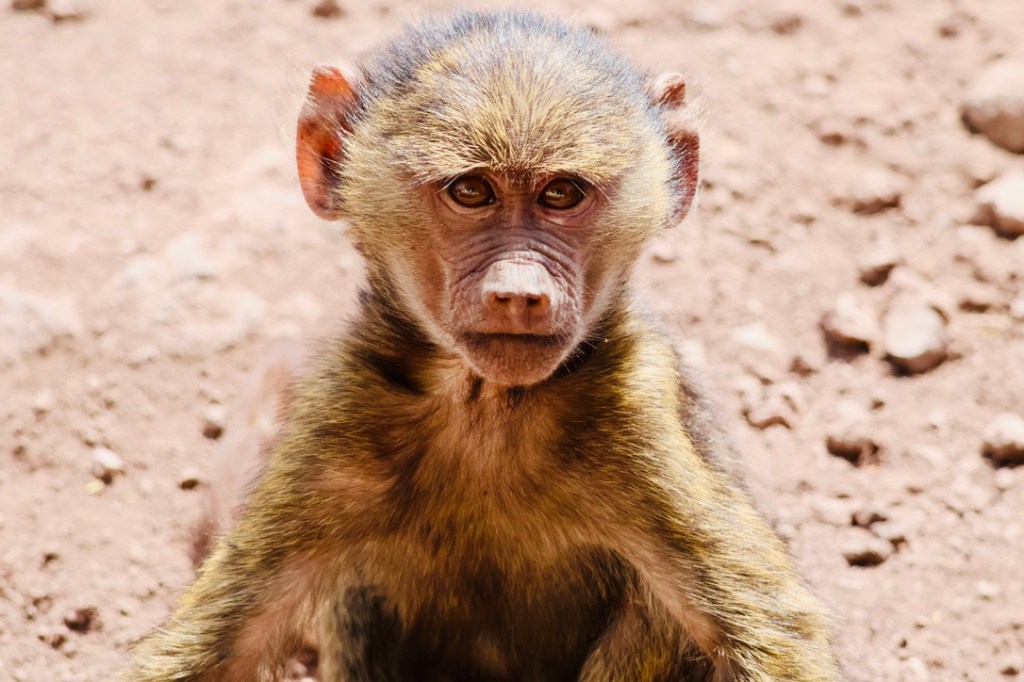
A quick side note about safaris here – to state the stupidly obvious, they involve a lot of sitting/standing, and of course a lot of driving (really slowly). This makes it all really accessible – which is great – but we also missed the trekking aspect of Rwanda which included a bit of exercise in the experience. On the other hand, getting eaten by a lion or trampled by an elephant or hippo would ruin the holiday, so we behaved, sat obediently in our steel box and watched the world come to us.
Before we knew it we were packing up again and leaving Ngorongoro. We had loved it, but to be honest, 2 days were probably enough and we were super excited to move on to the Serengeti (which appropriately means ‘endless’ in Masai) and the chance to see the Great Migration. If you’d asked us about what we wanted to go on safari for over the last 25 years, this is what we would have said.
Like everything on this trip, the pace was brisk but hopefully we had enough time to see what we wanted to. The plan for the day was a morning drive into the north western corner of the Serengeti, a quick game drive and then to our Kirawa Serena bush camp for the night. The bush camp was not far from Lake Victoria and very close to the Grumeti Game Reserve and Grumeti River, where we would hopefully have the opportunity to spot some focussed looking wilderbeest herds heading for their dry season vacations in Kenya.
That was the plan.
We pulled out of Lions Paw and bounced our way along the crater rim to rejoin the ‘highway’ from Arusha to Lake Victoria via the Serengeti. Fair to say the roads weren’t in great shape, and the expected 5 hour transit ended by taking 9 hours as Malles attempted to navigate around the worst of the holes and bumps. It was still a pretty bone shuddering transit.
Even our ‘indestructible’ Land Cruiser didn’t cope – in the space of that 9 hours we managed to:
- rattle so hard that the steering wheel cover shook off, and the radio shook out of the console
- one of the passenger seats shook out of the moorings
- ultimately we broke one of the shock absorbers – which we had to remove
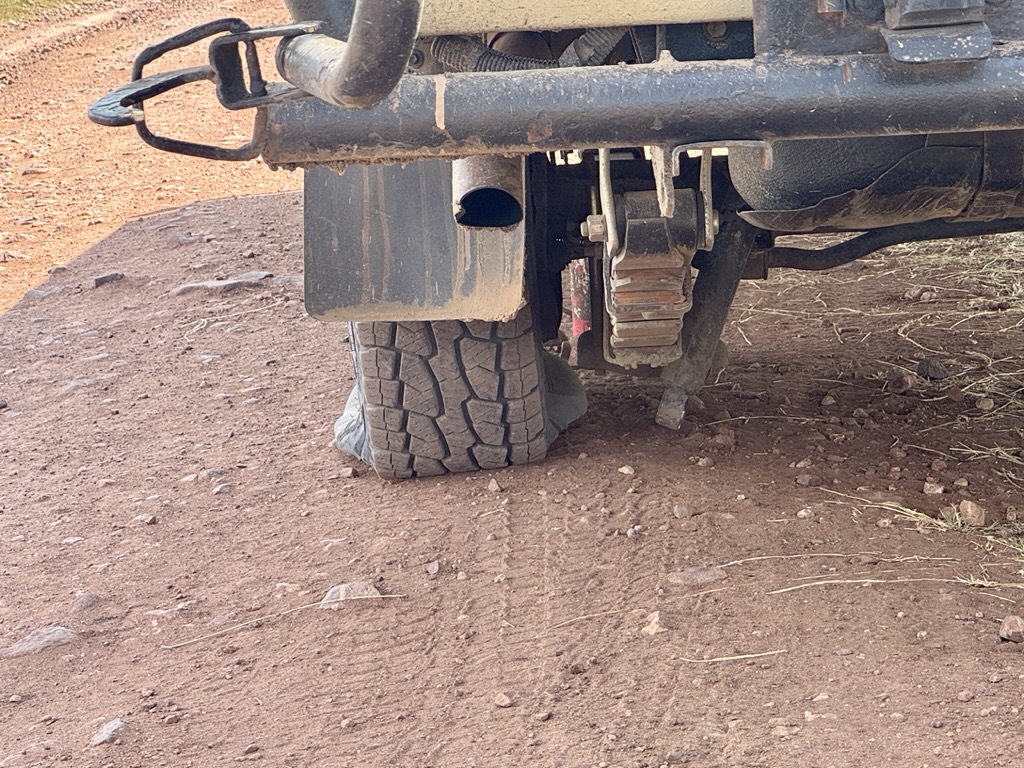
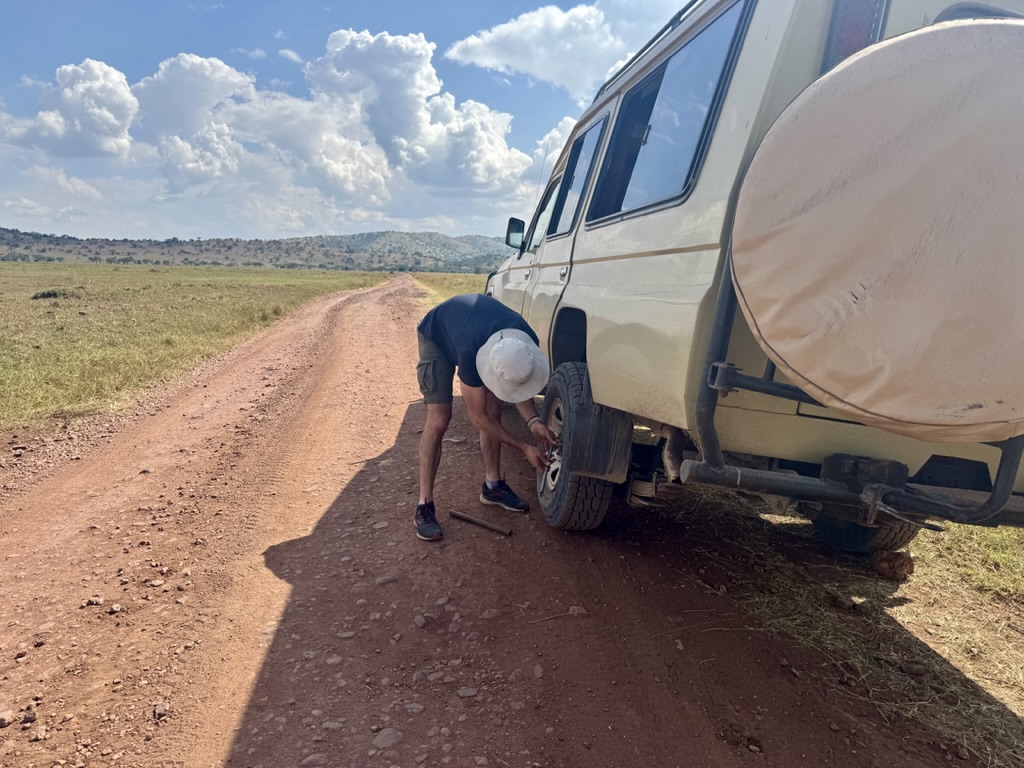
- … and finally blew a tyre
… so fair to say it was a pretty rough journey!
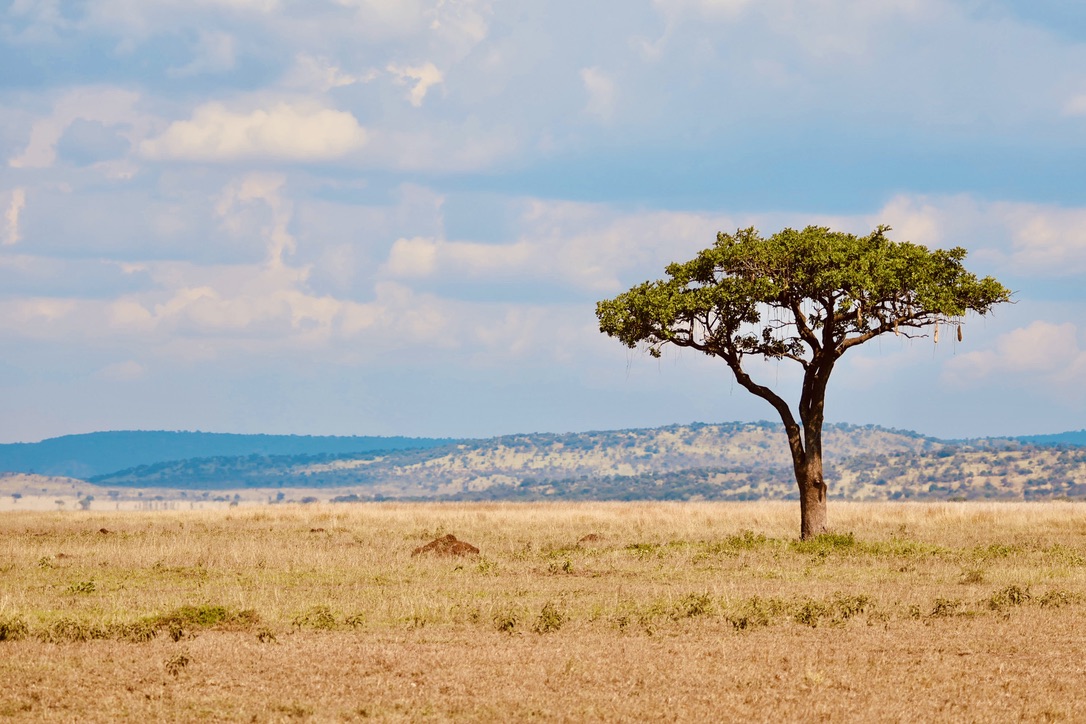
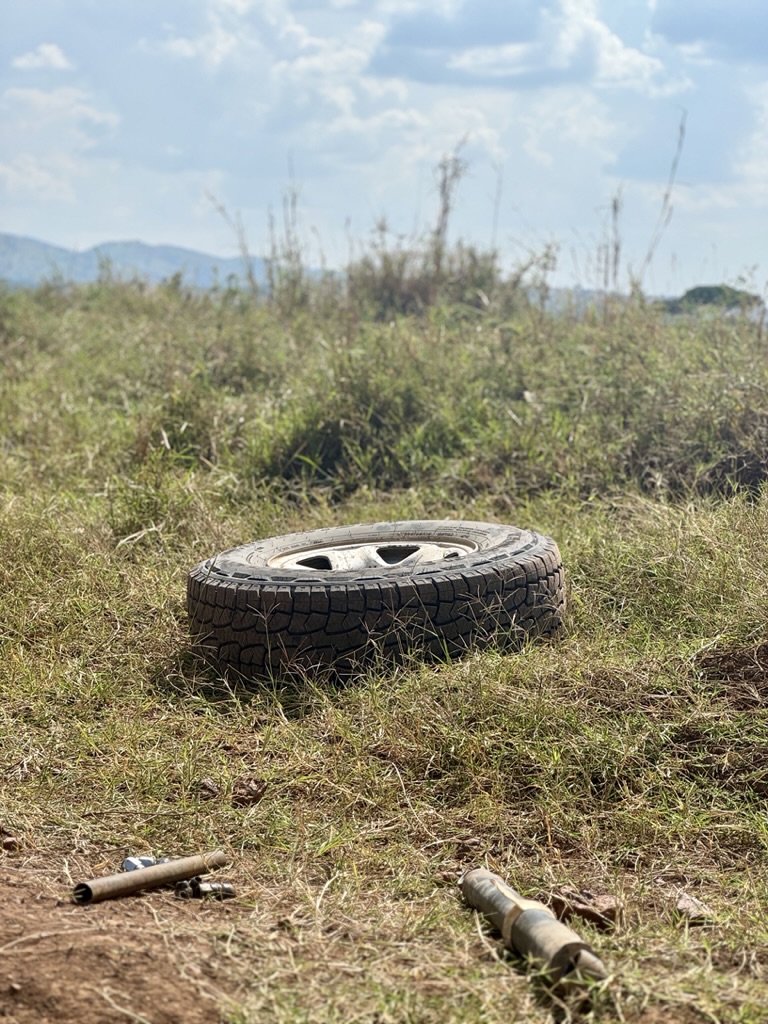
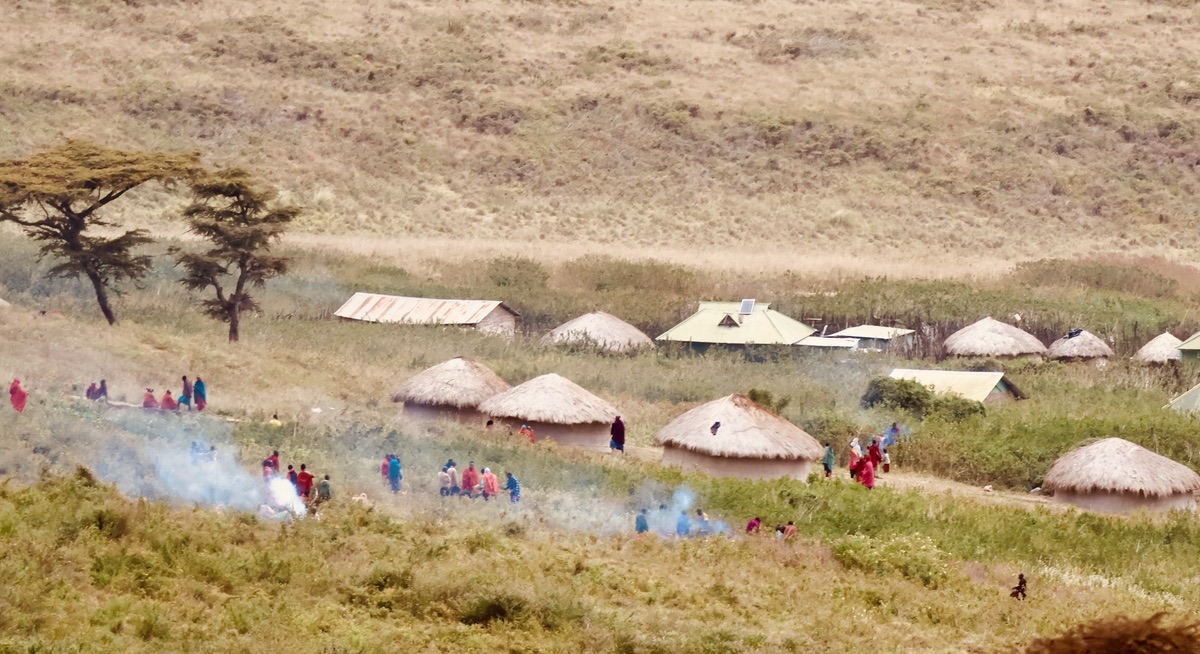
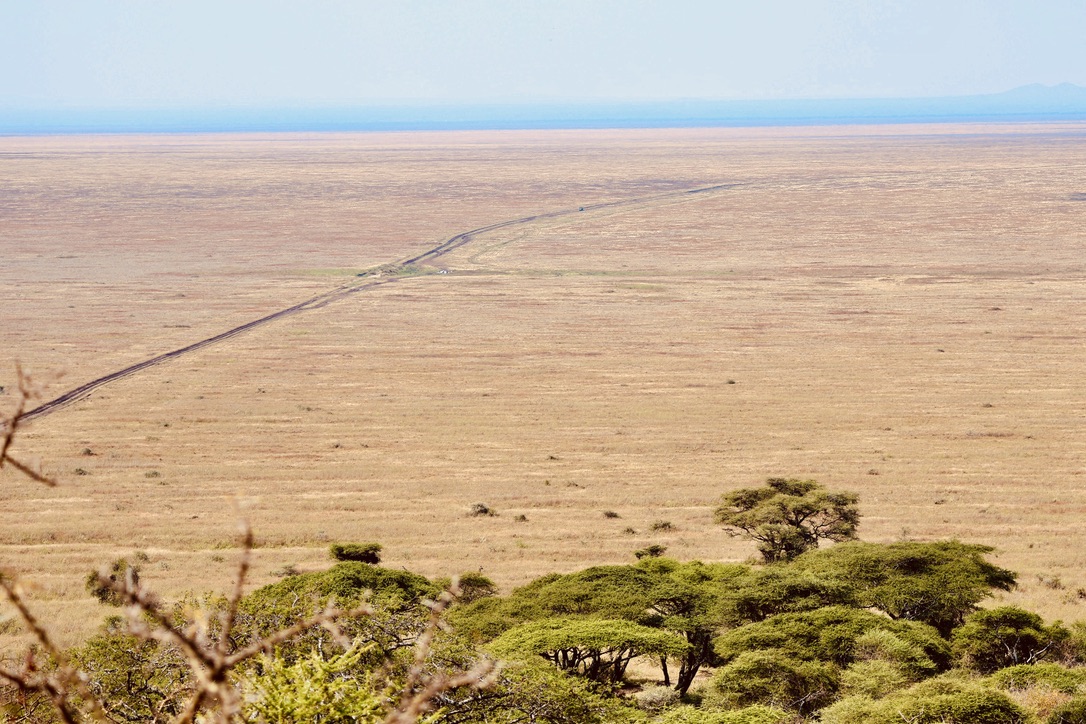
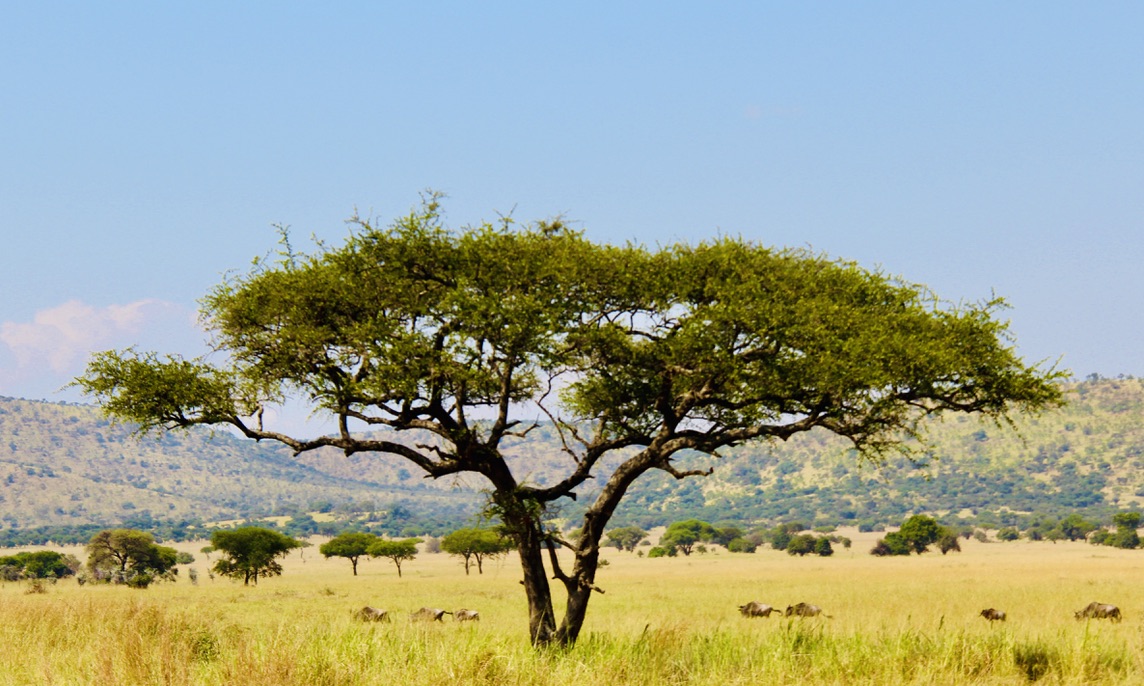
On the flip side, over that 9 hours we had the privilege of crossing most of the Serengeti and were treated to stunning landscapes of grassy plains speckled with beautiful Acacia trees, Masai villages with their traditional thatch roofed huts and Masai herdsmen herding their cattle and goats through the plains.
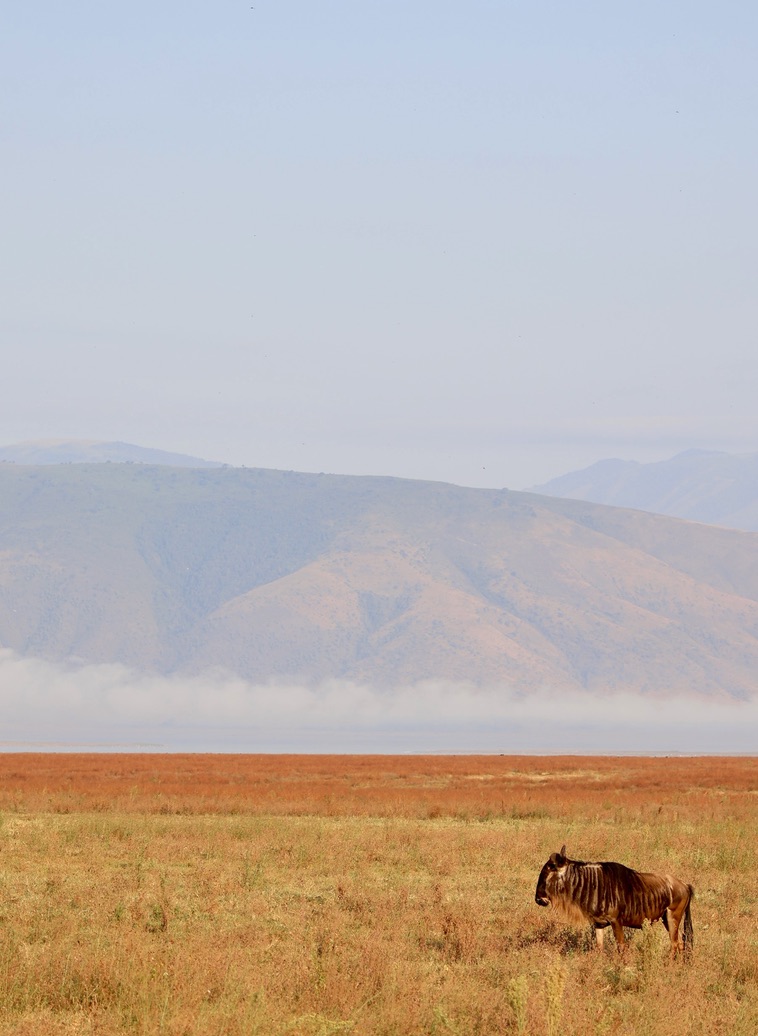
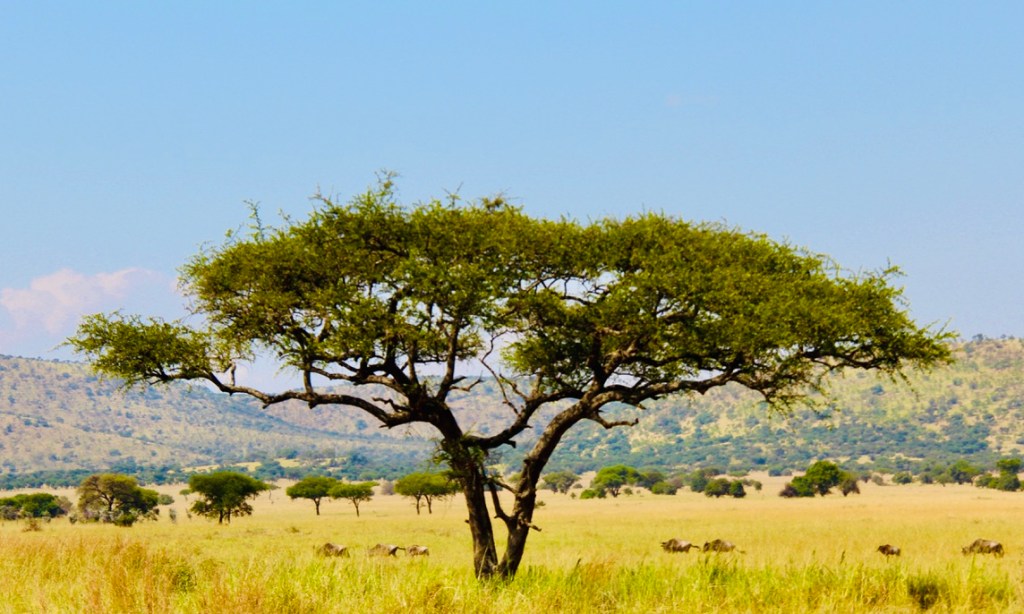
We were also treated to some of the most prolific fauna that we’ve seen all trip. Zebra in their hundreds, herds of elephant and giraffe by the side of the road and gazelle by the thousands. We even saw a lion perched 10 meters up a tree.
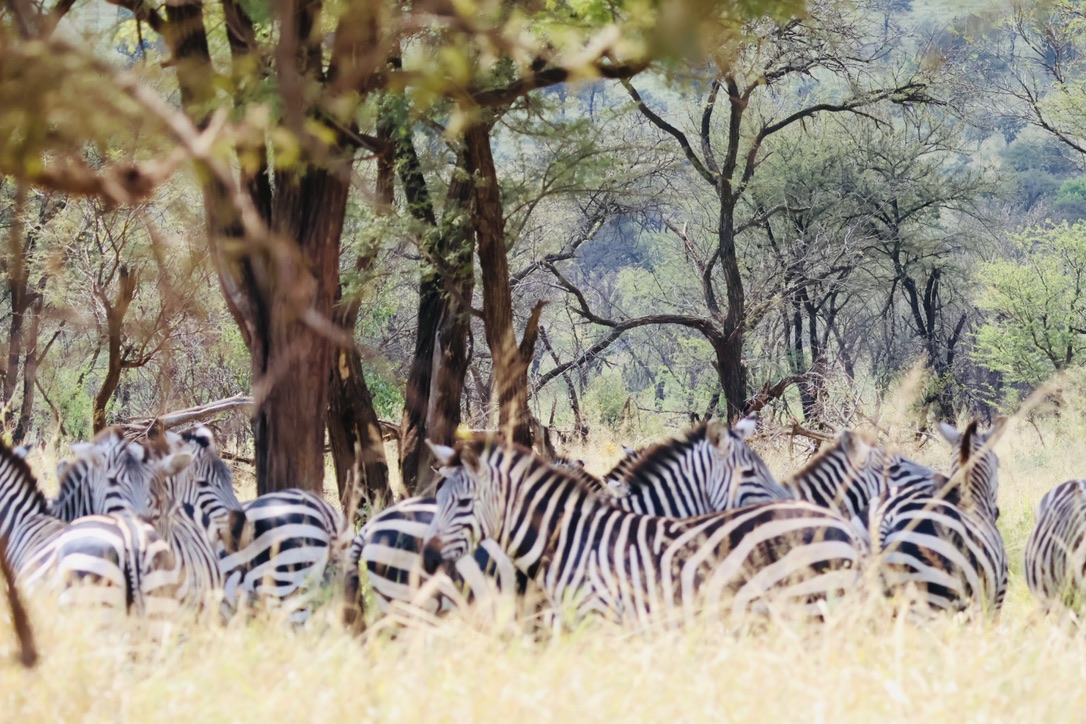
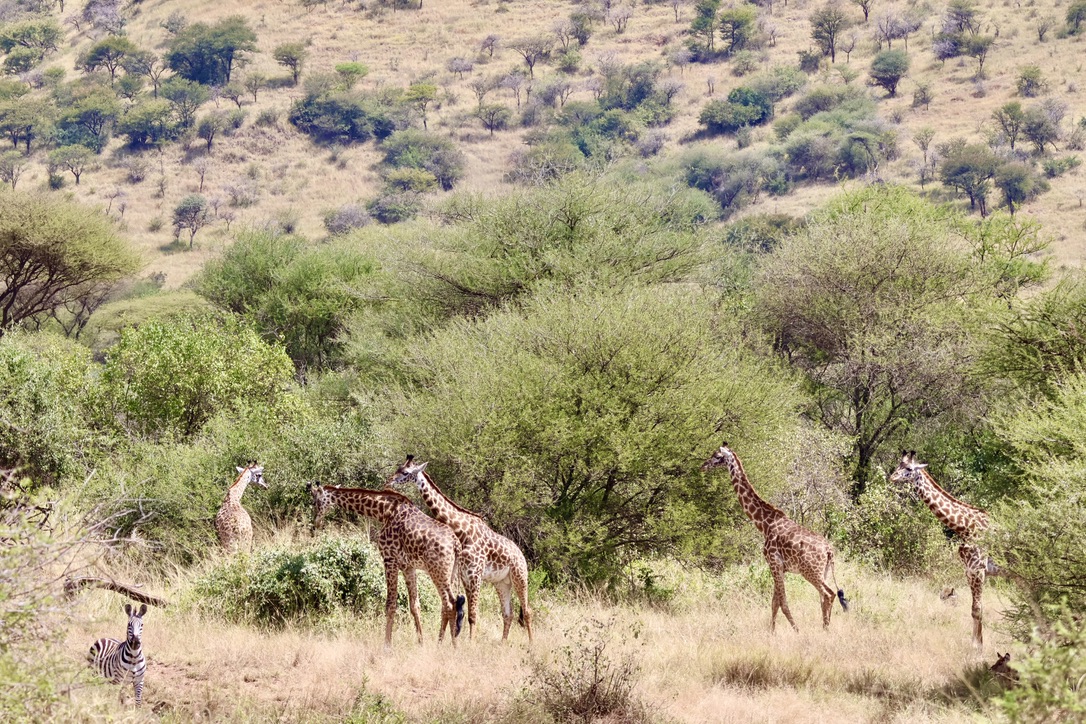
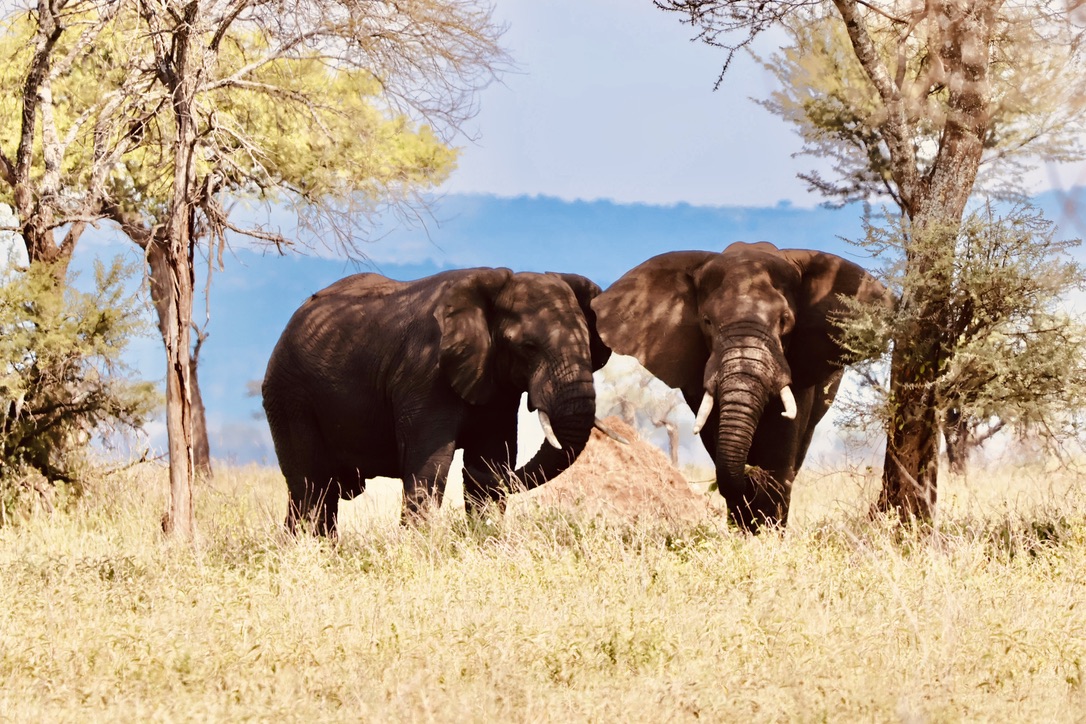
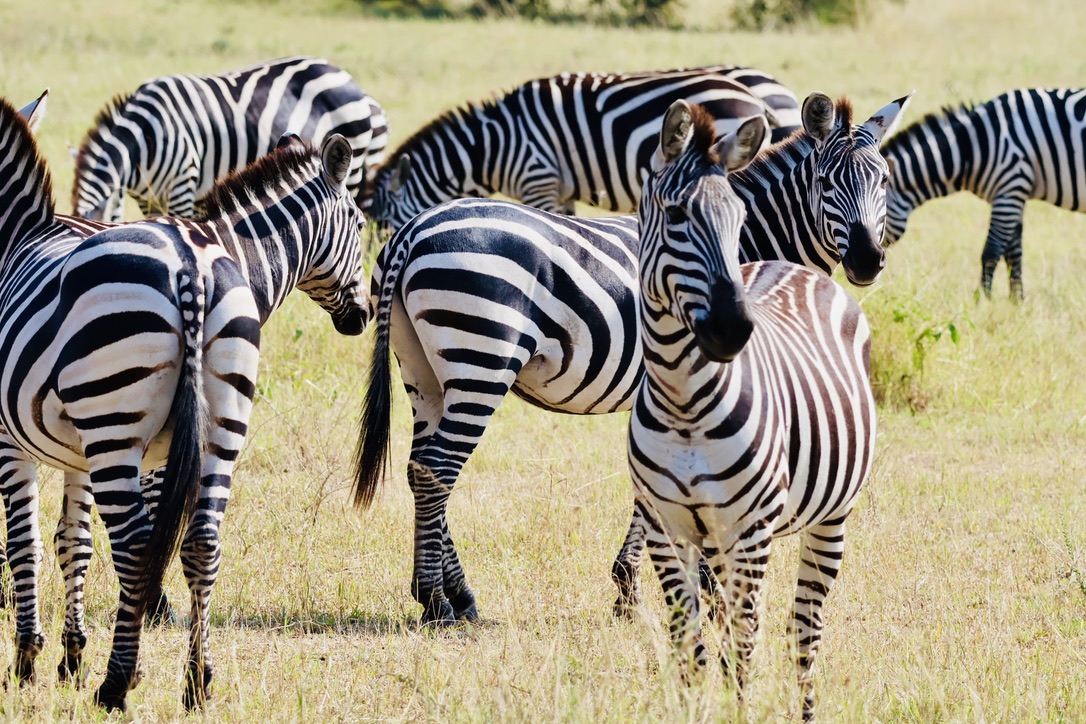
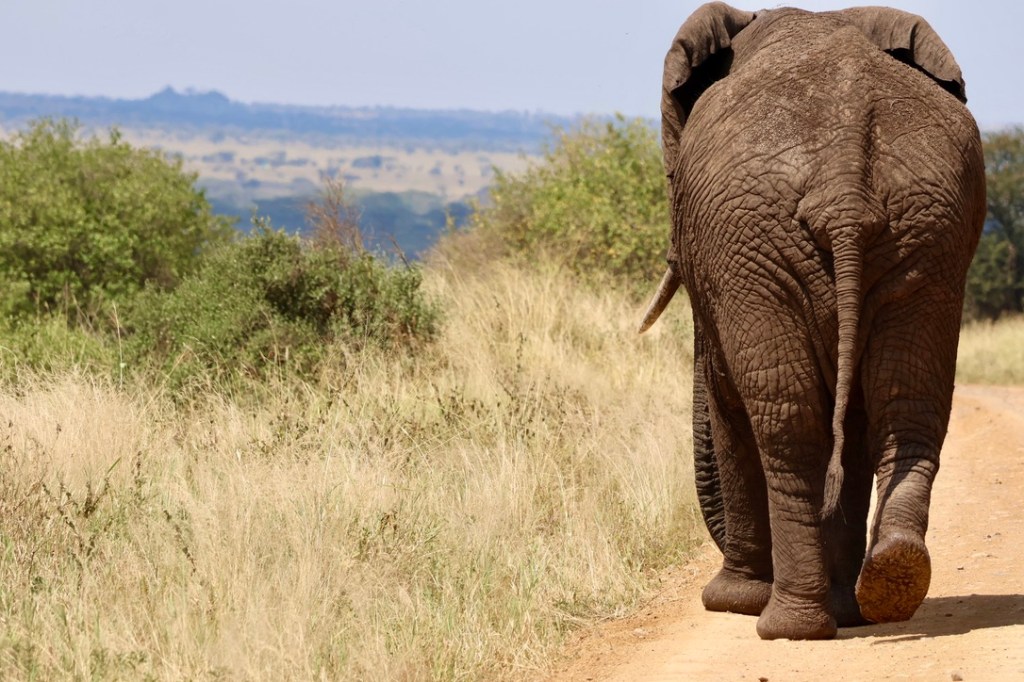
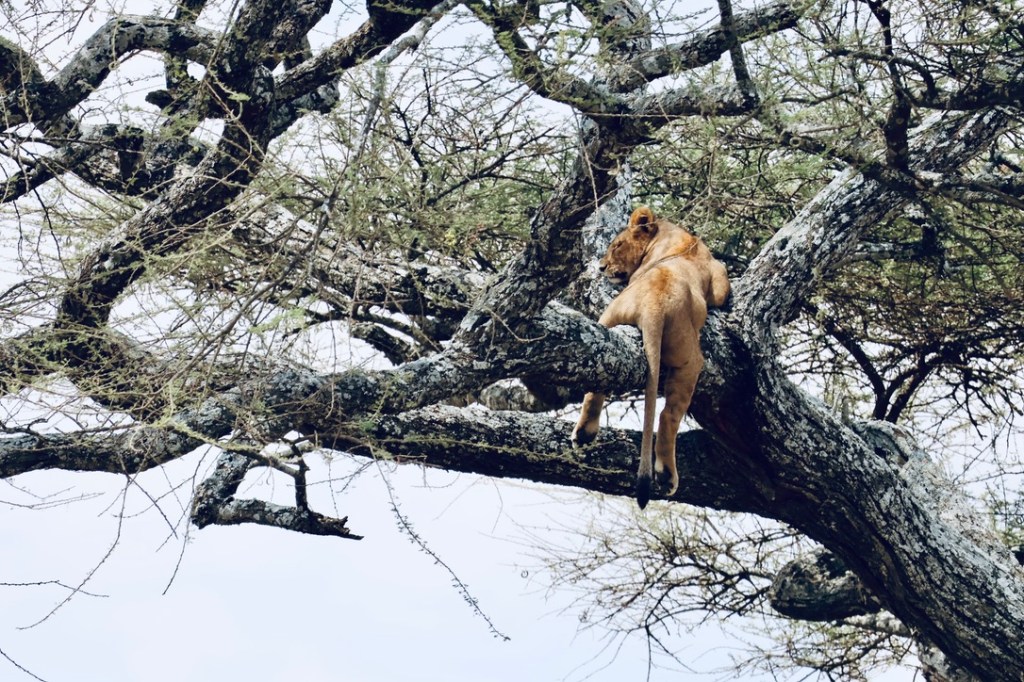
Despite the trials of driving in such challenging conditions, Malles was still good enough to stop every time we squealed loud enough.
Who needs a ‘game drive’ when you can just drive past game like this?
Fair to say we were trashed when we arrived at the beautiful Serena Kirawa bush camp that night. We were greeted by the now expected over-the-top service and made our way to our tented ‘bush camp’ – complete with mosquito net-covered 4 poster bed (because why wouldn’t you have a 4 poster bed in the middle of the outback?). Everything about the place felt like a call back to colonial times (more internal cringing).
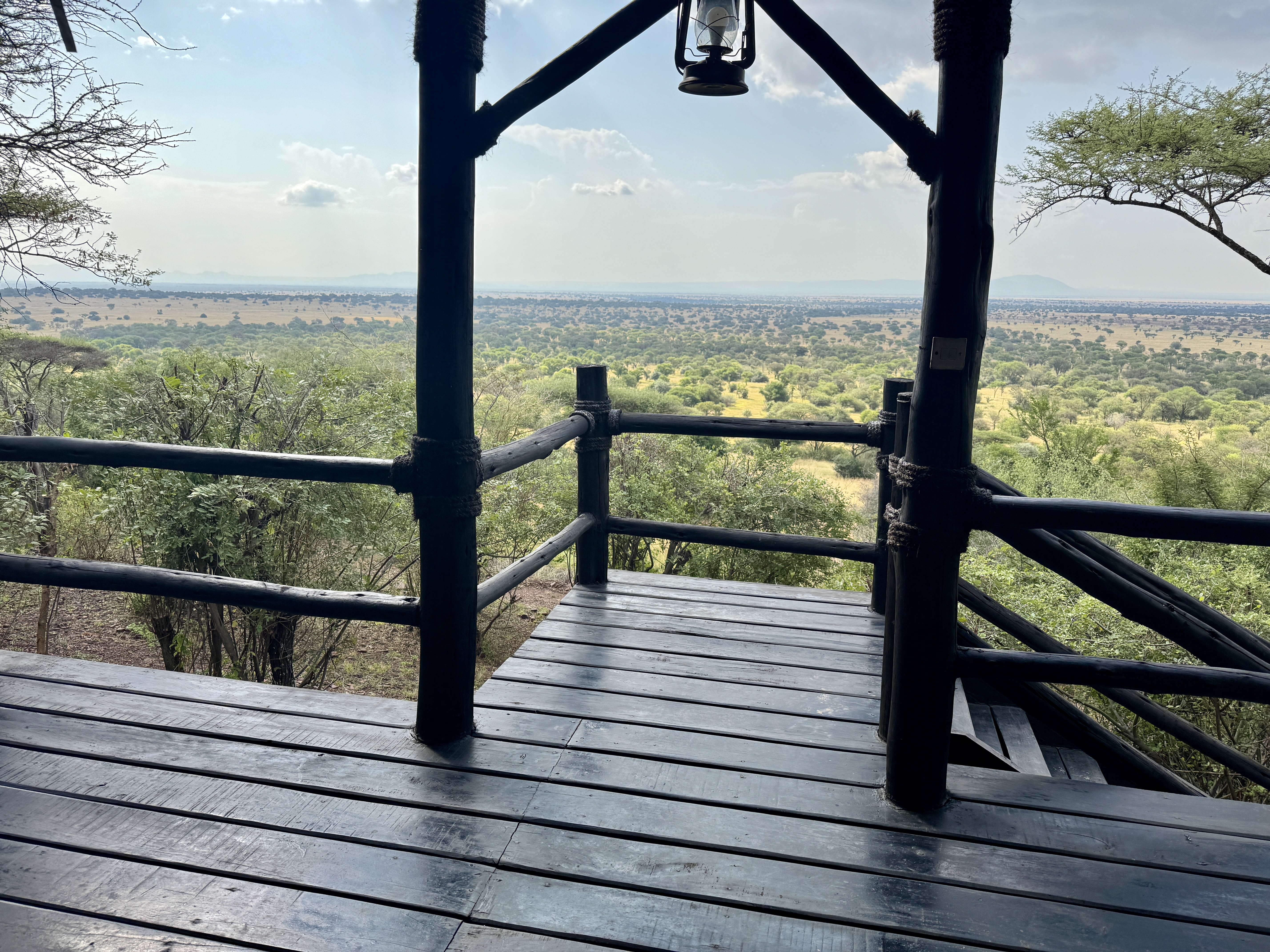
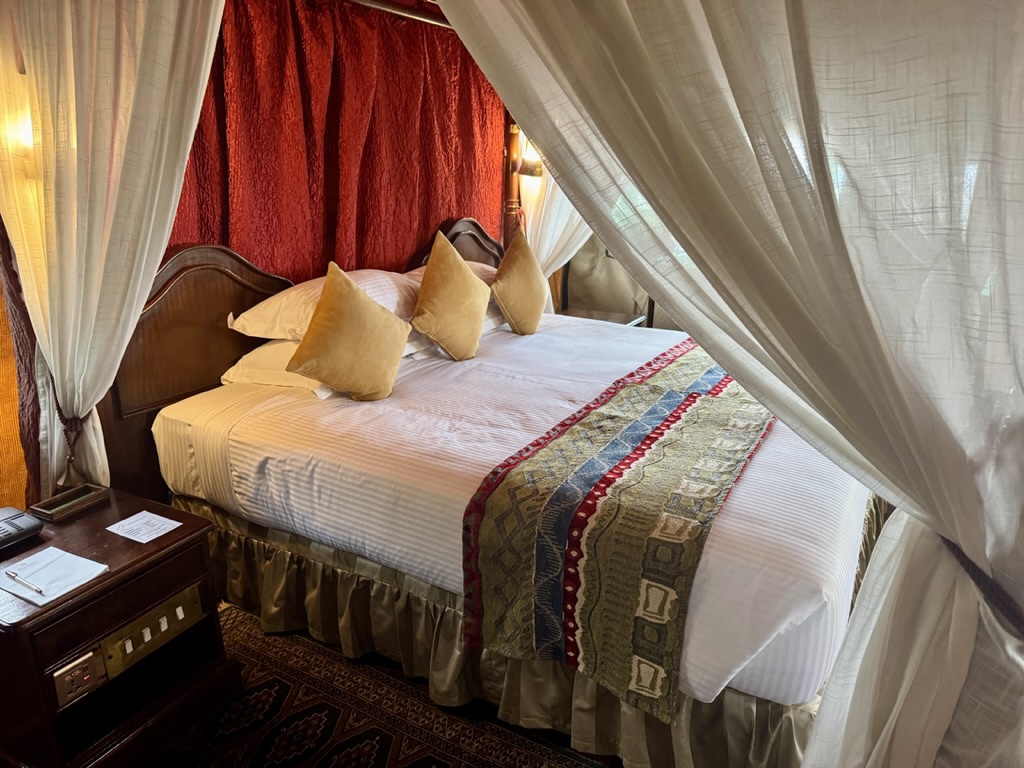
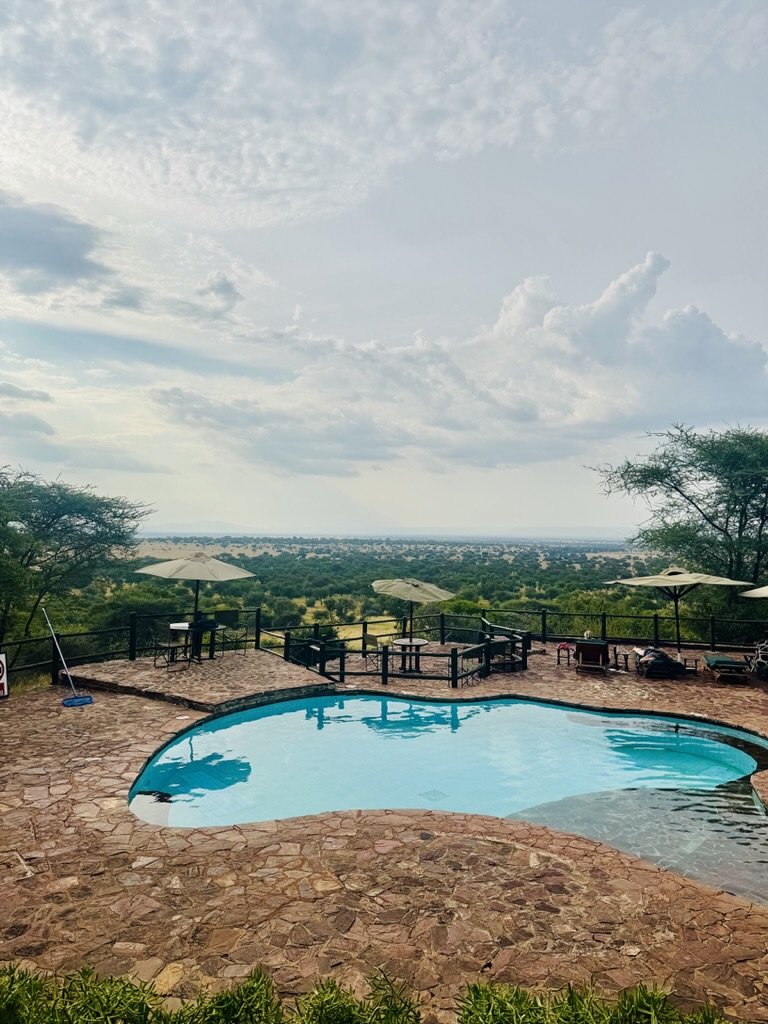
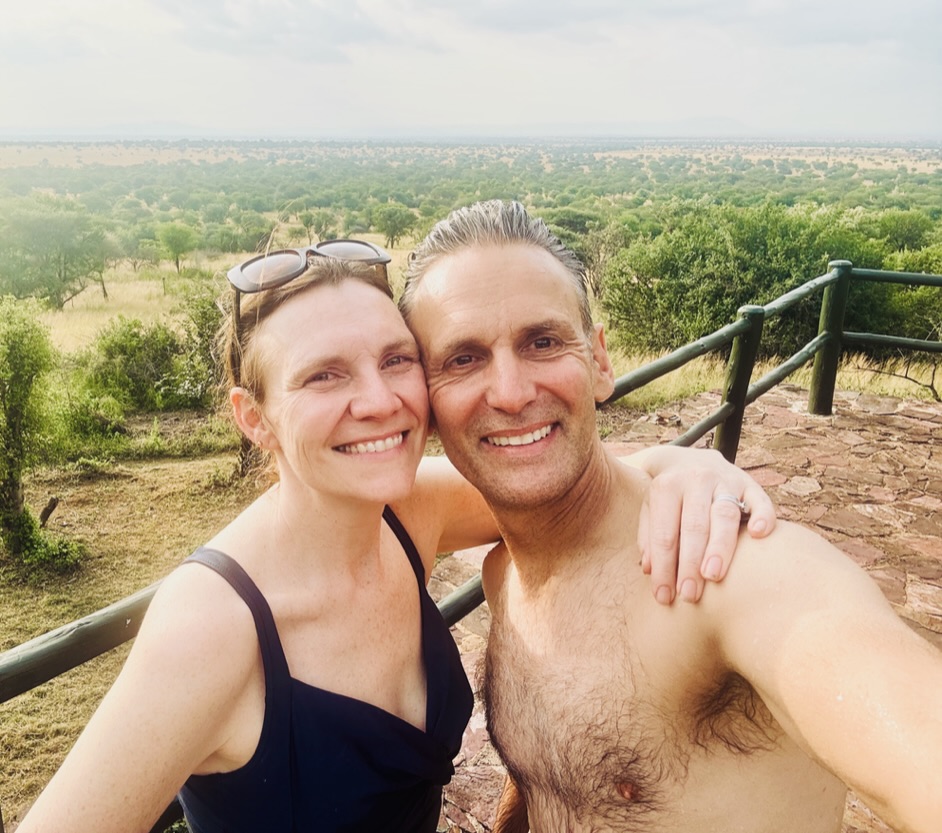
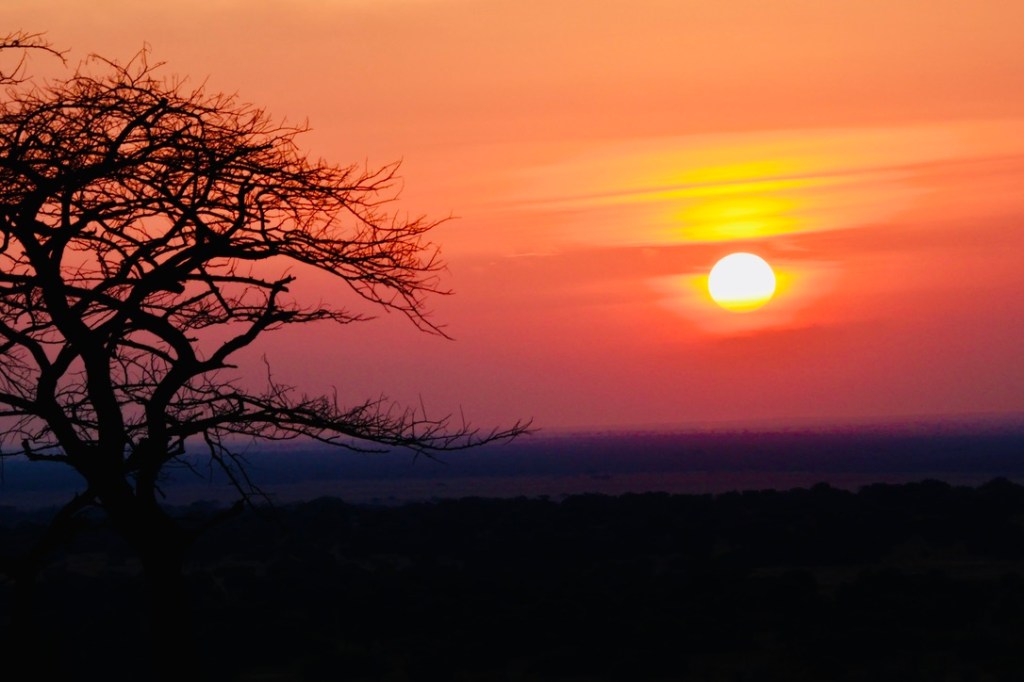
Still, we weren’t cringing at the pool, or the sunset over the Serengeti plain to Lake Victoria in the distance, or the even more spectacular sunrise the following morning.
Today was our last full day of safari-ing so we wanted to start early again – we were keen to maximise our chances of seeing the wildebeest migration. Reports from groups that went out yesterday were patchy – some talk of wildebeest, others suggesting that we’d missed the boat and they were all drinking cocktails with their lion mates further north towards Kenya.
Malles and our Land Cruiser limped up just after 630 – both of them looked a little worse for wear after yesterday. They would both probably breathe a sigh of relief when we were dropped at the airfield tomorrow and they could make their way back to Arusha for some repair and relaxation.
The order of the day was wildebeest, with a side order of hippo; ideally both found on or near the Grumeti River. Bur first… sunrise.
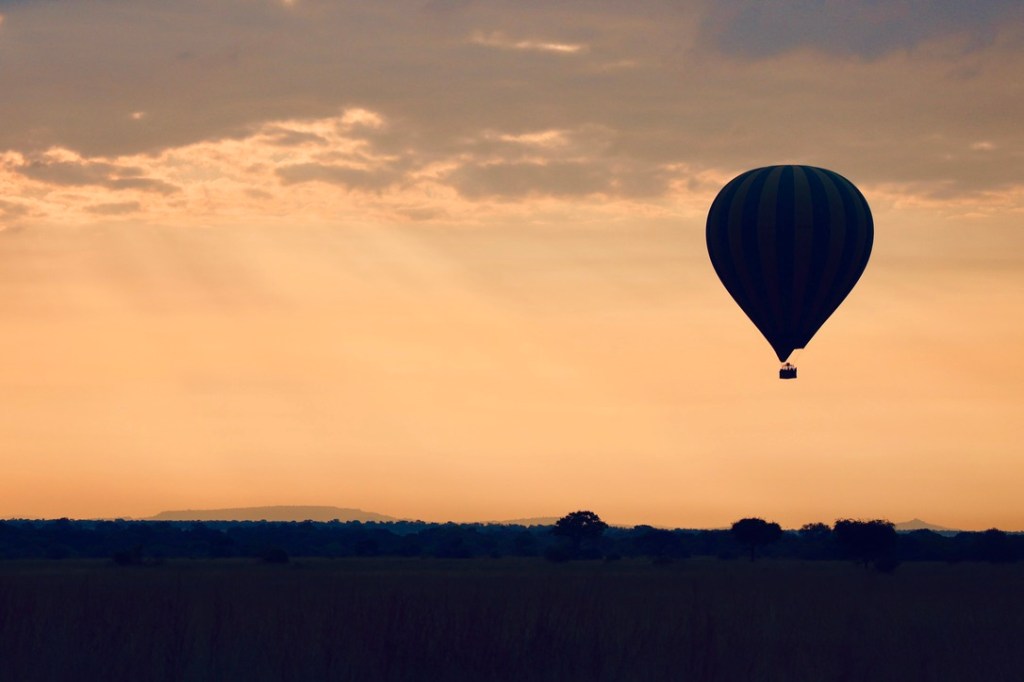
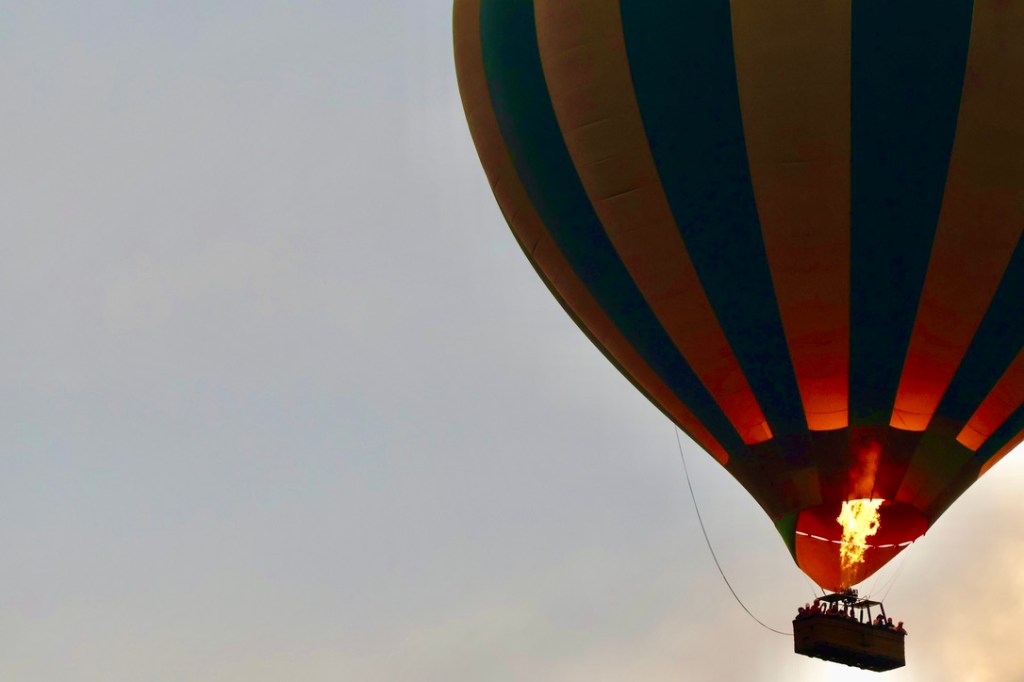
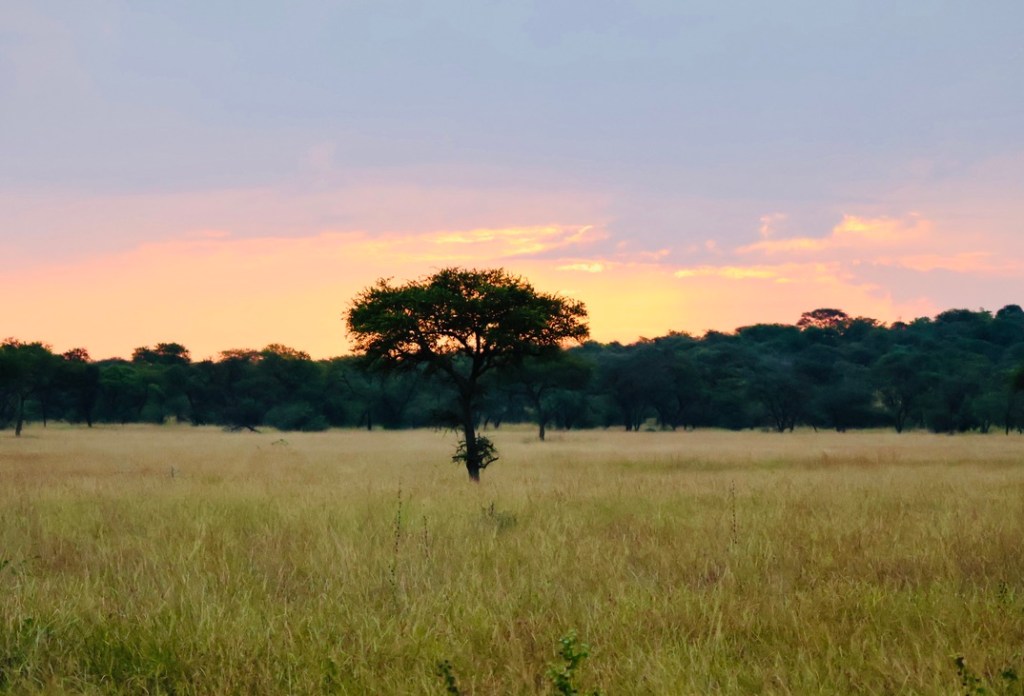
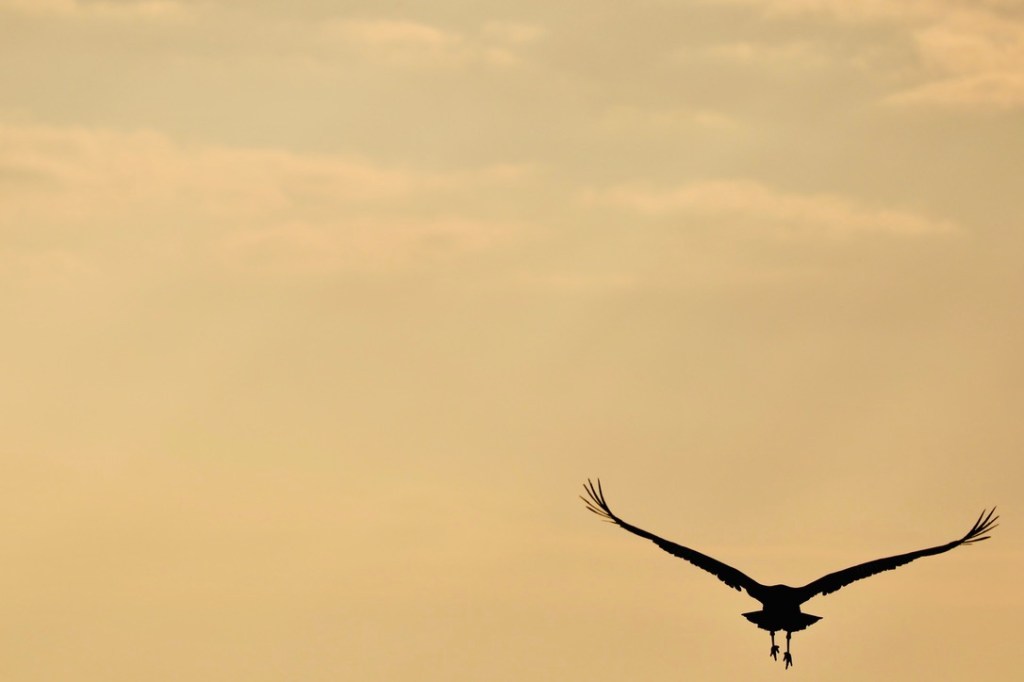
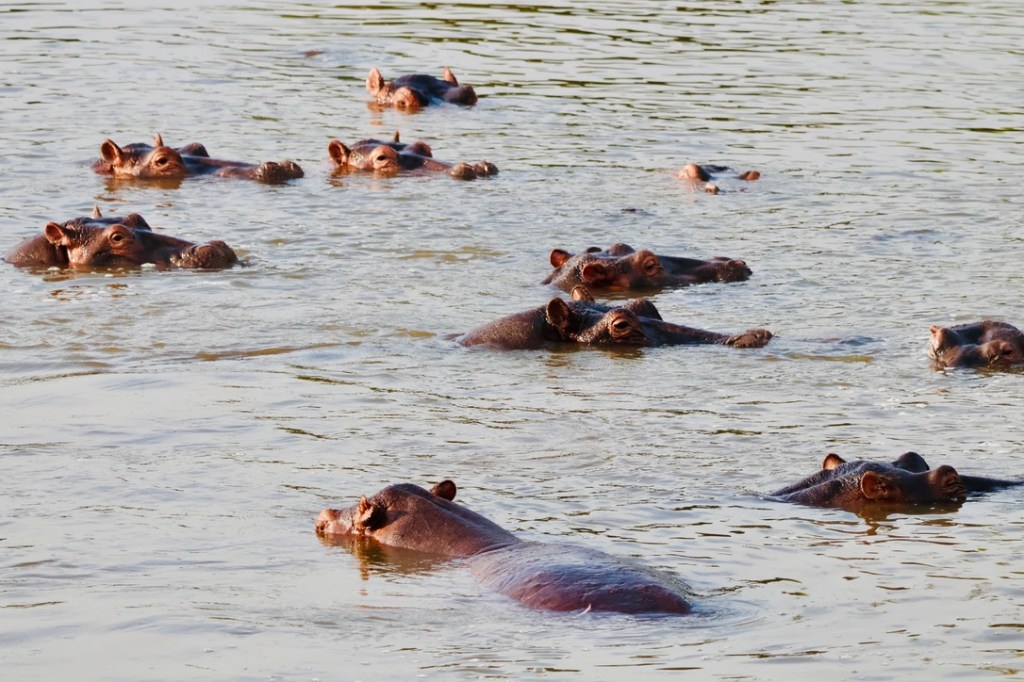
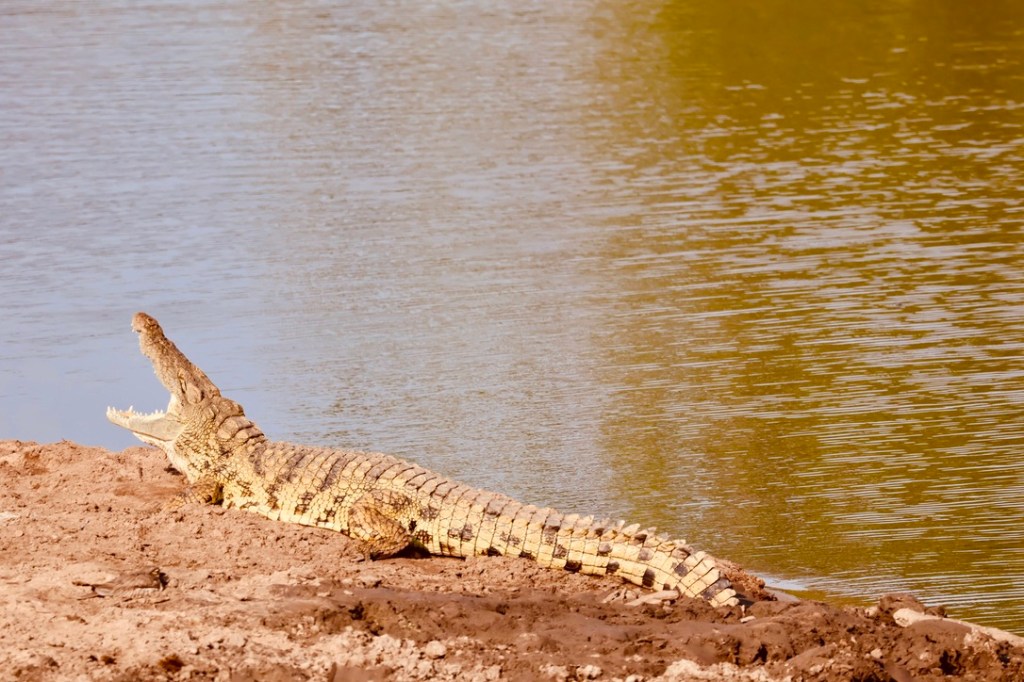
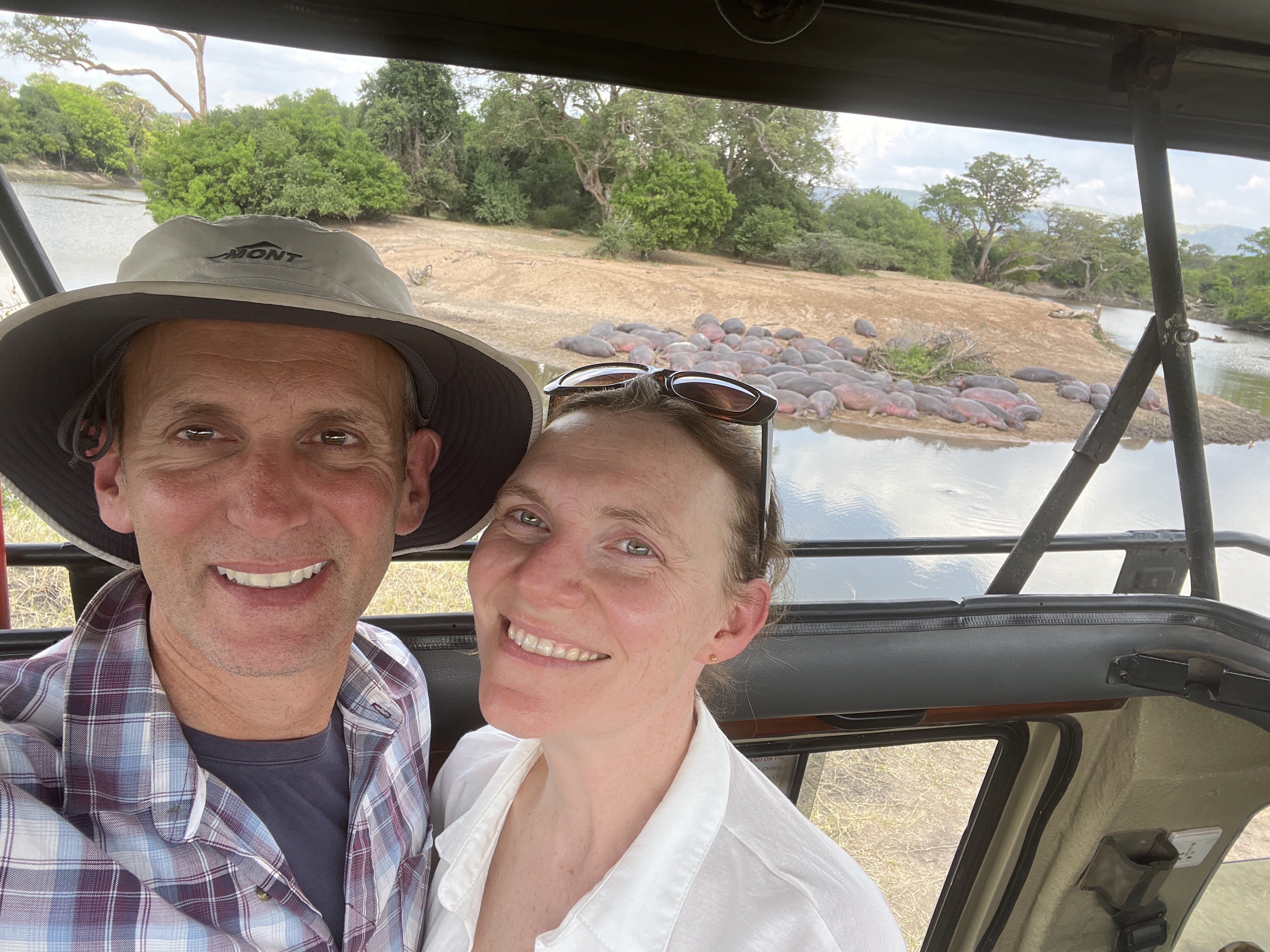
We started our day of viewing at the river banks and were immediately treated to a large herd of hippos having a morning bath under the watchful eye of a number of crocodiles who seemed more interested in the troop of baboons which were playing on the banks.
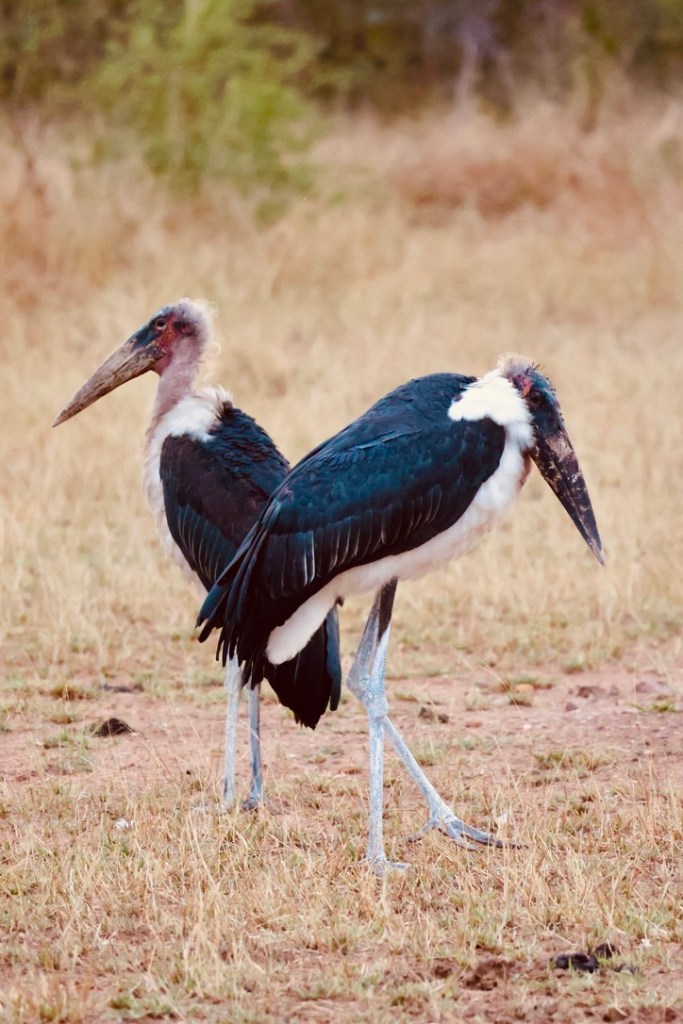
Large, ugly vulture like birds looked on with interest from afar, no doubt evaluating how much of the baboon would be left for them after the crocodiles were finished.
… but then nothing happened. Everyone just went on with their days. The crocodiles slept in the sun. The hippos snorted and floated in the water in complete calm. Only the baboons moved about. This is one of the things we’ve discovered here – carnivores and herbivores can co-exist quite happily for long periods of time and nothing happens. It’s only when someone gets peckish that things become problematic, and this morning the Grumeti River was an oasis of calm.
We eventually moved on in search of the wildebeest. We drove and drove across the plain seeing literally nothing.
Our first impressions of the Serengeti from yesterday were not playing out.
There was not, in fact, herds of elephants, giraffe and zebra around every corner.
There were areas of grassland which were, well, just grass. And it seemed like we were in the middle of a big chunk of grassland.
Not even a gazelle in sight.
Certainly not a wildebeest.
Malles’s speech from a few days ago echoed in our minds – safari is a game… maybe today we would lose. Or at least not win.
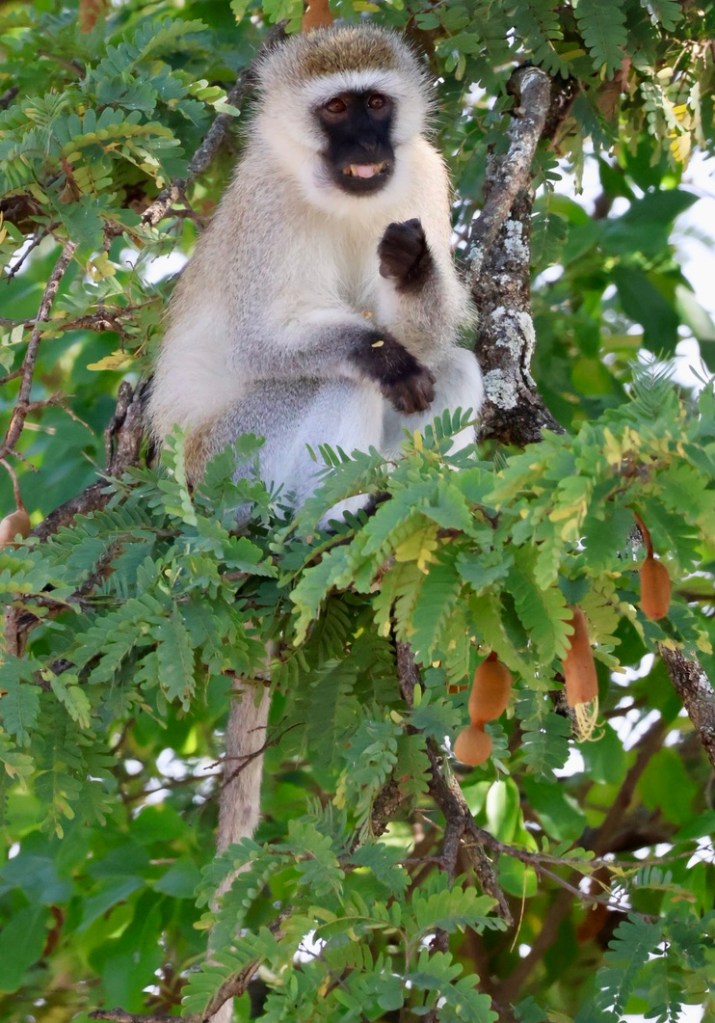
We drove for more than an hour with only the horse flies (which can bite through 2 layers of shirt) for company. We drove past the Grumeti airstrip and at least saw a couple of fun spider monkeys.
We checked in with other guides. Not a wildebeest in sight.
Consoling ourselves with the idea of going back to the river for lunch with the hippos, we started making our way back.
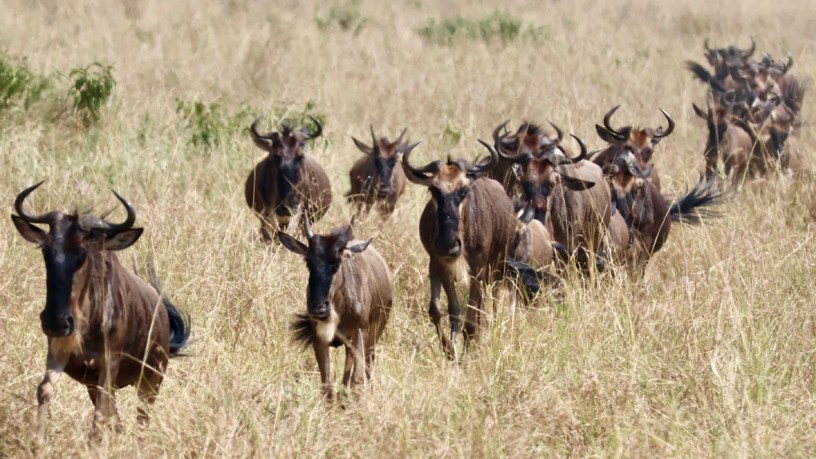
Then we saw them – first a couple of wildebeest walking with purpose in parallel to our road. Then we saw it was part of a column, and the column went on like a freight train from hundreds of metres. Thousands of wildebeest heading north with purpose (and, to be fair, a couple of more rebellious ones heading in the other direction).
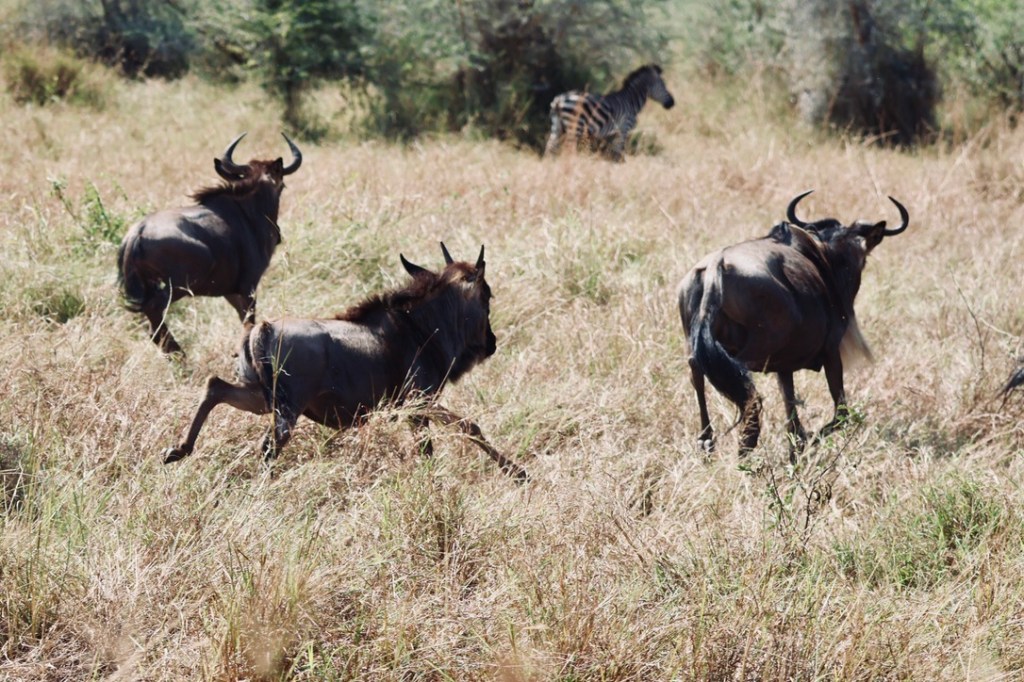
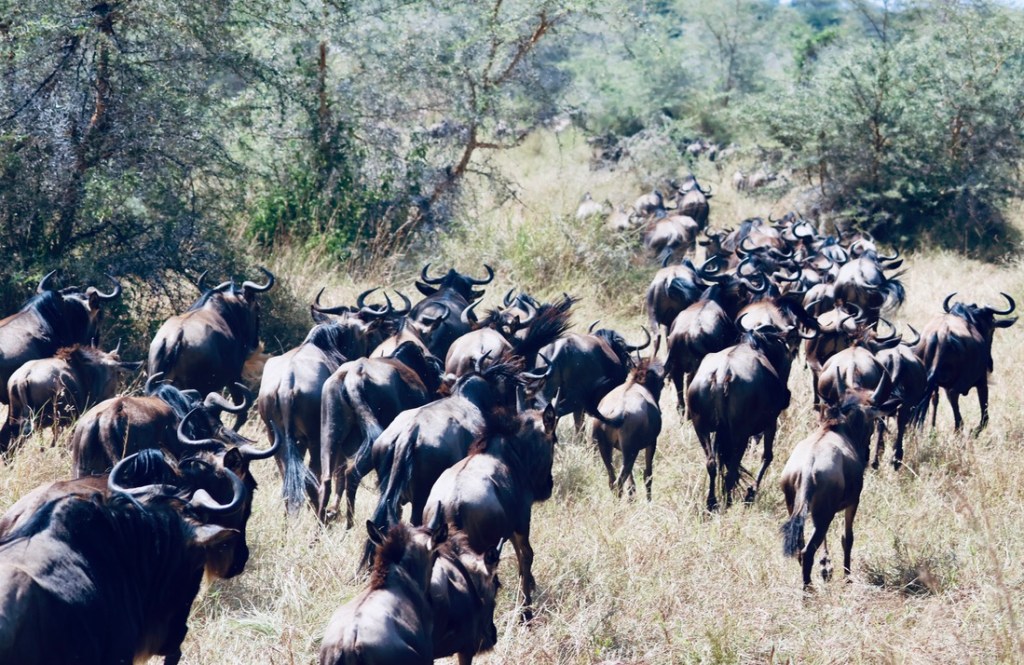
Just the sheer scale of life operating in unison is super impactful. I’m pretty sure that if you asked a wildebeest what they were doing, they wouldn’t know. But as a collective, they are following their instincts that sends them north at this time of year towards Kenya and greener pastures for the upcoming dry season.
Eventually we reached the head of the column, and watched the pack go past. It took a while.

Satiated, we started making our way back to the river.
En route we were literally blocked by another herd heading north, this one needing to cross our road. Not as big as the first, but we had the opportunity to see the herd as they literally ran right past us. And these guys weren’t meandering, they were running. And not just wildebeest, but zebra and antelope too (who don’t really run, they more prance).
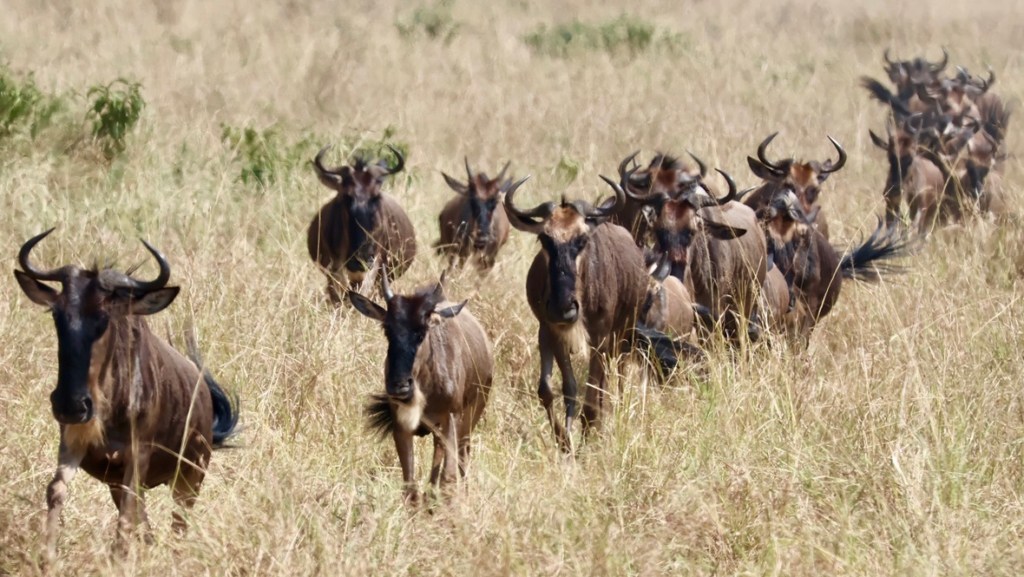
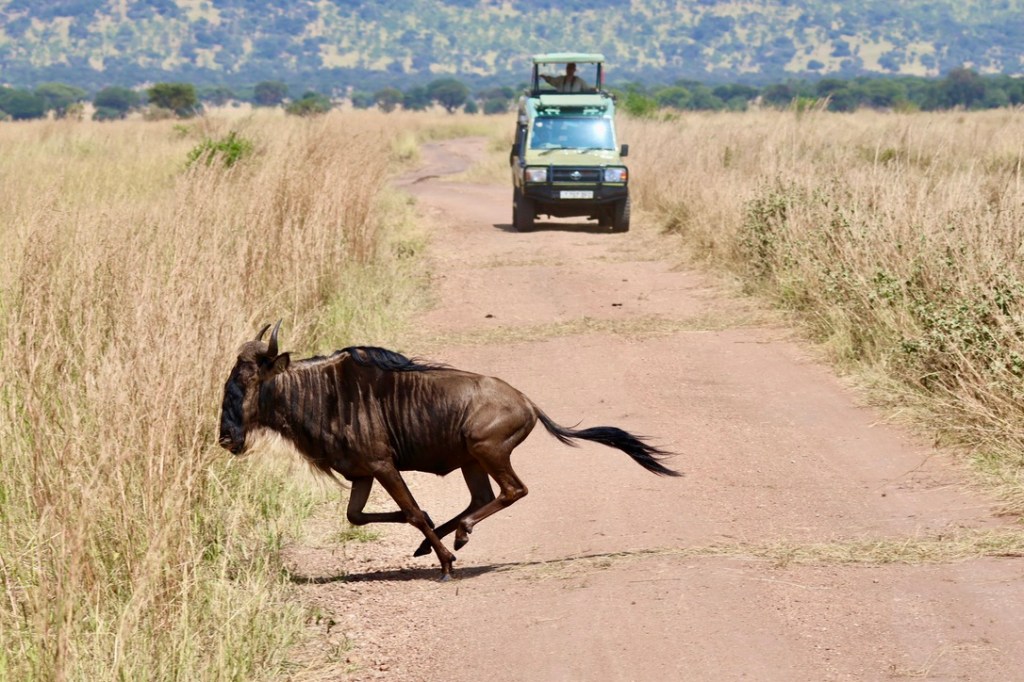
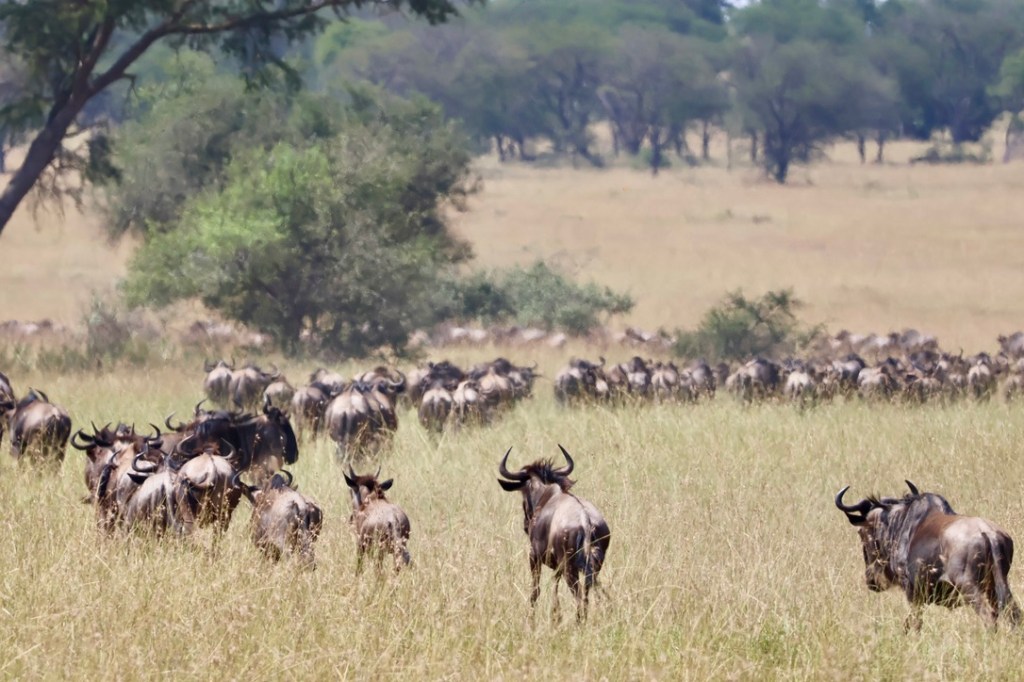
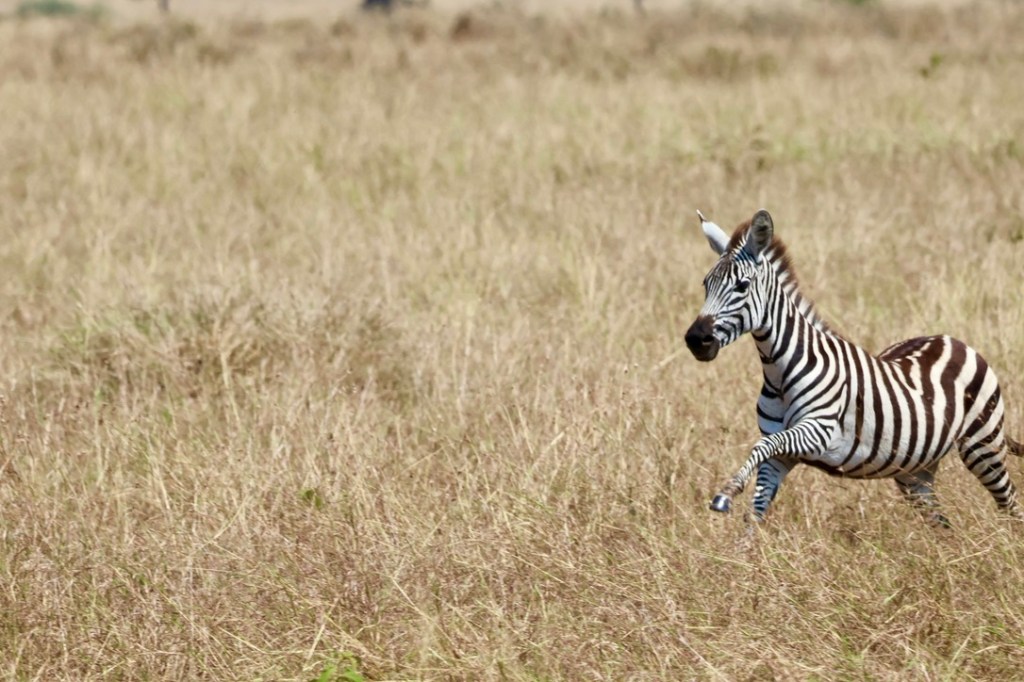
What was really lovely was the urgent calls from a large, healthy looking wildebeest towards the back of the pack – which comprised some of the young and a number of limping adults. She/he was waiting for them and urging them to keep up with the rest of the herd – I guess the consequences of not keeping up are pretty well understood, even among wildebeest!
From there, we really did go back to the river for lunch with the hippos. We had been saying how great it would be to see the hippos out of the water. They spend most of their days floating about, coming out at dusk to feed and sleep. We had even asked Malles if we could come back at dusk to see them (no, as the game reserve closes at 5pm).
We were expecting to see a lot of hippo noses and eyes, with their bodies concealed in the water.
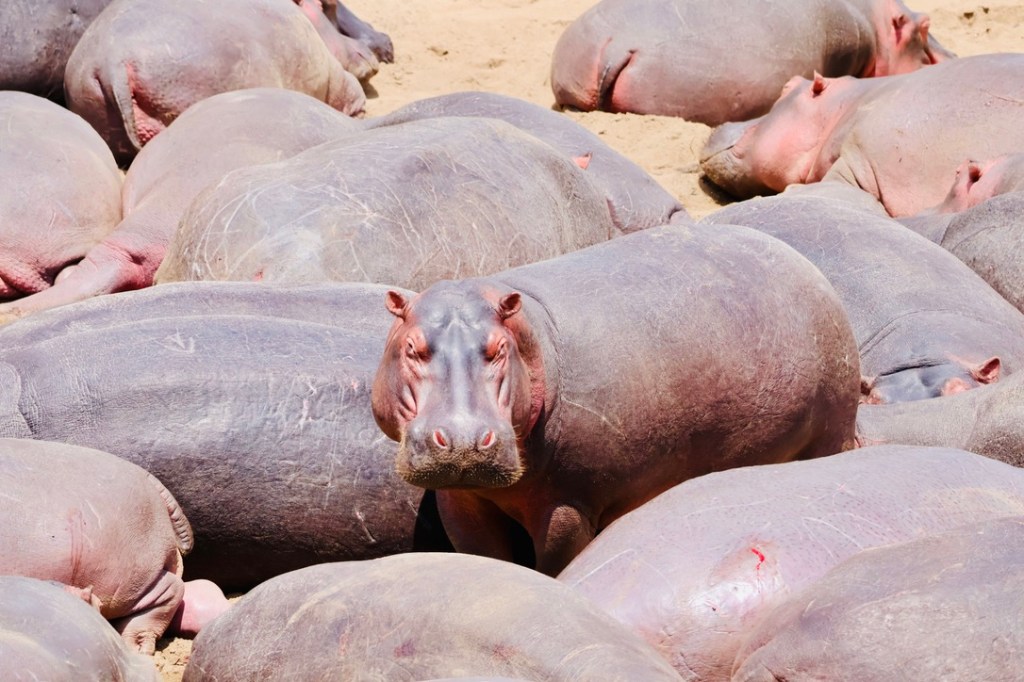
Instead we were greeted with 73 hippos (yes, we counted) sunning themselves on the banks of the river, alongside a couple of smaller crocodiles.
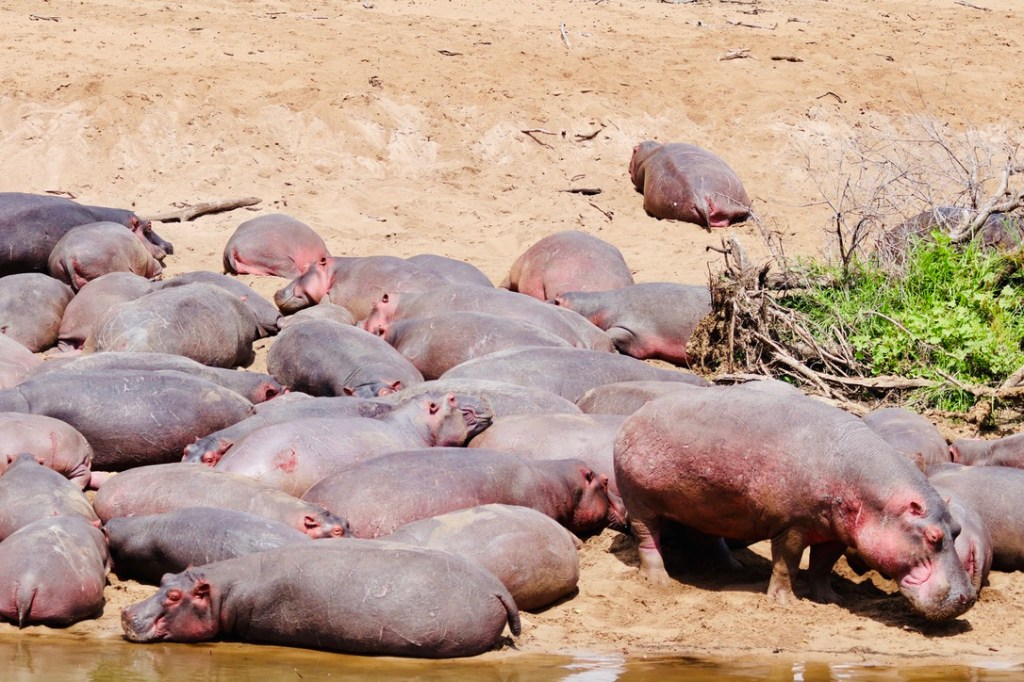
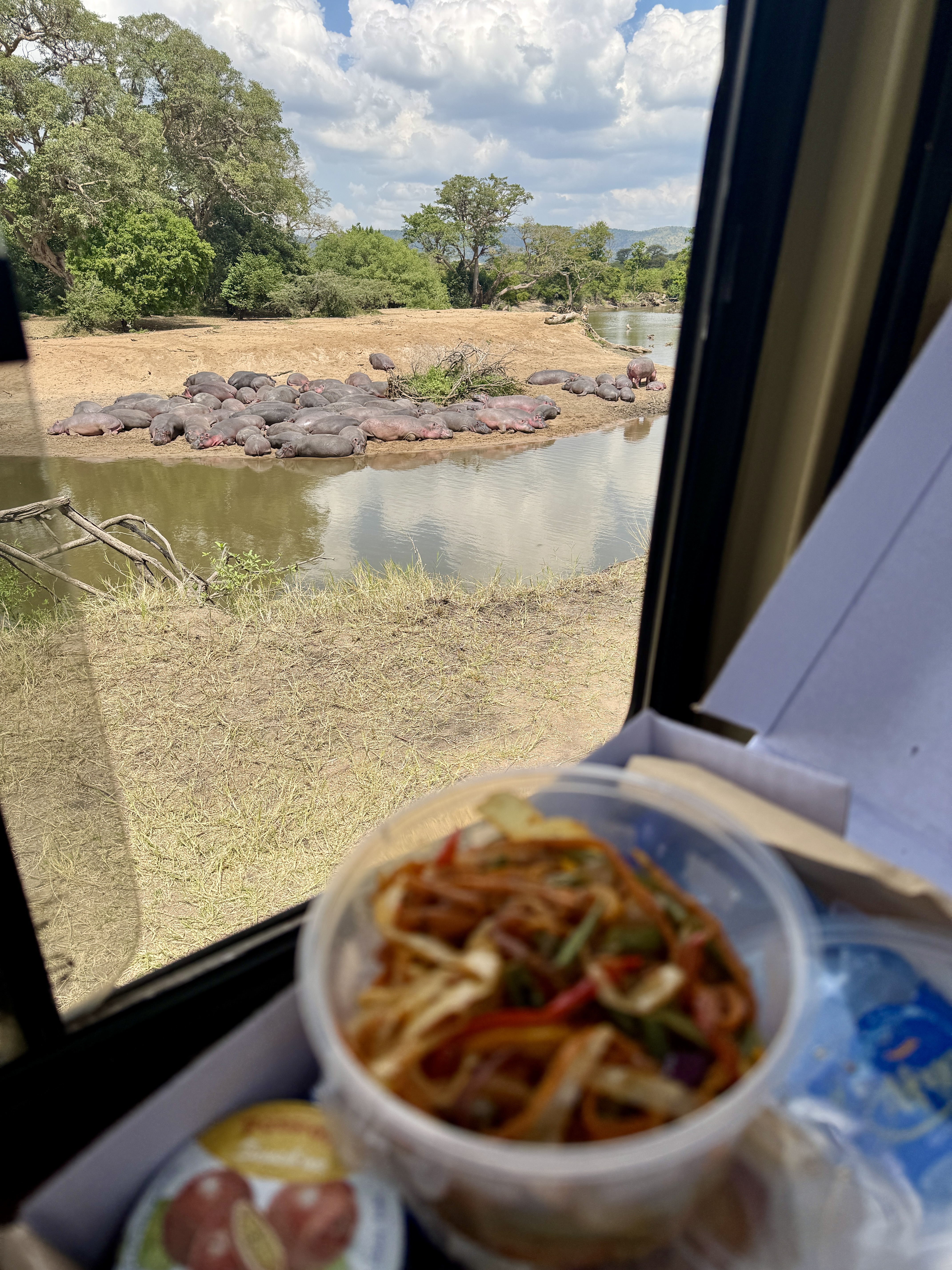
The size of these guys makes quite an impression, and also their colour (they are not just grey, the are in fact grey and pink). They were literally sitting on top of each other.
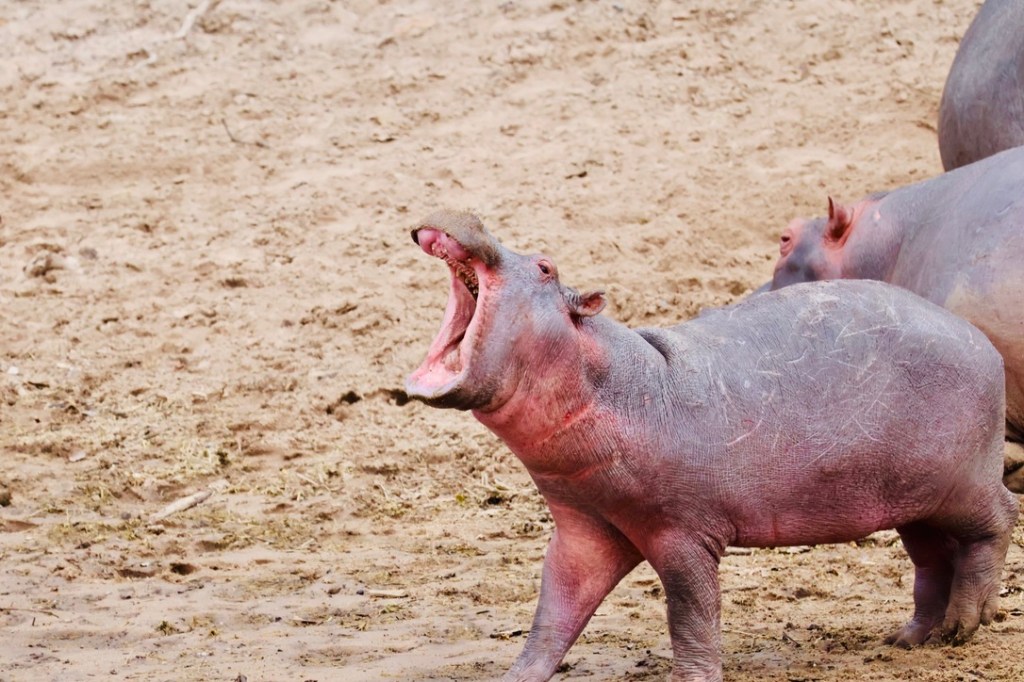
After a while they started to wake from their afternoon naps in the sun and meander back to the water, often yawning and showing their massive mouths and sparse teeth, and looking exactly like a cartoon hippo.
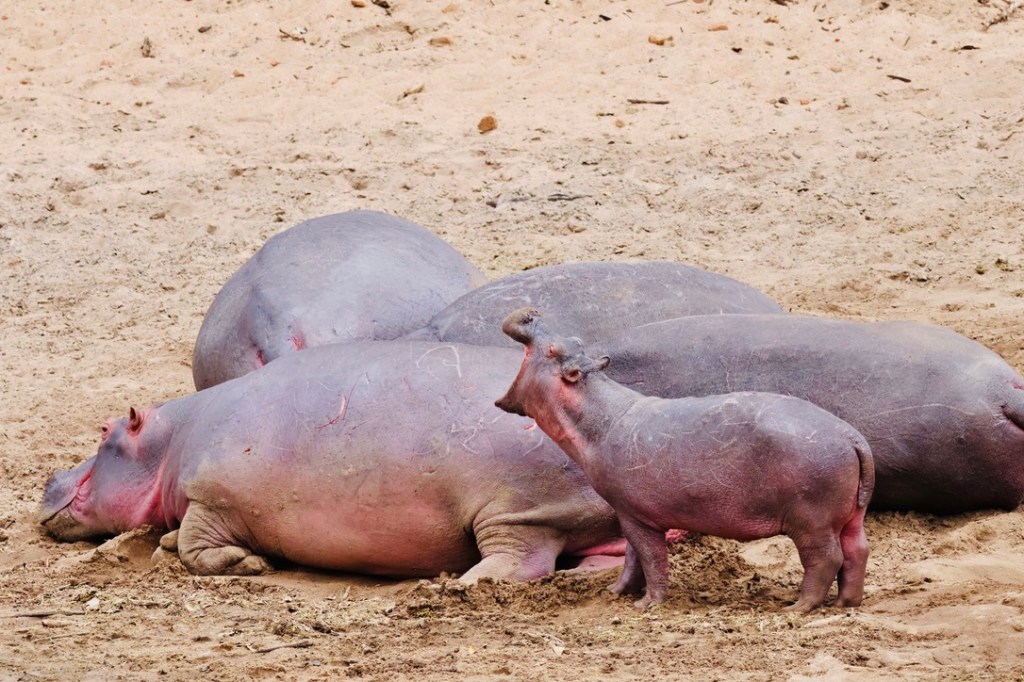
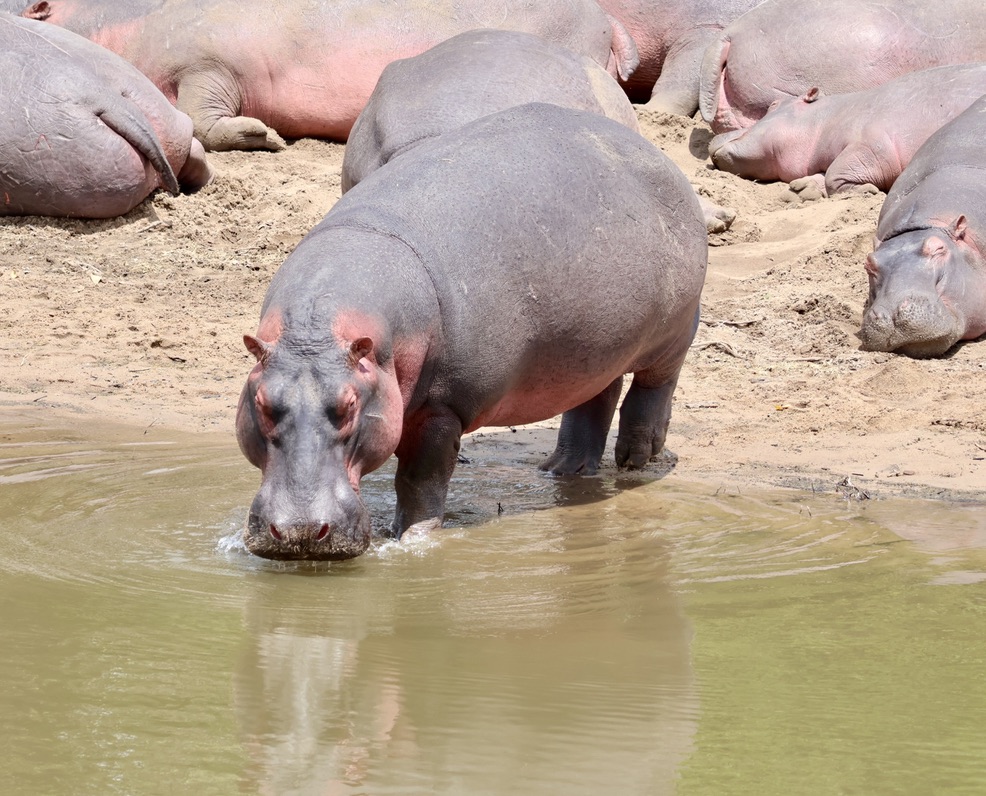
Quite the company for lunch.
After an hour or so we asked Malles ‘What are the options from here’. He responded ‘There are no options’.
We had ticked all the boxes and broken our guide. And his car. It was time to head back for a swim and watch the sunset for the last time.
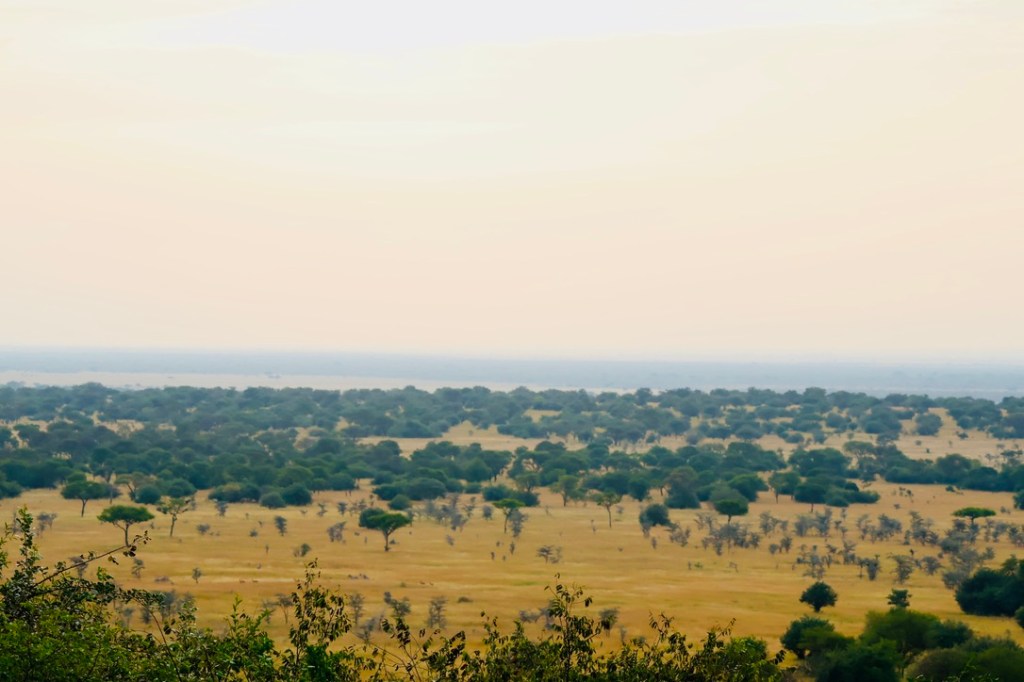
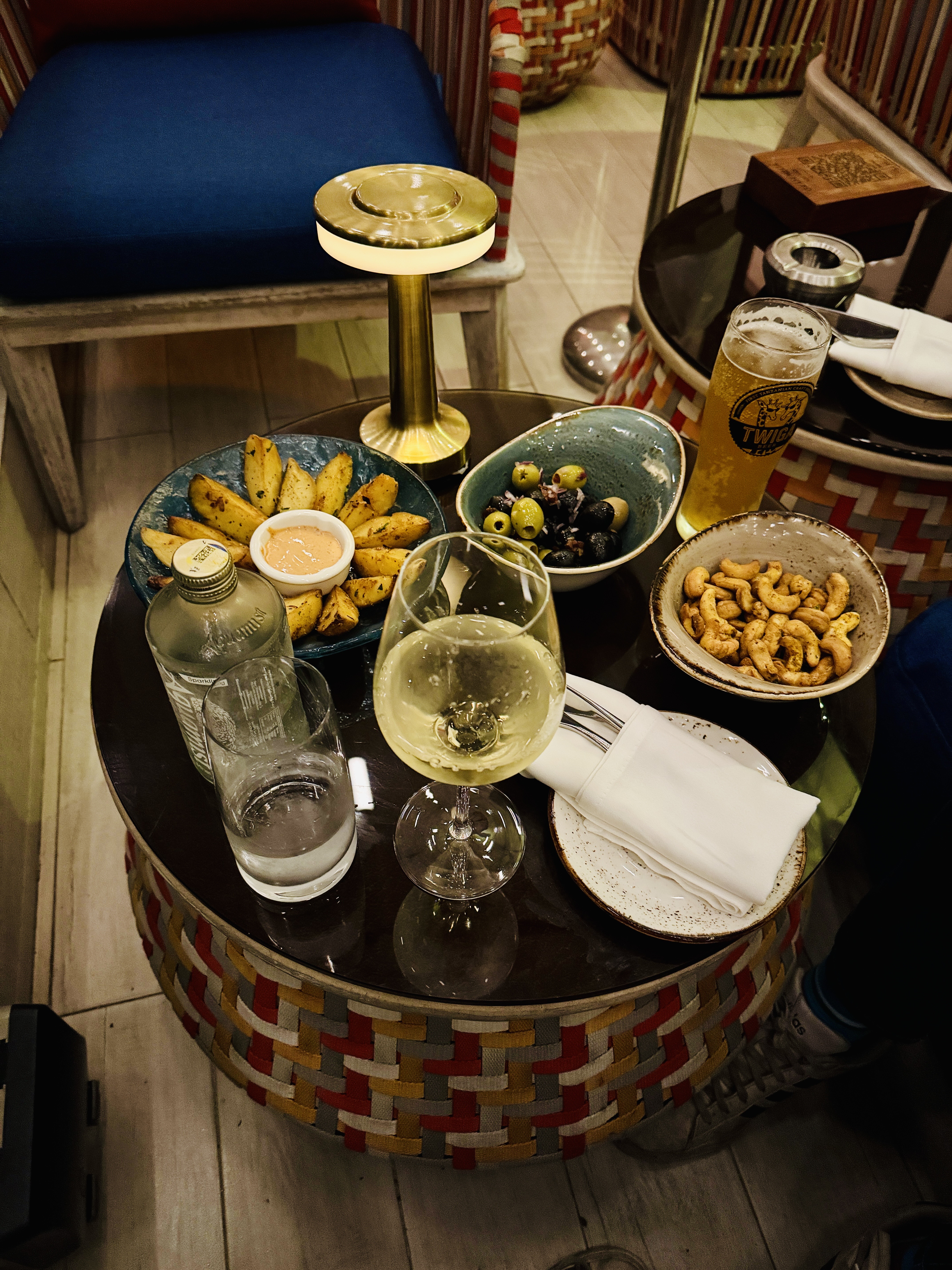
We were treated to a beautiful sunset over the Serengeti plain for our last night, enjoyed with a cold Kilimanjaro beer and some hot roasted cashew nuts.
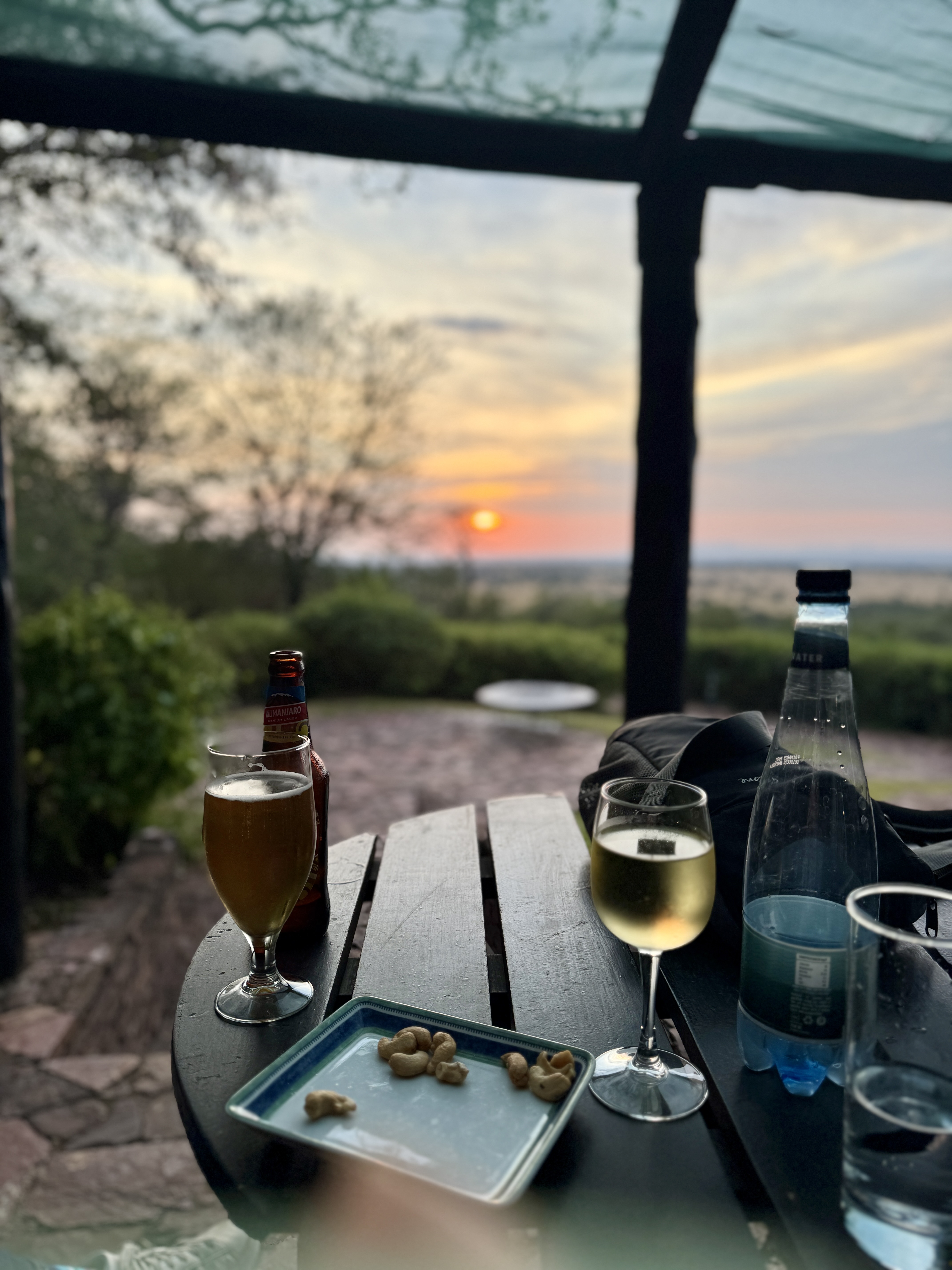
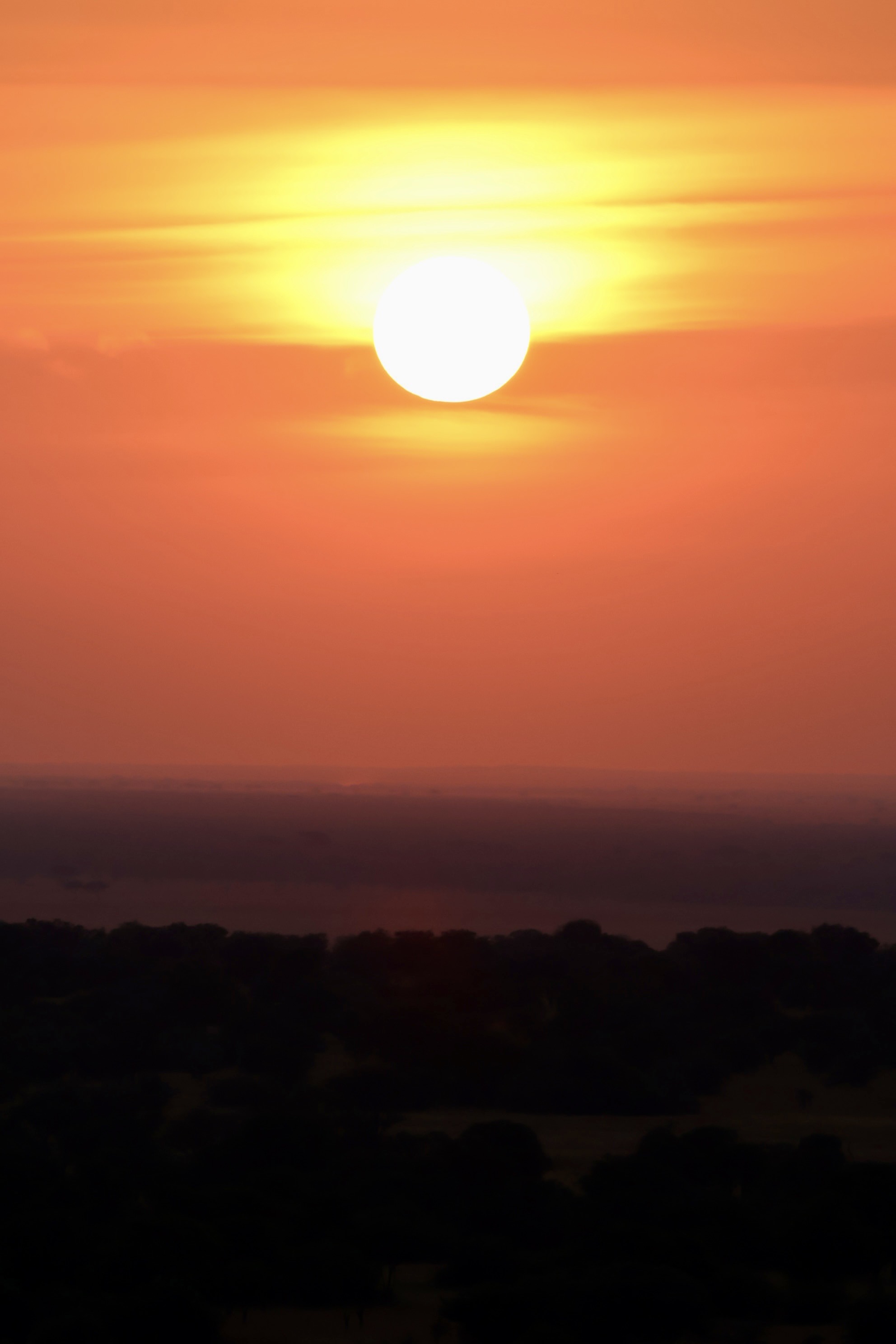
It didn’t get much better than that. Mother Nature then extended herself even further when she treated us to a thunderstorm after dinner and we got to watch the landscape light up under peels of thunder and sheet lightening, interspersed with spectacular fork lightening hitting the plain below.
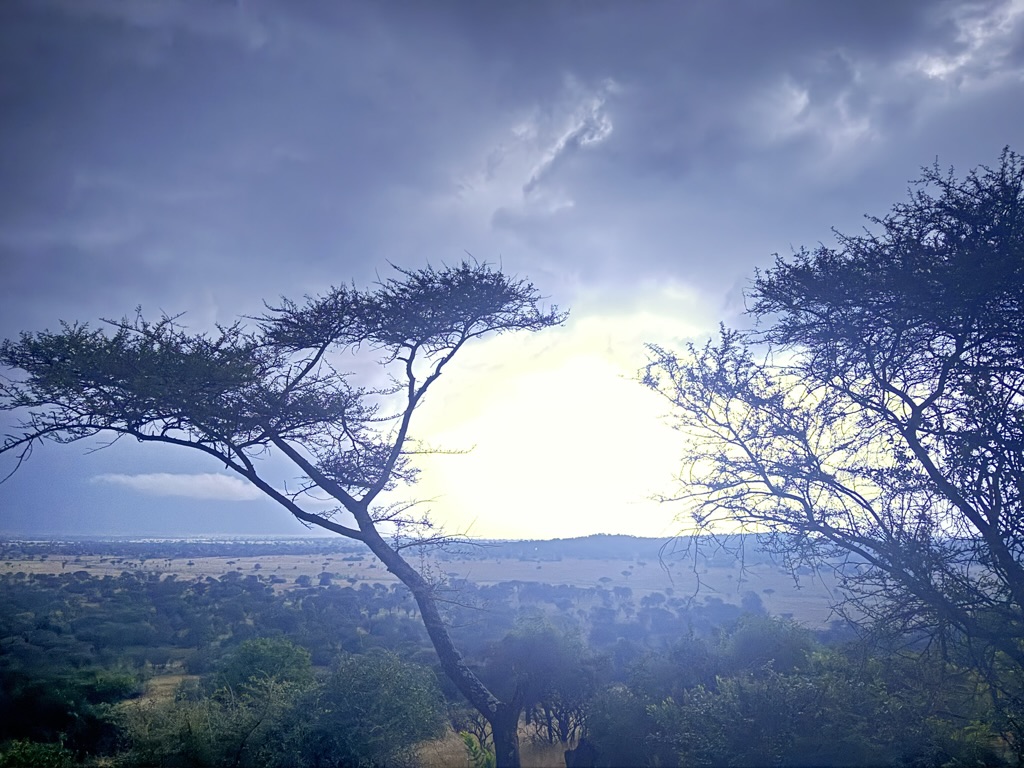
Quite the send off.
We were up early again for our last morning and on the road by 6am – still dark. The question on everyone’s minds, of course, was whether the car would make it the bumpy, 3 hour drive back to the Seronera Airstrip, and would Malles?
We cut a deal with Malles – we would keep the roof open to enjoy the sunrise and watch any passing wildlife and, in exchange, we would resist the temptation to ask him to stop every time we saw a field mouse! (Sorry Malles).
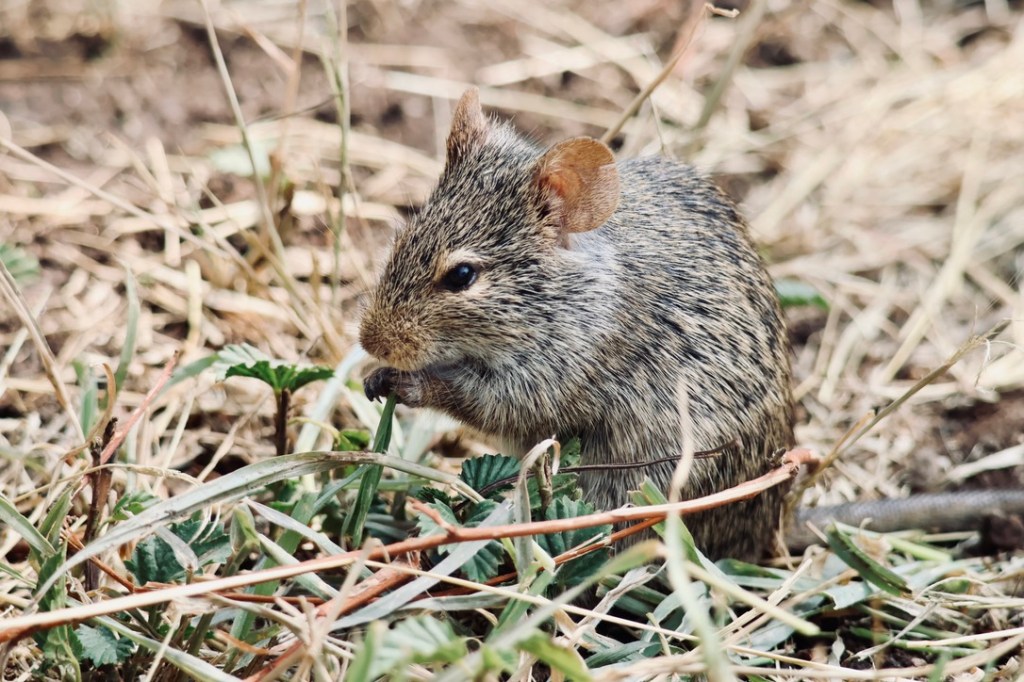
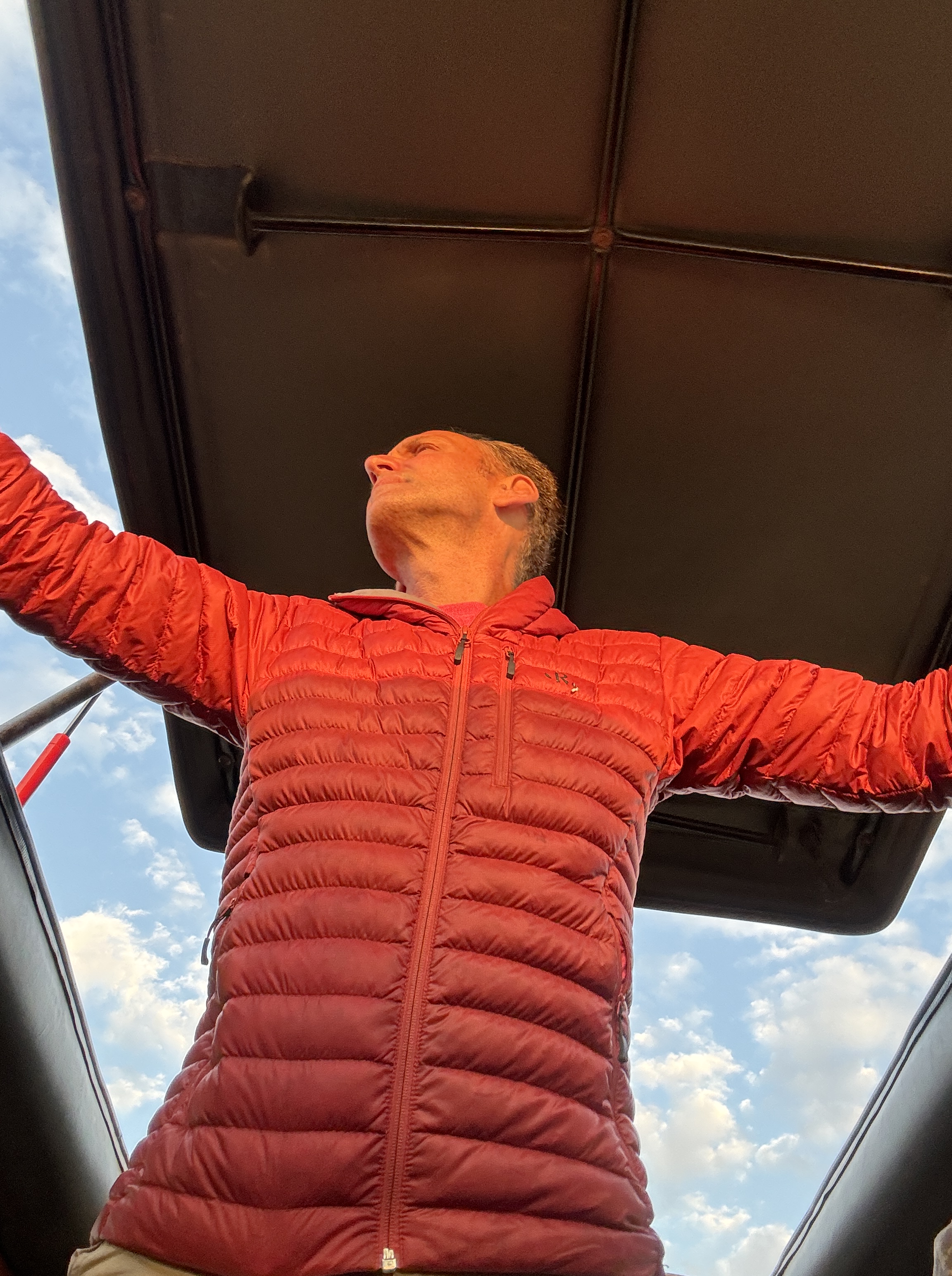
Begrudgingly he agreed. (NB: in theory, the roof is meant to be open for game drives only – from a safety and a car wear and tear perspective. The safety piece we could respect; the car was already worn and torn and we don’t imagine we could do any further damage).
As the sun rose of over the Serengeti for the last time (for us at least) we drove past another huge herd of wildebeest. So much for the theory that they had already all gone north – this was probably our biggest caravan yet and there must have been tens of thousands spread over a kilometre or more. We drove to the front and watching them cross the road immediately behind us by the hundreds.
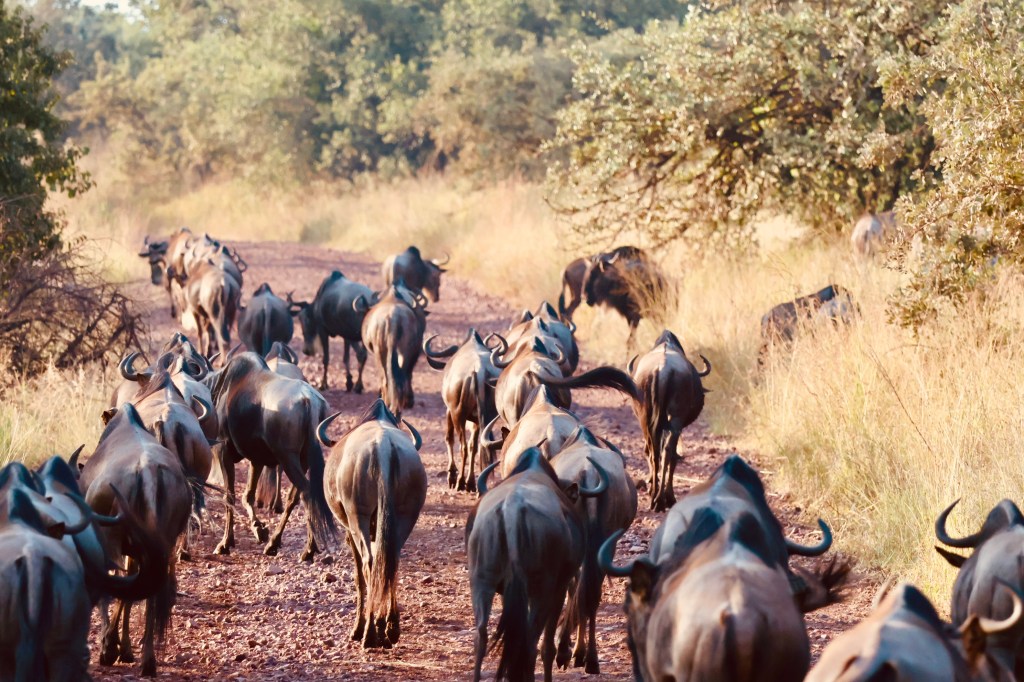
We looked to our right and saw 2 male lions closely following the procession with hungry interest.
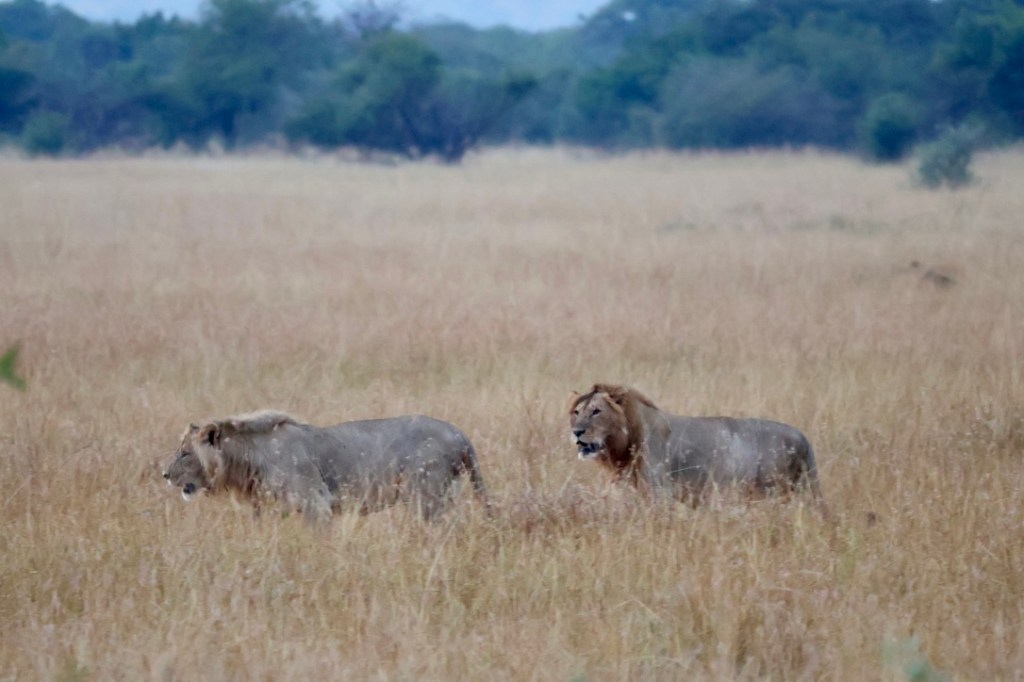
They casually wandered across the road behind us and approach the wildebeest with a level of coordination befitting a platoon of marines.
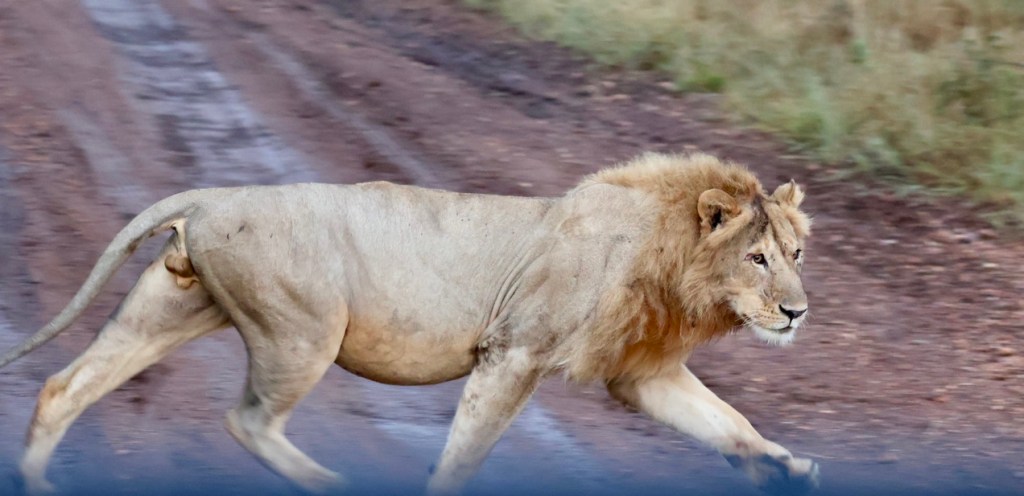
They stalked across the long grass, approaching the caravan (which was a couple of hundred metres from us). The wildebeest caught the scent of the lions, their braying increased to fever pitch and the caravan split into 3 groups. The front group kept pushing forward to safety. The back group held back out of the lions’ reach. The middle group clustered together, terrified and braying loudly. The lions split off from each other, one going around the back of the group, the other edging forward in the long grass.
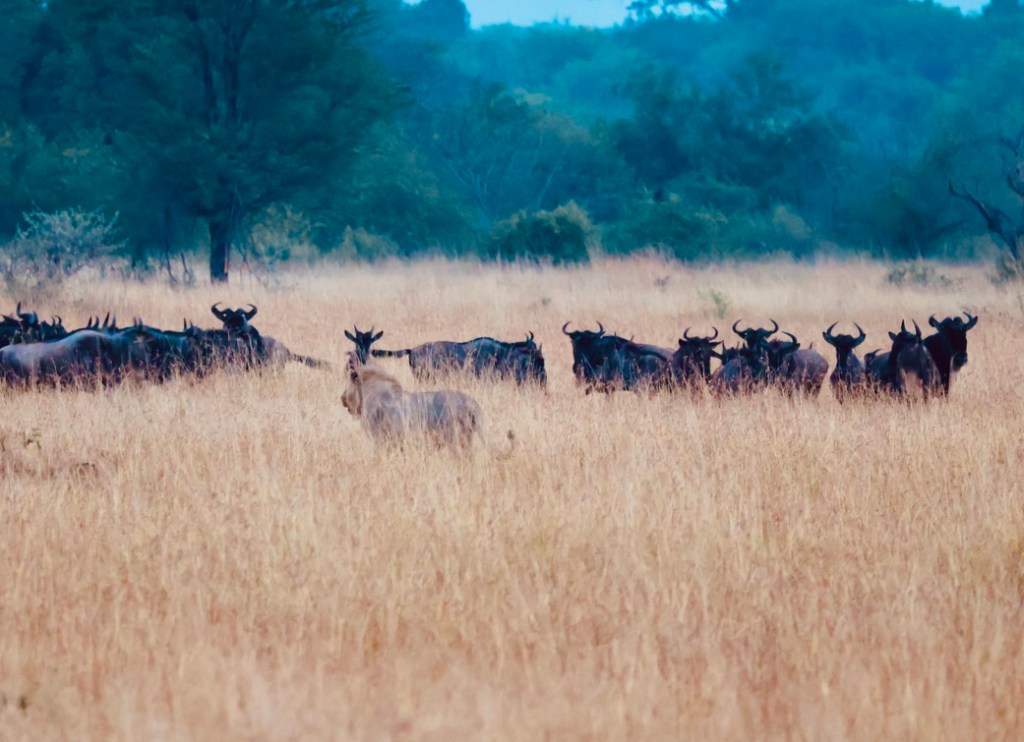
It was all happening in the distance – visible only through binoculars.
Malles, watching the clock of our flight and his 12 hour drive home decided enough was enough, and we drove off. He was a broken man and we didn’t push back.
We’re sure that the wildebeest invited the lions over for tea, they worked through their differences and all lived happily ever after.
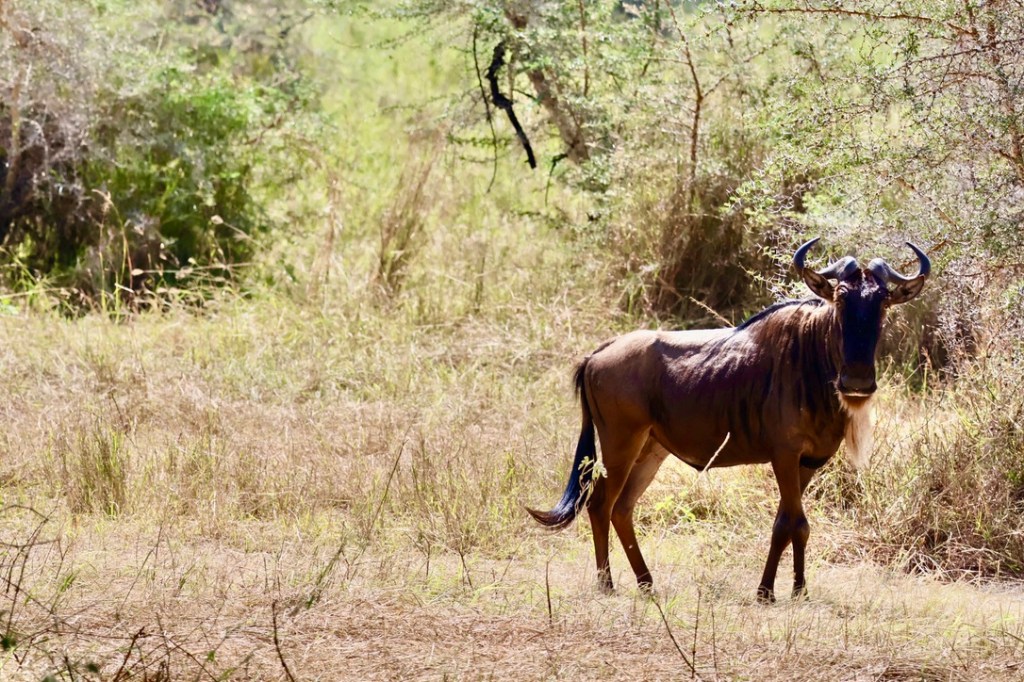
As the sun climbed in the sky our drive continued past another 3 massive herds of wildebeest, 2 heading north towards the Masai Mara, the other smaller group strangely heading south. We’ve heard more than once that wildebeest aren’t smart and maybe this reinforces that. But having seen how they interact and look after each other, we’re positively in the pro-wildebeest camp, and won’t have any bad words spoken about them.
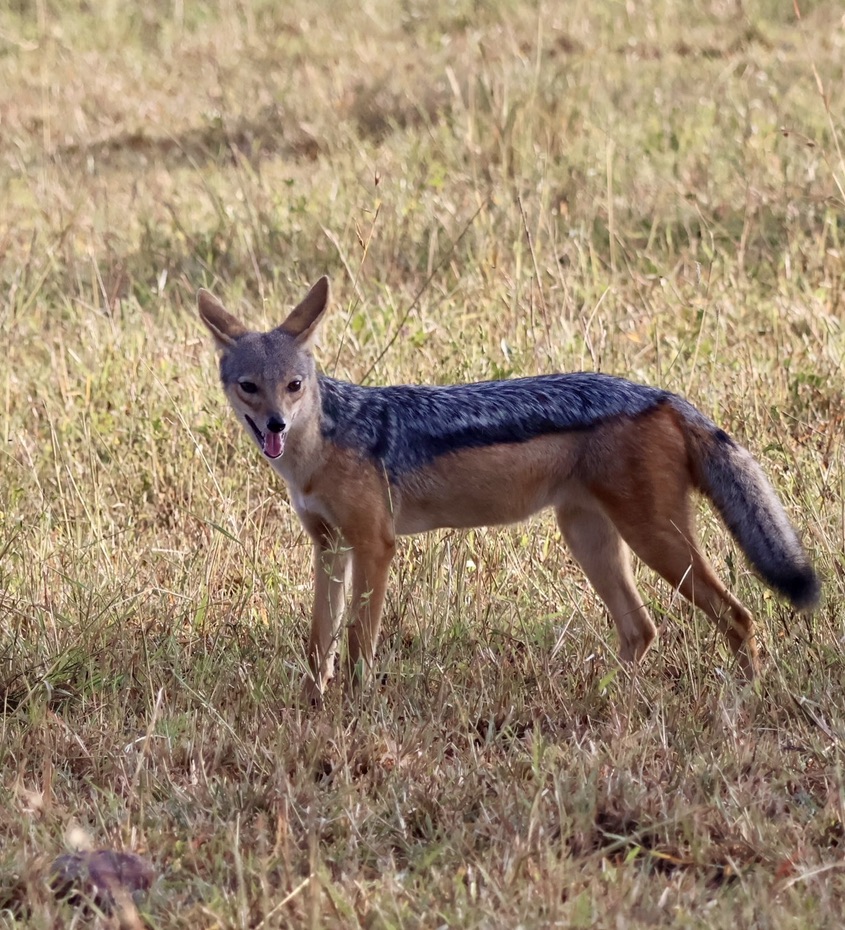
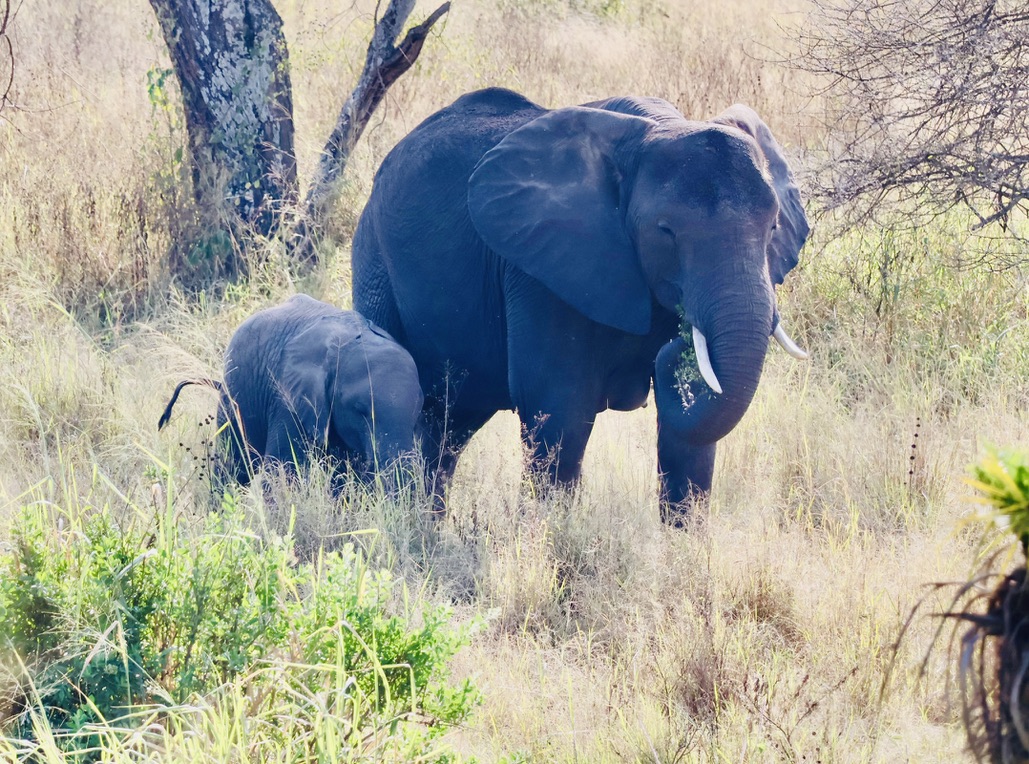
We also got to meet some hyenas and dikdiks (baby antelope) and say goodbye to a large herd of zebras, a couple of warthogs, a solitary hippo, a couple of lone giraffe and a beautiful herd of elephants, including a baby. We literally couldn’t have asked for more from our last drive.
As we got closer to our destination, Malles seemed to get a new lease of life. After driving pretty conservatively after the course of the last few days, he turned into Fangio, pushing his broken Land Cruiser faster and faster down the bumpy dusty roads (there is a theory that the speed ‘flattens out’ some of the bumps, but we assume that is for cars with all 4 shock absorbers in place). Ant was hanging on for dear life with his head out of the roof, craning to see the last animals.
Some 5kms from the air strip and inevitably, Malles tried to bounce over one rock too many. We heard a pop and then a hissing sound that we knew too well. That would be the second flat – this time on the front left.
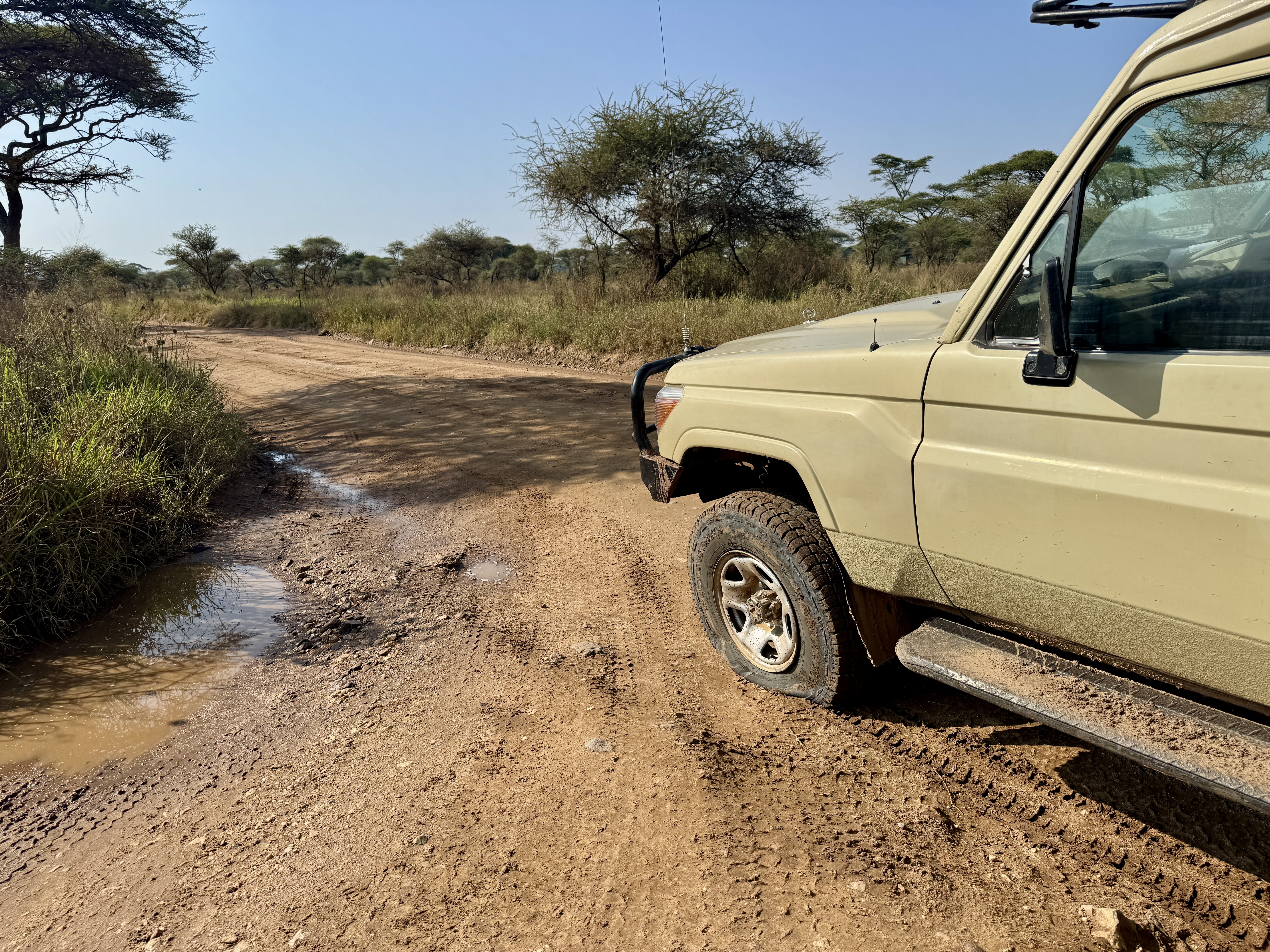
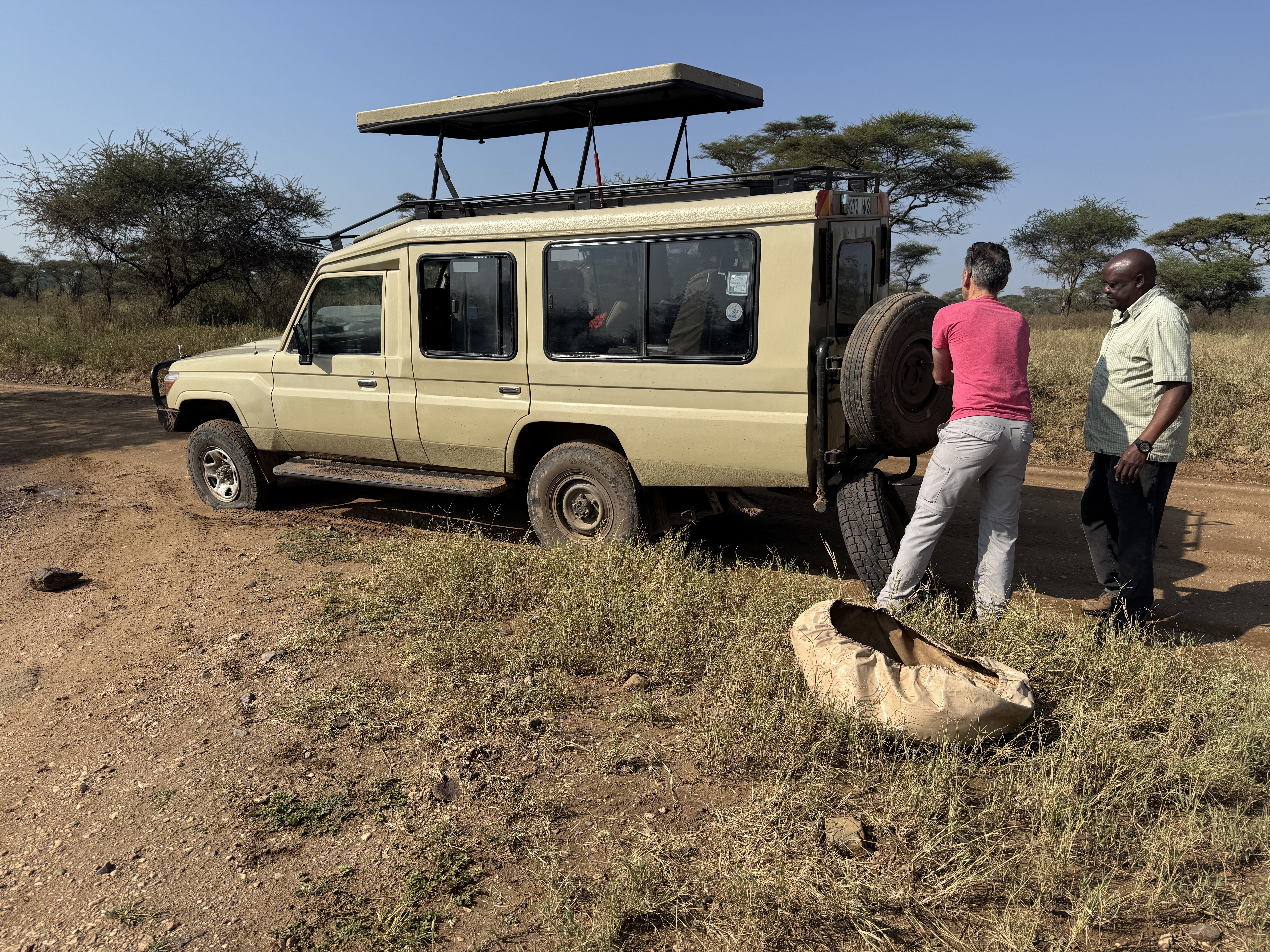
We stopped and jumped out – we knew the drill.
We got the car up on the jack, uncovered the second spare tyre cover and tried to unscrew the bolts holding it into place. Unfortunately these were not the standard size bolt, and Malles didn’t have the right size spanner to unscrew them.
So we were stuck.
Well, to be honest, Malles was stuck; we had a plane to catch in 90 mins.
He flagged us down another Land Cruiser and we said a rapid goodbye. We were bundled into a new, a significantly more roadworthy vehicle and he was left to find another spanner. Or another tyre. Or perhaps another car.
We hope he makes it home tonight.
In the meantime we boarded our Cessna Caravan 12 seater for the hour long flight to Arusha.
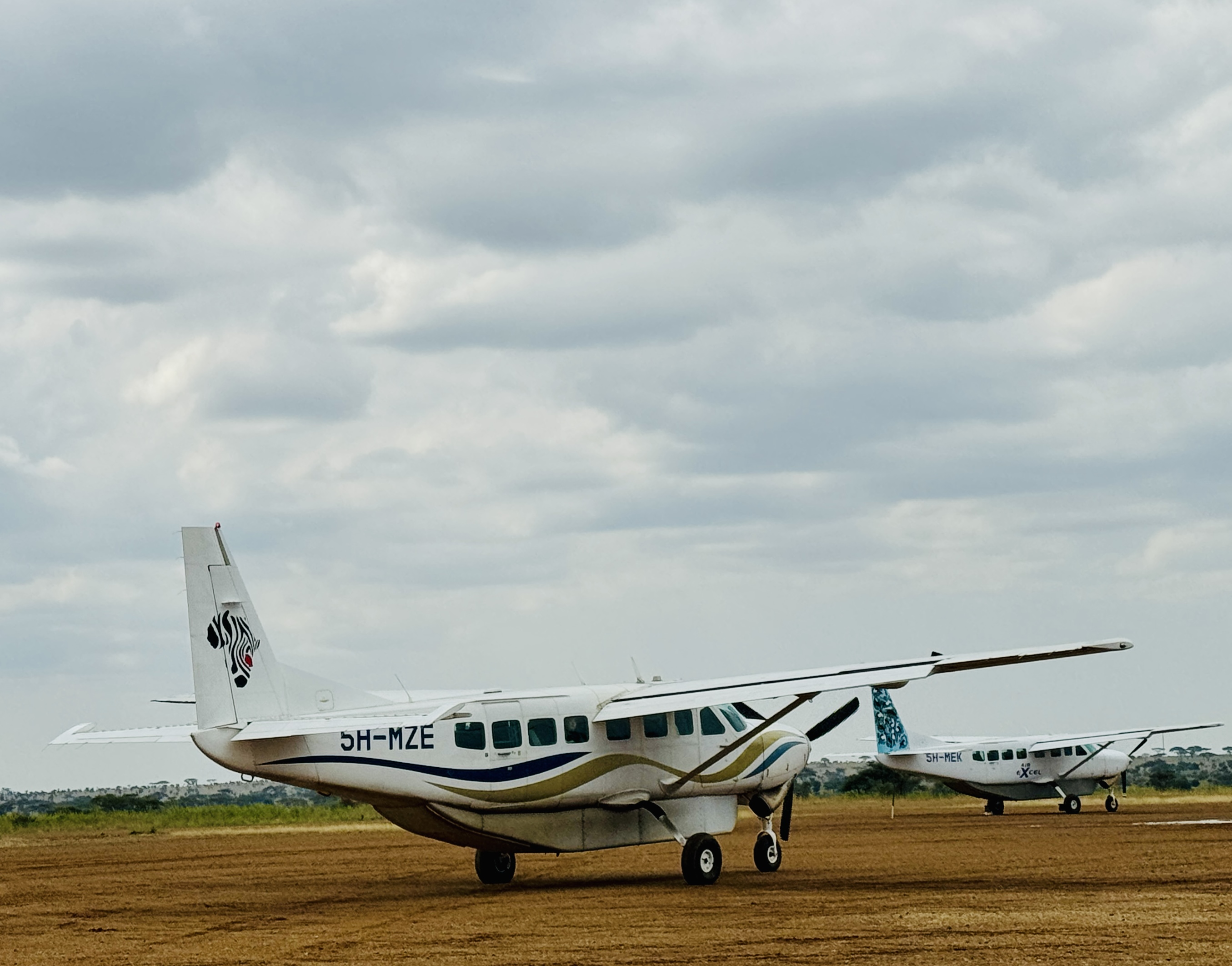
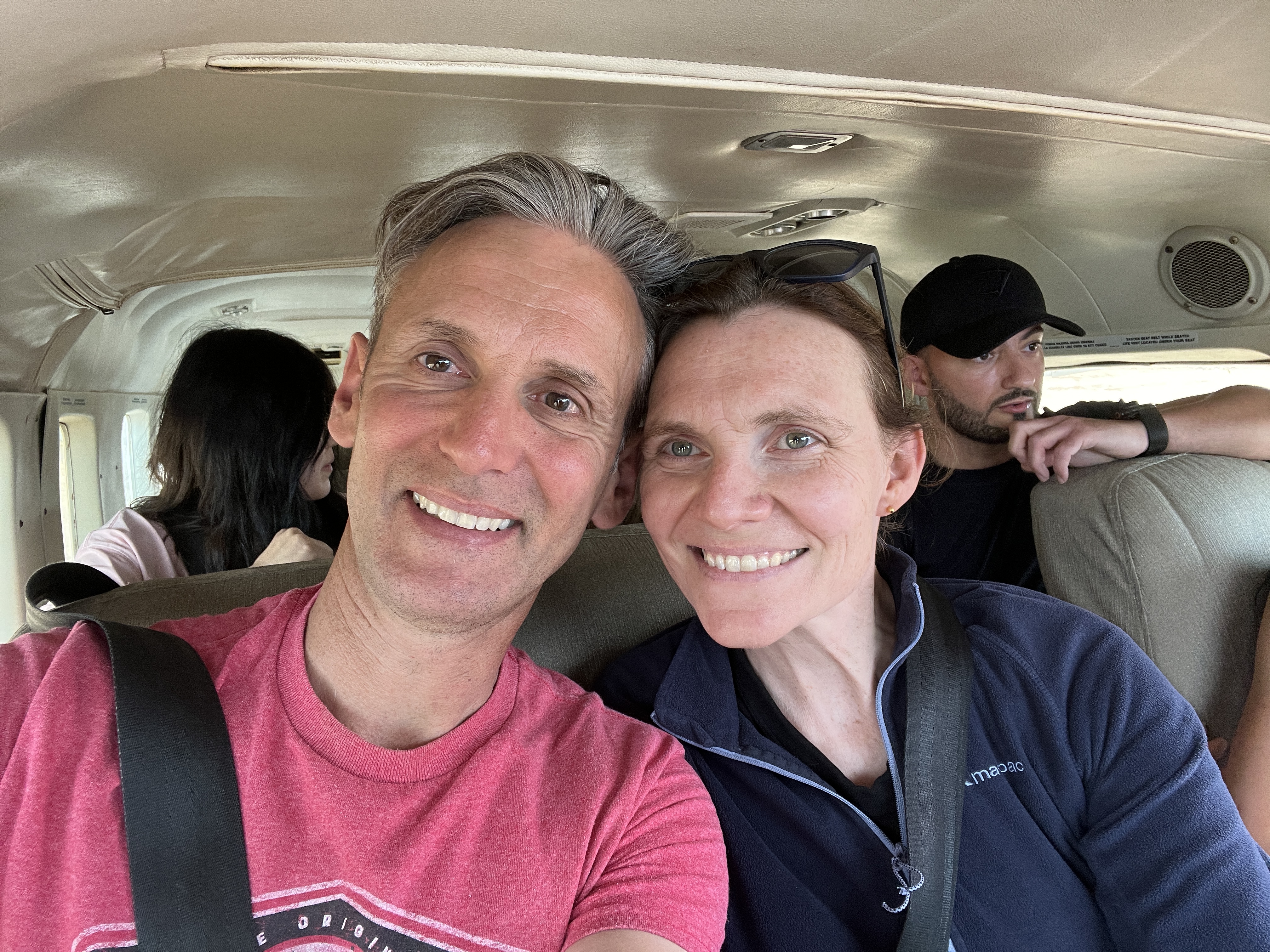
The plane was definitely the same vintage as our now abandoned Land Cruiser, and appeared on first inspection to have as many issues. The pilot, on the other hand, was at the other end of the generational spectrum to Malles. He would definitely getting carded going to an Australian bar, and would as likely as not be refused service.

Age notwithstanding, he seemed to know what to do to coax the old Cessna airborne and we were soon flying over the Serengiti with an amazing view of the fields below. The clouds enveloped us just above the Ngorongoro Crater, so we didn’t get a last look at that, but before long we were touching down smoothly at Arusha Airport.
Even Liz, now that she’d started breathing normally again, acknowledged that this was a preferable option to 10 hours of bouncing down bone/car shattering dirt tracks to get back.
We got picked up at Arusha and whisked across to Kilimanjaro Airport via a quick stop for lunch.
We endured the now expected 2 hours of queuing, multiple security and passport checks that is expected in this part of the world, and eventually boarded our Qatar flight bound for Doha then London.
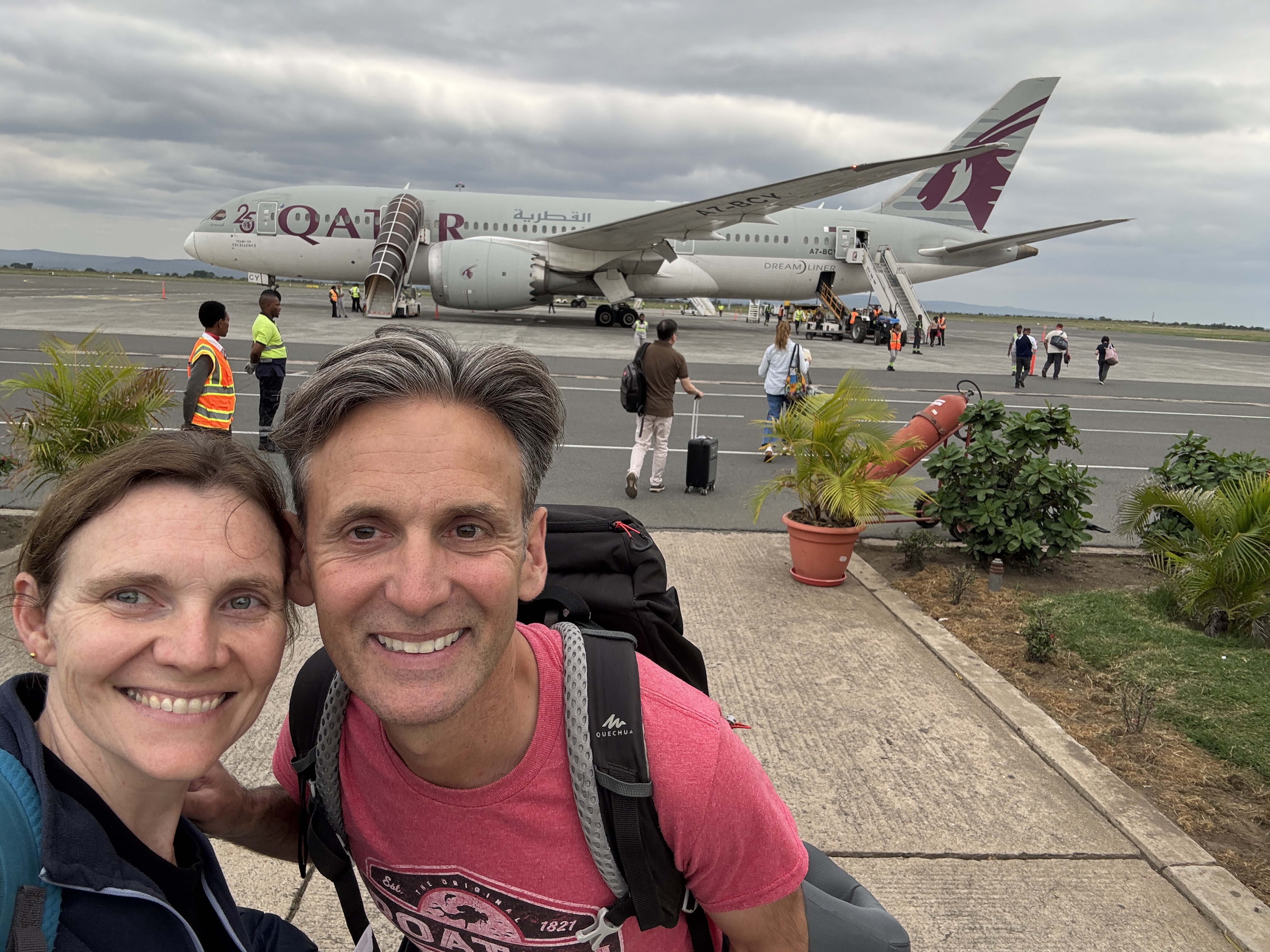
That is assuming the escalating conflict between Iran, Israel and the US doesn’t escalate whilst we’re in the air and close Qatari airspace.
Our 8 day African extravaganza had been an awesome experience.
We had experienced a totally new region for both of us, had a number of new and incredibly memorable experiences and had the wonderful opportunity to spend some quality time together without the kids – in a number of genuinely exceptional places. It doesn’t get much better than that.
Sorry girls – we love you but it’s nice to have some time just the two of us too!
There’s no doubt the trip was short, but it actually felt like it went for ages – probably because we moving so much and doing lots of different things. And, to be honest, I don’t think we needed a lot more time in the places we visited. There’s always additional things we could have seen, but that’s a very slippery (and expensive) slope. It was a short but perfectly formed break.
Now it was time to go home and see our girls, thank the dog sitter/nannies and various local families who helped keep the girls on track and afloat whilst we were away and, of course, start planning the next trip!
Addendum:
Our 787 Dreamliner made it’s way north over Uganda and into the Sudan, cutting it’s way briskly through the clear evening sky. We were making good time – planning to arrive in Doha 30 minutes early which would ease our planned rapid transfer. Liz had just enjoyed ‘the best meal ever on a plane’ before settling in for a movie and maybe a quick nap. Things were looking good.
Suddenly the cabin lights were turned up to full and we were awakened from our movies or naps to the sound of the Captain’s voice – Qatari airspace was shut and we would be landing in Jeddah, Saudi instead.
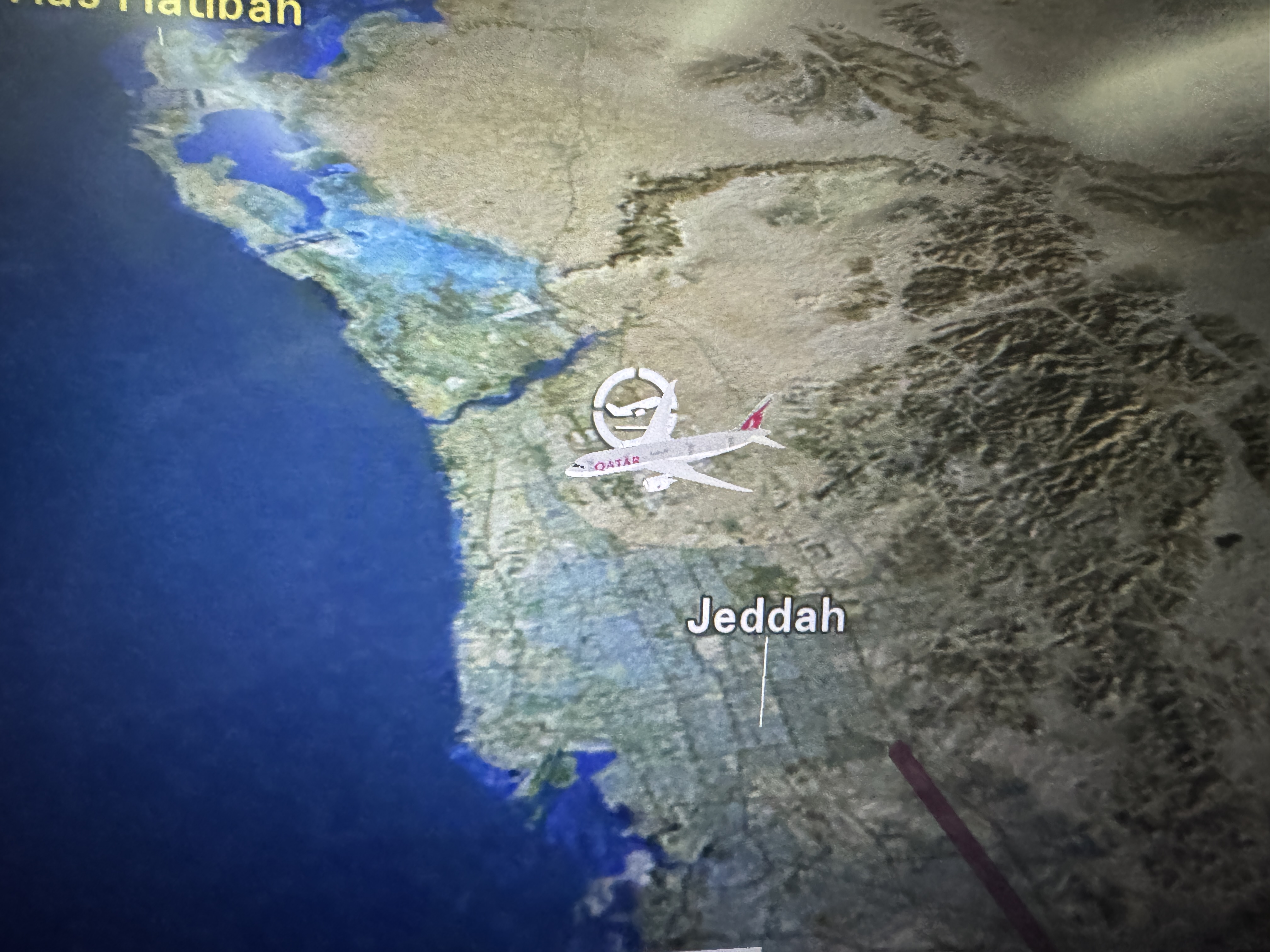
No reason was provided, no details of duration or plans once we landed. Cabin crew looked decidedly unsettled and a little panicky.
Our minds were left to wander of the reason during the 40 minute approach over the Sudan and the Red Sea.
Obviously there was a war going on between Israel and Iran, and the US had just bombed Iran’s nuclear enrichment facilities. How serious was it for the Qataris to shut their airspace?
NB: many other countries in the region had already done the same, and many western airlines were not flying through the Middle East this week… but Qatar typically had a higher threshold for such things.
How serious was it?
We landed in Jeddah, the autonomic cabin crew announcement welcoming us to Jeddah like it was always the plan. Still no reason as to why, or for how long. We pulled down our cabin bags and stood up, waiting to disembark.
We jumped online and read about the well telegraphed tactical strikes Iran had unleashed on US military bases in Qatar. Seen by most as a measured response to the US bombings, it was still enough to close Qatari airspace.
We started booking accomodation in Jeddah, looking at creative routes to get us home the following day and pondering what fridge magnet we would buy.
Still no word from Qatar. The only advice we got was to sit down whilst we waited for ground crew and further instruction from Qatar customer service.
Passengers around us were canvassing opinions and theories as to why (bombing strike, or something more serious? Armed with our BBC app, we were suddenly filling the news vacuum for our fellow travellers.
Over the next 2 hours a number of other Qatar planes arrived in Jeddah and parked up next to us.
Like us, no one got off. We just sat there. In silence and without any guidance as to what was going on. Communication was clearly not their strong suit.
After 4 hours on the ground the radio crackled to life and the Captain informed us that Qatari airspace was opening up, and we would soon be bound for Doha.
This was welcome news indeed.
Back in the air for another 2 hours as we flew across Saudi to land uneventfully in Qatar at around 3am. We were shattered and bracing ourselves for the inevitable chaos that we assumed we would walk into as Doha Airport tried to recover from it’s 8 hour lock down.
Not in our wildest dreams could we have anticipated the sheer magnitude of the chaos that ensued.
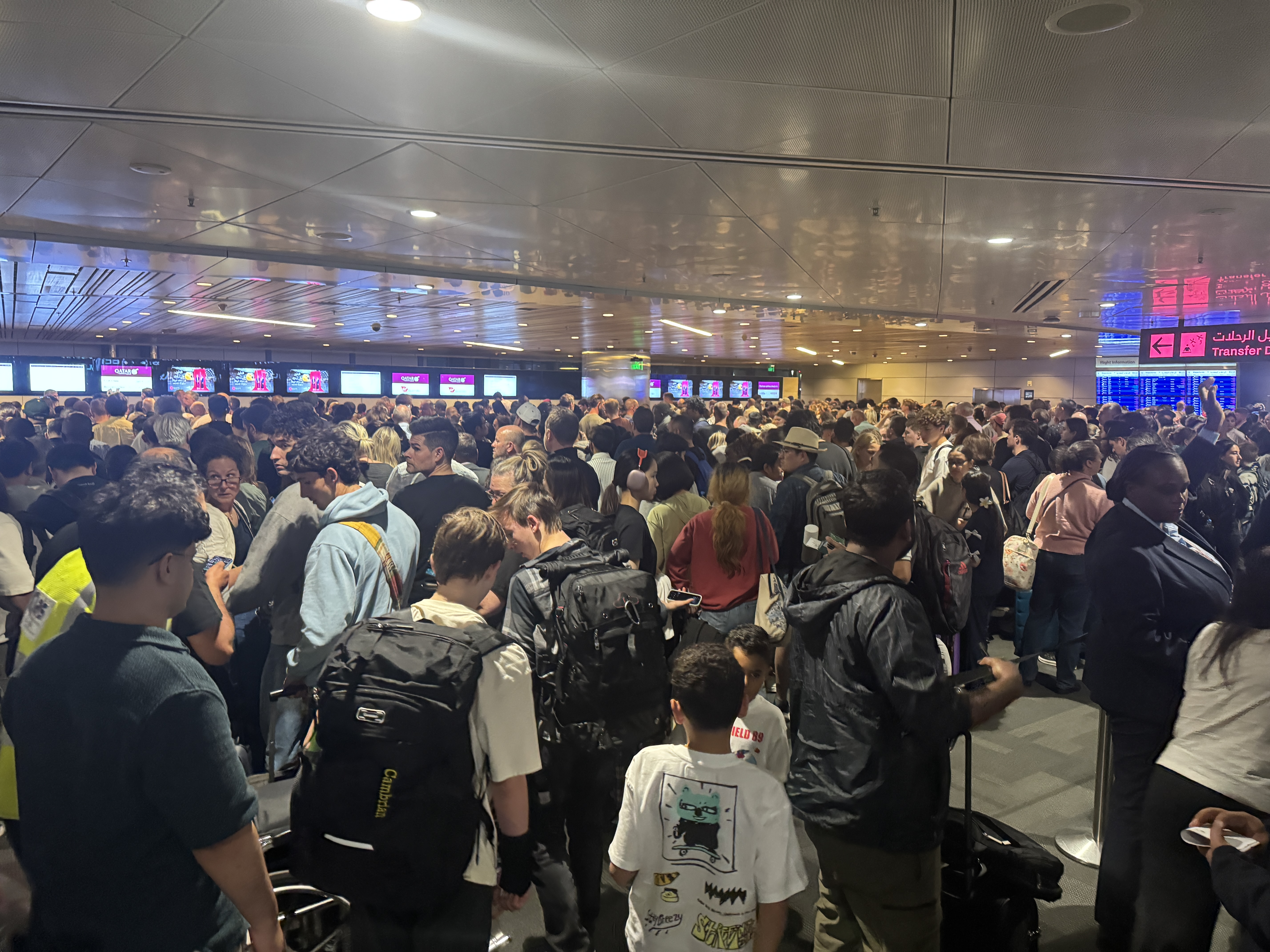
Doha Airport is always busy transiting passengers from all over the world, but it is normally orderly and smooth.
Not today.
Literally thousands of people were milling and pushing around the 5 transit desks. At 3am the line was already snaking through the terminal, it would grow exponentially over the next few hours as more flights landed.
No flights were leaving. Flights were either indefinitely delayed or cancelled, apparently at random. There was no communication in the airport, signage was not keeping up with the fluid situation, crowd control was non existent and staff not trained. The IT system failed at one point, bringing everything to a standstill, and the website was not accessible from within Qatar (presumably due to high volumes of traffic).
Literally the whole airport and airline was failing before our eyes.
Initially we thought we were one of the lucky ones with a flight that was delayed rather than cancelled and needing to be rebooked.
We went through transfer security and into the main terminal, making our to the gate. Only when we arrived at the gate did we realise the error of our ways, and that there were 2 Qatar flights leaving Doha at the same time, and sadly ours had been cancelled.
At this point we split up. Liz parked in a line in front of a kiosk in Terminal A with one very frazzled customer service agent painstakingly working through rebooking customers – each one taking him about 15 mins. Liz joined the relatively orderly queue at about position 25.
Ant went back up to the main transit desk, where the melee we’d seen when we first arrived had expanded exponentially as new flights had arrived with nowhere to go. Apparently the crowds in front of the transit desks welled to something like 20,000 (according to media reports), the tentacles of the lines spread out around the airport, around corners and disappeared off into the horizon.
Queue jumping was rife. Those who played by the rules were rewarded with 5+ hour wait times to get tickets changed. Each time the lines merged (which happened frequently) or someone was caught queue jumping (pretty much constantly) a fight would break out.
I thought I’d be there for around 3-4 hours. I hadn’t anticipated the impact of the ‘tributary’ lines flowing into the ‘main’ line that I was in… which completely broke the process altogether. Half hearted attempts from inept or disinterested security personnel did little to streamline the process.
We passed the time texting back and forth brainstorming options and talking to Adam, seeing if we could activate Qatar Australia to help us out (sadly not on this occasion).
After almost 4 hours I had progressed about halfway down the line but then come to a complete stop, making no progress for at least 30 minutes. The airport was broken.
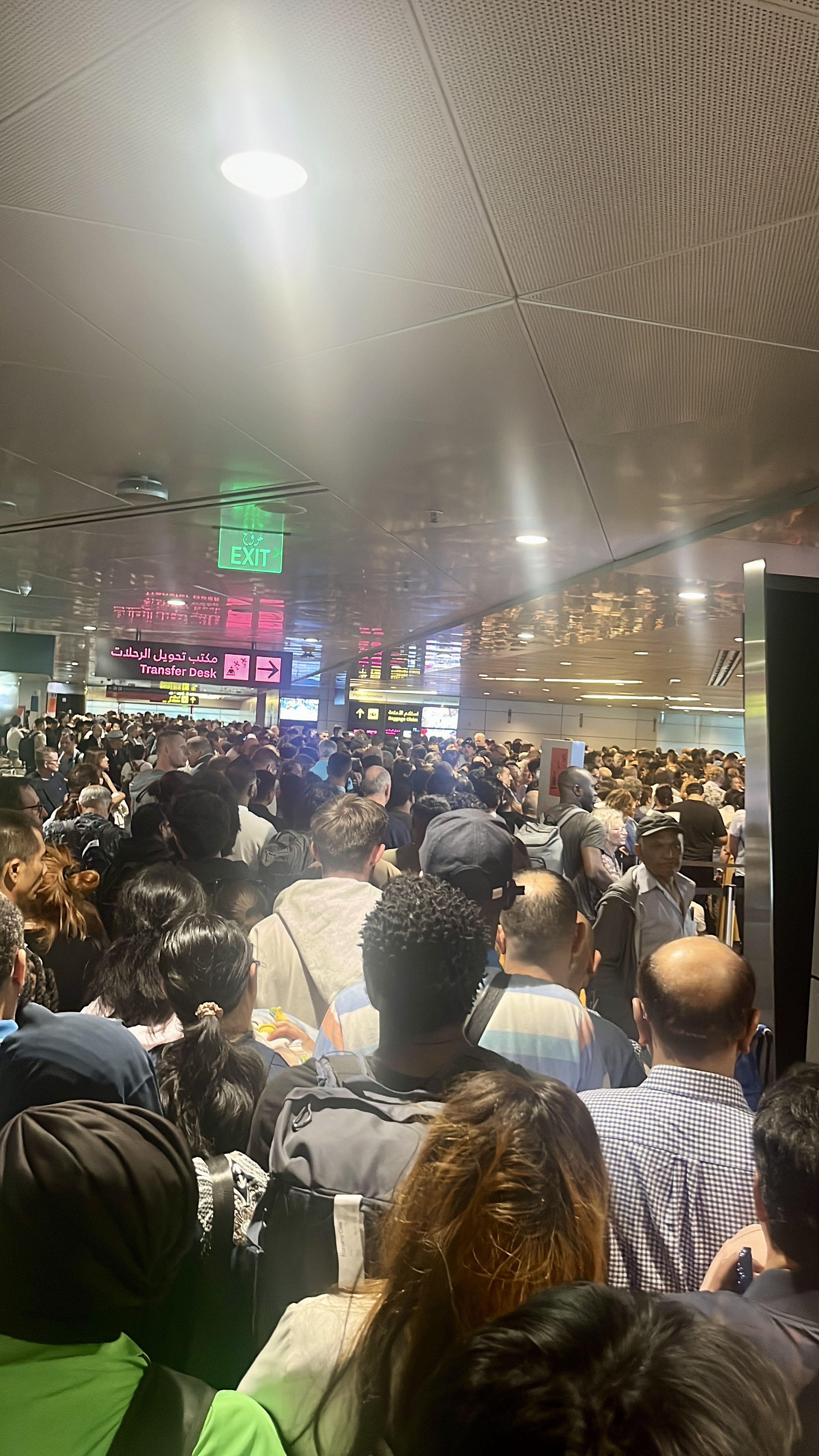
Luckily Liz was having a bit more luck in the ‘smaller’ line downstairs, which was still being serviced by the solitary staff member who was rapidly becoming a workers comp stress case. Whilst I was stuck in an increasingly febrile environment some 60 meters from the transfer desks I got the call that Liz had made the front of her queue.
I pushed my way through the mob and ran downstairs, flooded with relief at having some semblance of personal space back. The scene that greeted me as I made my way through towards the transfer desk outside A3 was from a dystopian novel.
The line now snaked its way several hundred meters towards the desk, populated by a collection of weary travellers broken by disrupted flights, unscheduled stopovers and glacial lines.
As I approached the transfer desk it became more like the Hunger Games with angry travellers mobbing the desk, thrusting passports and boarding passes at the two (yes, they’d managed to find reinforcement) harried looking staff behind the desk. There was yelling, screaming, begging, cajoling, arguments, stories of woe and injustice and more than a few tears.
To be fair to the stressed out looking staff member, he was trying to serve those who had been queuing ahead of those who had approached the desk through more nefarious means. In the middle of it all was Liz, elbows out, ‘reminding’ her fellow travellers of the line that snaked behind her and into the distance along the terminal.
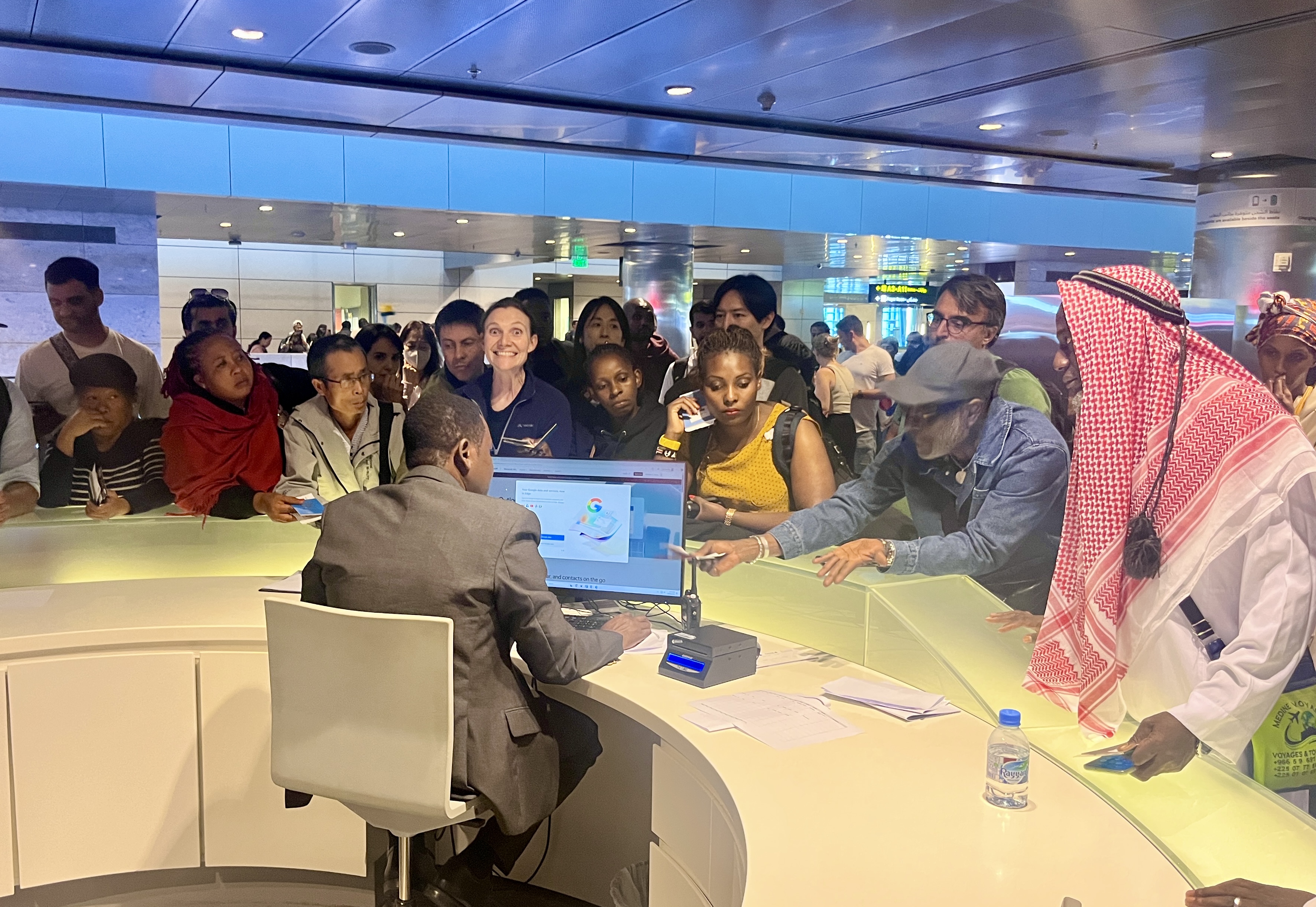
I thrust my passport and boarding pass into her hands and retreated to ‘behind’ the circular desk where I could watch the painstaking process that our hero (read the harried employee changing the bookings) work through to change our flights. He stumbled through a number of welcome windows on his Windows 95 UI, had to login to 2 separate systems but eventually found us seats on QR001, departing for LHR at midday.
It was 10am and we’d been at this for almost 7 hours. We were exhausted but happy to have a boarding pass in our hands.
We were going home – and we’d even have a chance to see the girls tonight.
Happy Happy Happy.
We quickly grabbed some food and made our way to the gate for our 11am boarding.
Happy Happy Happy.
We then noticed the number of flights that had actually taken off this morning. None. All the UK flights that were meant to leave this morning were still yet to board. The only activity on the board was the continual rolling updates of increasing delays.
The airport was broken.
Our initial enthusiasm waned, along with our chance of seeing the girls tonight.
We spent the rest of the day doing our best impressions of Tom Hanks in The Airport. We stretched out (wtih the majority of other passengers) and snoozed on the floor. We ate bad food (some of which, to be fair to Qatar, was subsidised), we turned the terminal into our offices and did a bunch of work. We finalised trip photos. We commented on the incompetence that was abundant around us. We chatted to other passengers and exchanged queueing stories (top of the pops was a Philippine family with a baby who had left Manila; sojourned in India during the lockdown; arrived in Qatar to find their onward flight cancelled; hit the queues for 7 hours to get a new boarding pass, only to have that flight cancelled too; back into the queue for another 5 hours for another boarding pass onto our flight. All with a young baby. And they still had a smile for us when we saw them. Gold Star.
The 14 hours of unplanned transit slid by. We went from being excited to be leaving to grateful that we had a flight too numb from exhaustion. Around 5pm we started googling curfew times at Heathrow Airport (11.30). To make the curfew we would have to leave by 5.30pm local time.
Sadly, although we were fully ‘boarded’ in the terminal, we were still planeless, or at least there was no plane at the gate. Apparently the plane was somewhere else in the airport. Unfortunately there were no buses. Because, of course, the airport was broken.
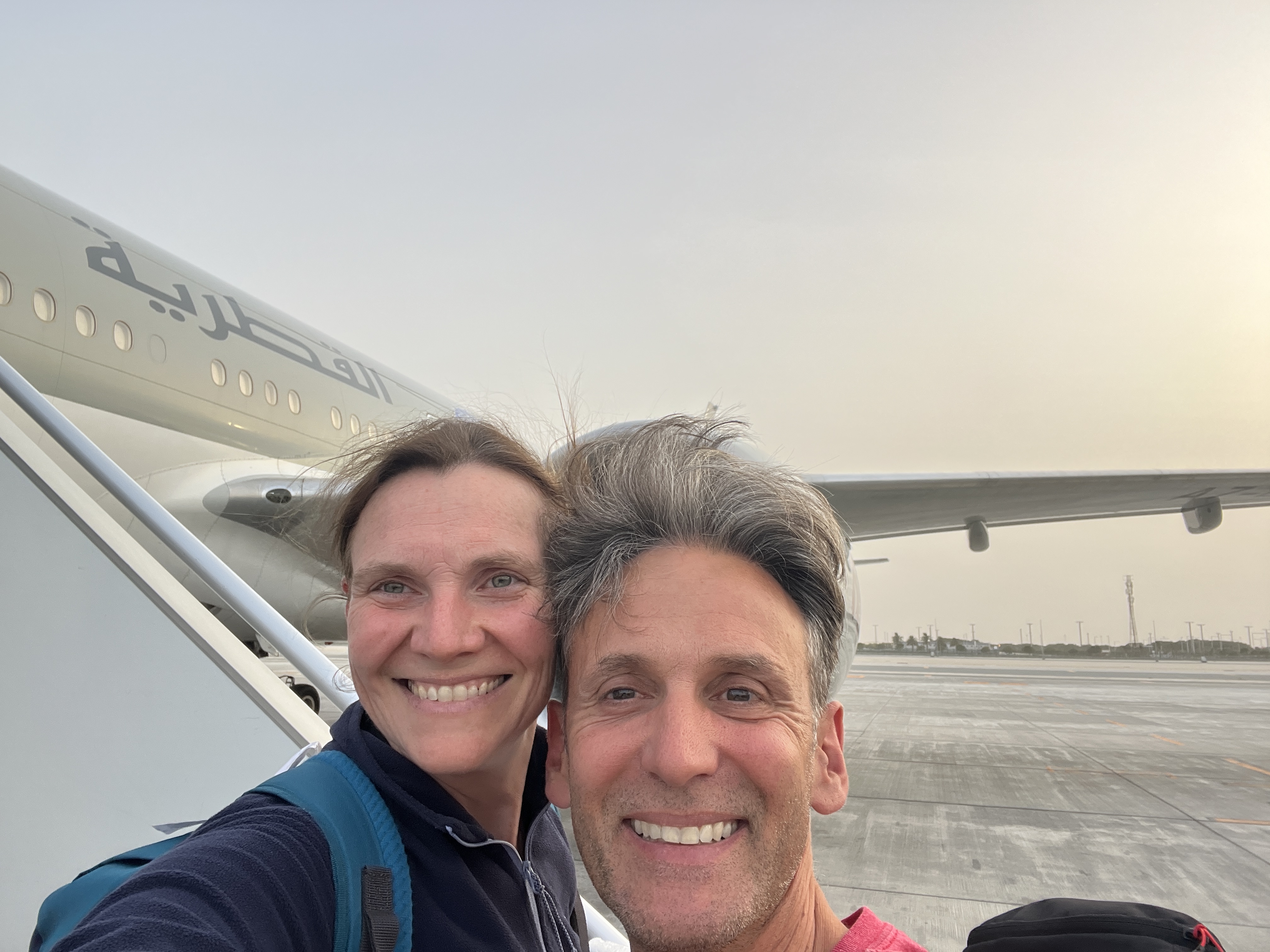
The clock ticked. We fidgeted nervously. Eventually the buses arrived and we drove to the very edge of the airport, some 15 minutes from the terminal to find our solitary plane sitting like the lone giraffe we spotted on the Serengeti plain some 30 hours ago. It already felt like a lifetime ago.
It’s now 6pm and we are on the plane. Fully boarded but not yet ready to leave. We’ve planned our movies and our wines (we deserve it) and might even get a quick nap before we arrive just before the curfew (in theory at least).
We should be home by 2ish and raring to go for work tomorrow. Only 20 hours behind schedule.
In any case, it has been worth it. Hopefully I’m not premature in saying that we had survived the trials and tribulations of our return journey, and soon this story would become just a footnote on our amazing adventures of the last couple of weeks.
 Joseph FAMILY ADVENTURES 2023 - 2025